For many people planning a trip to New York City, seeing a Broadway show is almost automatic. Buy a ticket, have dinner, go to the theatre, perhaps visit a museum or another attraction the next day.
For some Disabled people and their families, the itinerary can collapse over something considerably less glamorous: there is nowhere appropriate to use the bathroom.
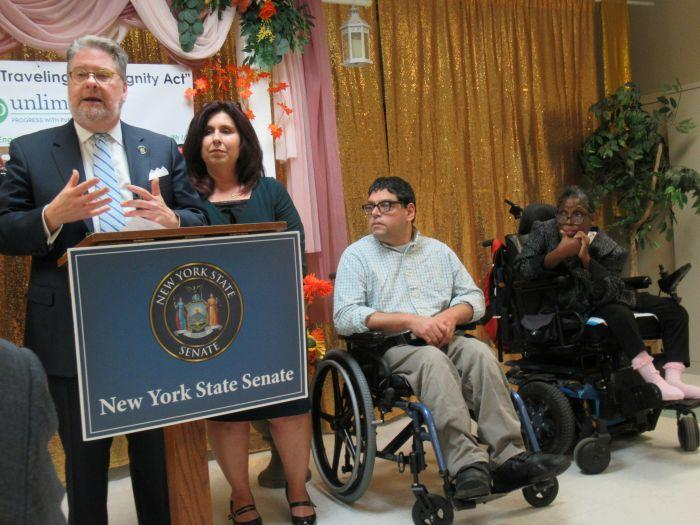
New York State’s proposed Traveling with Dignity Act, S.4042B/A.6219B, addresses a specific access barrier that ordinary accessible-restroom standards have left unresolved. The bill passed both houses of the Legislature in June and is awaiting action by Governor Kathy Hochul. Senator Pete Harckham and Assemblymember Chris Burdick renewed their call for her signature in August.
The legislation requires height-adjustable adult changing accommodations in covered facilities. The bill specifically includes large commercial places of public amusement such as theatres, auditoriums, convention centers, exhibition halls, amusement parks and sports arenas with maximum occupancy of at least 2,500 people. It also establishes requirements involving state-owned public buildings.
An ordinary wheelchair-accessible restroom does not necessarily solve the problem for someone who cannot independently transfer to a toilet or who requires assistance with continence care. Without an adult changing table, the available alternatives can include a restroom floor, the back of a vehicle, returning to a hotel, or simply staying home.
That has obvious consequences in New York City, where a visitor may spend an entire day away from a hotel room.
A Broadway matinee may be only one part of that day. Someone might travel into Manhattan, have lunch, attend a performance, visit a museum and have dinner before returning to a hotel. A New Yorker may be traveling across boroughs rather than returning to an accessible bathroom at home. The practical radius of either person’s day depends partly upon where appropriate restroom facilities exist.
Theatre access is also larger than the wheelchair seating location inside the auditorium. A patron can have a perfectly usable wheelchair seat and still be unable to attend because essential personal care cannot safely be performed during several hours away from home.
The legislation would not place an adult changing table inside every Broadway theatre. The commercial-facility provision uses a 2,500-person maximum-occupancy threshold, which is important when discussing Broadway because many individual Broadway houses are smaller than that.
Its usefulness to theatre-goers nevertheless extends beyond the auditorium door.
More adult changing facilities across museums, public buildings, large entertainment venues and other covered locations would give Disabled residents and tourists additional places around which an accessible day in New York can actually be planned. It also establishes a clear New York standard that other theatres, restaurants, hotels and entertainment businesses can choose to meet even where the statute does not compel them to do so.
The people affected include adults with cerebral palsy and other developmental disabilities, people with significant mobility impairments, veterans with traumatic injuries, older adults and anyone else whose disability makes an ordinary restroom inadequate. Harckham’s office reported that advocates themselves had been unable to travel to Albany to advocate for the legislation because appropriate changing facilities were unavailable.
That is about as concrete an illustration of the barrier as New York could ask for.
A city can sell accessible theatre seats, museum admissions, concert tickets and hotel rooms. A visitor still has to make it through the rest of the day.
The Traveling with Dignity Act would give more Disabled New Yorkers and visitors another piece of the physical infrastructure necessary to do exactly that.
Read the Traveling with Dignity Act and follow its status at the New York State Senate
(Image: Senator Pete Harkham)