by Kelsey Maurine Brickl
On Broadway and in the West End, ushers walk through auditoriums carrying illuminated signs telling patrons to put their phones away before shows begin. Playbills and programmes carry printed rules. Some productions add inserts. Houses make severe prerecorded announcements before the performance begins. Staff intervene when patrons continue filming or texting. One long-running West End musical insists that because phones did not exist at the time of the musical’s setting, they must be set aside. Another long-running Broadway musical even turned the warning into a beloved part of the entertainment, using a cheeky royal character to command “his subjects” in the audience to silence their phones.
None of these measures guarantees obedience. People still text, film, and say rude things to ushers. Frustrated threads on Reddit excoriate audience members for ignoring the theatre staff’s warnings. Theatres use them anyway.They use them because they expect instructions, repetition, staff presence and intervention to influence a large majority of audience behavior. They devote staff time, equipment, printed material and production resources to doing so. They also consider the issue important enough to establish rules before the audience even takes its seats.That existing practice and industry mindset has obvious implications for wheelchair sightlines during curtain calls.
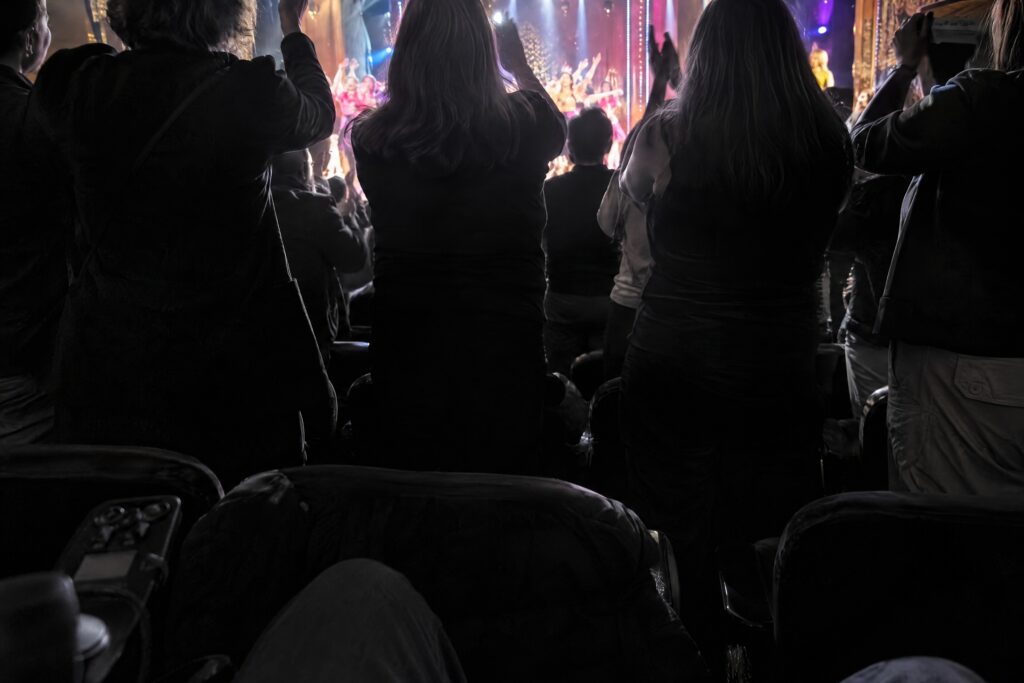
When several hundred patrons stand at once, a Disabled wheelchair user remains seated. A sightline that worked during the performance can disappear behind backs, shoulders, coats and handbags. The problem becomes especially serious when the production continues after the audience has begun standing. Extended curtain calls, reprises, walk-downs, speeches, charity appeals, choreographed finales and full songs after bows are no longer rare flourishes; they are an increasingly standard part of commercial musical staging. The obstruction now falls on material the audience was sold as performance. The more houses treat the call as a second finale, the less honest it is to call the blocked minute “just applause.” Ghost Light Access has written about this before in May 2026, in “The Curtain Call Access Problem.” In July 2026, after publishing that article, while attending performances in London, the problem made itself clear without exception.
Many audience members and performers who mean well may genuinely regard standing as a gesture of showing and receiving appreciation. Theatre culture may regard it as tradition. But neither explanation alters the geometry inside the auditorium or the impact to Disabled people. The wheelchair user bought a ticket, too. That person has the exact same rights to access the same show as a person who can stand and applaud. Elderly patrons, Little People, people who transferred from a wheelchair into a seat, cane and crutch users who cannot get up quickly or at all, and people with invisible disabilities that make standing unsafe or impossible are also full-price ticket-holders who remain at seated eye height when the room rises.
A rule or announcement that protects sightlines at the end of a show is not a special plea for one mobility device; it is how a seated auditorium stops treating the ability to leap up as a condition of seeing the ending. The person who can stand does not have a right to remove the Disabled patron’s view in the name of tradition or showing appreciation. This is a false sense of entitlement not supported by law.
Under the UK Equality Act 2010, a theatre is already under an anticipatory duty to make reasonable adjustments so Disabled patrons are not put at a substantial disadvantage. Asking a house to keep the rows in front of wheelchair spaces seated through staged post-bow material is a textbook low-cost adjustment, not a novel legal theory. U.S. ADA Title III is more geometric than the Equality Act, but it still requires full and equal enjoyment of the service sold and reasonable modifications to policies. In a house designed and ticketed as a seated event, a foreseeable standing blockade of still-running material is a modification problem, not a loophole created by standing-ovation custom.
A patron who cannot stand must not lose access to the end of a performance because other patrons physically can and feel entitled to do so. If a production includes a song after the bows, that song remains part of the fully ticketed performance, and all patrons have equal access under the law to view that song. If the company performs an extended curtain-call sequence, the wheelchair patron is still entitled to see it.
A tradition created around ambulatory bodies is not relevant if it infringes on the access rights of the Disabled patrons seated behind them. If that theatre tradition must be altered or eliminated to ensure that all patrons can view the entire show fairly and lawfully, then that is what must happen.Too often, the response from traditionalists on social media or from members of staff is that theatres cannot control what hundreds of people do. However, their own operating practices say otherwise.
They may not control audience behavior perfectly, but they routinely attempt to govern it when they consider the underlying interest sufficiently important. They tell patrons when to silence phones. They prohibit recording. They specify when photography is allowed. They send ushers through rows with illuminated warnings. They print rules in programmes and Playbills. They make announcements over the sound system. They approach individual patrons who refuse to comply.The industry has already accepted the principle that audience conduct inside an auditorium can be managed through advance instruction and staff intervention.
Standing during a curtain call is not uniquely immune from that principle.A theatre that can distribute an insert saying not to use a phone can distribute an instruction asking patrons to remain seated through a final song. A house that can make a serious announcement about recording can make one explaining that remaining seated during specified material preserves the sightlines of wheelchair users. A production willing to build a comic phone warning into its pre-show routine has already demonstrated how easily an audience instruction can be incorporated into theatrical presentation without destroying the atmosphere of the evening.
Ushers already interrupt filming, talking, and phone light in the name of other people’s experience. Asking the two or three people in front of a known non-standing patron to sit through a staged final number is the same category of house management, only with a civil-rights interest on the other side. Atmosphere is not a legal interest that outranks the right of a ticketed Disabled person to see the performance they paid for. The instruction does not have to be punitive or complicated. It can even be tagged onto the firm requests about phones:
Please remain seated through the final song so that all patrons can see the complete performance.
The objection that some patrons may ignore it proves very little. Some patrons ignore phone rules, too. Theatres still try. Ushers approach patrons who are very obviously filming and ask them to put their phones away. They can also approach patrons standing in front of a wheelchair user and ask them to sit. Imperfect compliance has never persuaded theatres to abandon illuminated signs, announcements, printed notices or usher intervention.I now have a practical reason to examine this question beyond the general argument.
In late October, my husband and I have a “staycation” planned, and during that time we are seeing a popular Broadway show I have been wanting to see and review for some time. I notified the theatre in advance that I will be attending in a wheelchair location and that the production contains material after the bows. Because I cannot stand to recover a sightline once the audience rises, I asked how I would be able to see that material.The theatre has now given me a written commitment that my view of the final song will be coordinated with the knowledge that I will remain in my wheelchair.
The written and documented commitment is significant. The problem is foreseeable many weeks before the performance. The theatre knows where I will be seated. It knows that I cannot stand. It knows that the audience may stand during the bows. It knows that the production continues after those bows. It has agreed in writing that my view will be coordinated while I remain in my wheelchair. There is plenty of time for the theatre to solve the problem. The solution therefore has to exist in operations, not in wishful thinking on the night.
Moving a wheelchair user out of the purchased location into an aisle, doorway, cross-aisle or circulation space does not solve the underlying problem. It creates a potential serious safety hazard and is not equal access. Many wheelchair users cannot be parked in the back because of co-existing conditions — pain, autonomic instability, sight or hearing access, transfer needs, proximity to an accessible toilet, or the need to leave without climbing a stadium rake. “Sit them at the rear where standing heads matter less” is not an accommodation available to the body that bought the ticket. Most Broadway and West End wheelchair spaces are not front-row either. They sit mid-orchestra or on a cross-aisle behind ambulatory rows, which is exactly the geometry in which a standing ovation erases the designed sightline.
Leaving before the final material does not solve it either. Wheelchair users are fully ticketed patrons entitled to see the entire show. The performance has not become accessible because the Disabled patron was removed from the place where the obstruction occurred.
Theatres already possess the tools. They possess the signs, the announcements, the printed material, the ushers, the house-management structure and the demonstrated willingness to instruct audiences when they decide an issue deserves attention.
Wheelchair sightlines deserve at least the same seriousness as somebody holding up an iPhone. This is supported by law and existing operations.
I look forward to seeing it happen in practice.
UPDATE SEPTEMBER 26TH:
Since this article was published, Roundabout Theatre Company’s own video from the first preview of The Imaginary Invalid, posted on its official social media account, documented audience members standing en masse during the bows, after I had already notified Roundabout in writing that all patrons in wheelchairs require an unobstructed sightline through the entire performance. This will include my own attendance from a designated wheelchair location on the date I attend, although my readers know that Ghost Light Access does not accept one-time, individualized accommodations as a substitute for blanket accessibility and uniform compliance from institutions.
I have therefore placed Roundabout on supplemental written notice that it must make every reasonable effort to ensure that patrons whose standing would obstruct my sightline remain seated for the relevant portion of my September 27 performance, while leaving Roundabout to determine the appropriate operational means of accomplishing that accommodation. I also expect that accommodation to begin immediately and to continue indefinitely moving forward so that it applies to all patrons seated in wheelchairs.
Roundabout now knows my precise wheelchair location, knows that I cannot stand to recover a blocked view, has had the sightline requirement in writing since September 17, has confirmed that my specific requests are noted on my account, and has itself published evidence that audiences are standing during the relevant portion of this production, leaving no factual uncertainty about the foreseeability of the problem.
Separately, Ghost Light Access also wishes to notify its readers in the United Kingdom that UK law actually protects theatre patrons in wheelchairs even more firmly and strictly about this issue. Under sections 20, 21, and 29 of the Equality Act 2010, theatres have an anticipatory duty to make reasonable adjustments where their practices place Disabled patrons at a substantial disadvantage, meaning they must consider foreseeable barriers before a particular wheelchair user is actually sitting behind one; where the theatre has advance notice of the patron, wheelchair location, inability to stand, and continuing post-bow material, that disadvantage is more specifically known still.
A theatre does not have to guarantee that every audience member obeys, but it must take reasonable steps to avoid the disadvantage, and announcements, printed instructions, usher briefings, and intervention with patrons blocking wheelchair sightlines are particularly difficult to characterize as unreasonable or impracticable when theatres already routinely use those same tools to regulate phones, recording, photography, and other audience conduct.