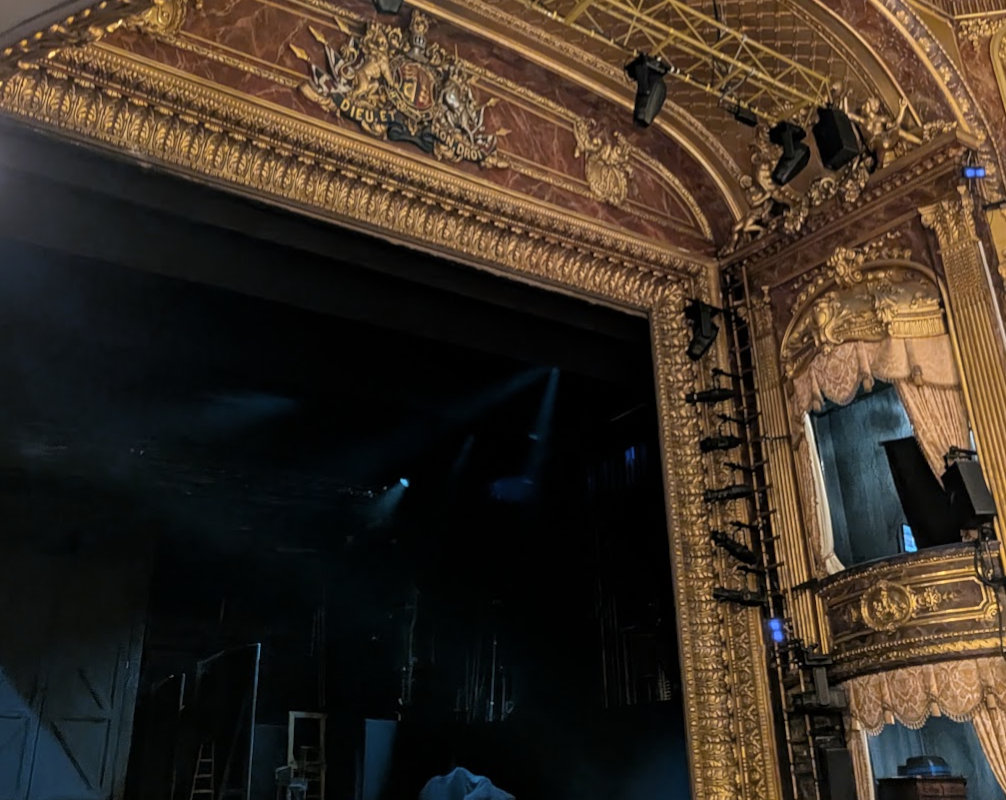
I publicly praised the Theatre Royal Haymarket for its accessibility. I meant it.
Before attending Grace Pervades in May, I had a complicated access problem. I am a full-time, non-ambulatory wheelchair user with visual and hearing impairments. The Haymarket’s usual wheelchair location at the rear of the Stalls did not meet my disability-related needs. The Theatre Royal Haymarket’s Theatre Manager initially, rather politely but somewhat firmly, offered alternative performances on 29 and 30 May and several dates in June.
There was a slight temporal and geographical problem with me attending the performances with those dates. “I live in New York City and will only be in London from 4 May through 10 May,” I replied in writing.
I checked the theatre’s online ticket inventory myself and sent evidence showing “significant unallocated inventory in Rows J, K, and L” for the performances I had actually booked. I proposed a solution that would work for everyone: moving patrons from the necessary end-of-row seats into better available seats so mine could be removed for my wheelchair. The Haymarket did it.
The Manager wrote that they had moved the patrons from L20/21 and M20/21 and that “these seats will be removed on the day for you.”
Fantastic, I thought. It’s all fixed! I replied back, verbatim, “That’s wonderful news and a very sensible solution all around.” I thanked him personally for sorting it out. In another email, I wrote that I appreciated “the care taken to put appropriate procedures in place for both performances” and asked him to thank the individuals he’d named as being responsible for ensuring egress safety and accessibility in general. The entire thing felt very polite, very respectful, and, well, very accessible.
When another access issue arose around stage-door crowds, an issue that I cover extensively with Ghost Light Access, I still explicitly told the theatre that it had done “a fantastic job ameliorating the prior seating issue.” The reallocation and planning, I wrote, were “sensible, constructive steps.” I was “genuinely appreciative.”
This is worth establishing before getting into what my subsequent Subject Access Request disclosed. I wasn’t performing gratitude. I was grateful. I still am.
However, I now see from what was communicated internally at the Theatre Royal Haymarket, I was already a “nightmare.”
One email described me as “a motorised wheelchair user” and continued: “she has been a nightmare.” My explanation that the rear Stalls did not meet my visual, hearing, mobility and postural requirements became “she refused to sit at the back of the Stalls.”
They also researched me. “We looked her up and she had successfully sued American Airlines!”
I had sued American Airlines. Why? Apparently it didn’t matter to them that American Airlines had failed to bring my custom prescription wheelchair, explicitly tagged for return to the gate of the aircraft, leaving my Disabled son and me stranded onboard for an hour until I cited my legal rights, or that the airline had provided no CRO when my family was in Paris and needed to check in in advance due to disabilities.
No, the theatre staff cackled internally about how they had Googled me adversarially and my having sued an airline was somehow proof that whatever was happening to them made them victims.
Another internal email about removing the seats began, “Really sorry about this but we need to accommodate a large electric wheelchair.” The work involved removing and replacing theatre seats so that a wheelchair user could occupy the wheelchair location. Apparently this required an apology to colleagues. Again, maintenance staff were the victims in the internal exchange.
The handover before my first attendance was particularly snarky, sarcastic, and ableist.
“Our charming Kelsey is coming tonight.”
“She is going to be a nightmare.”
The same email contained instructions to have the ramp ready, escort me inside, wait if I needed the toilet, meet me after the performance and take me to the roped-off area by the stage door, where security would be waiting. In other words, it described the practical arrangements necessary to accommodate a Disabled patron after weeks of detailed planning, while predicting that the patron herself would be a nightmare.
I went to the theatre.
“Kelsey was no problem at all.”
Someone had “a lovely chat” with me. The internal report recorded that I had told staff their access was “really great, far better than the Lyceum’s.”
So I had shifted from a steadfast prediction of “going to be a nightmare” to “was no problem at all.” I feel that that’s extremely embarrassing for the staff involved, or it should be. There is even a remarkable little moment of self-awareness in the email thread disclosed to me. Writing down all my access arrangements, one employee observed, “makes her sound like a nightmare.” Actual contact with me produced a different assessment: “she was perfectly pleasant and chatty so no real problem at all.”
Well. Huh. I’m glad we cleared that up.
Another email about my return visit was accidentally sent to me by one of the front-of-house managers. I pretended on the day I received it not to notice, trying to be gracious. An internal communication about that return visit said that people needed to be reasonable to me, except that “reasonable” was put in quotation marks.
Yes, the theatre determined that it was a bit absurd, all those reasonable things I had put into writing up to that point.
Other emails apologized to outside recipients for asking to borrow the ramp again that had been used for my first visit, which tells me the theatre had not kept it for other patrons. For more on why this isn’t acceptable, please see my essay “Bespoke is a Tell.”
I did return to the Haymarket. In June, I also published an article through Ghost Light Access highlighting West End theatres that I believed were getting accessibility right. I included the Haymarket.
“As someone who often documents access failures,” I told the Manager of the Theatre Royal Haymarket and his colleagues, “I think it is equally important to put good practice on the record.”
I meant it. I still do. That Manager replied that it was “a great read.” He even told me how he was going to pass it along among family members to whom it was particularly relevant. My praise was apparently circulated internally at the theatre.
I don’t regret publishing it. The Haymarket ultimately took a difficult access problem and solved it well. Staff planned my movement through a complicated historic building, removed seats for my wheelchair, considered evacuation, worked seriously on the stage-door safety problem and treated me pleasantly when I attended. I reported what I knew, and the work I observed deserved credit.
However, to be perfectly transparent, I do regret that some of the people receiving that praise knew something I didn’t.
I have spent years dealing with disability access, litigation, complaints, subject access requests and the peculiar metamorphosis by which a physical accessibility problem becomes a story about the personality of the Disabled person who keeps mentioning it. I recently published an entire satirical essay about precisely this phenomenon. I am not shocked that theatre employees sometimes say things privately that they would never say to a Disabled patron’s face.
I am disappointed that it was the Theatre Royal Haymarket. I feel rather like a parent who discovers that a child has put on Mama’s things, broken the handbag strap and gotten lipstick on the cat, and then had the audacity to show up with mascara on their cheek and lie about it all.
“We looked her up” bothered me for a more concrete reason. To arrange my access, I had already told the Haymarket that I am non-ambulatory, cannot transfer out of my wheelchair, have visual and hearing impairments, use a custom-prescribed power wheelchair, and would be travelling alone from New York. I gave them my wheelchair’s measurements. I explained what happens to my vision and hearing from the rear of the Stalls and why a smaller backup chair would leave me more vulnerable in a crowd. They needed some of that information to accommodate me, so I gave it to them.
I suspected, but did not know for certain, that while I was explaining my body to them, somebody at the theatre was looking me up. I suspected, but did not know for certain, that my Google footprint, including my lawsuit against American Airlines, had become information worth passing around internally. I learned that months later because I made a Subject Access Request.
You may have to tell a theatre an extraordinary amount about your body before somebody will remove a chair, find an appropriate wheelchair location or determine how you can evacuate the building. Keep the emails. Get the wheelchair location confirmed in writing. Document what was promised. Correct inaccurate descriptions of your needs. Do not accept an unusable accommodation because continuing to insist upon an effective one might make somebody think you are difficult.
I could have been considerably easier for the Haymarket. I could have accepted the rear Stalls even though they did not meet my disability needs. I wouldn’t have been able to see or hear, and I wouldn’t have been able to publish my criticism of the show. I could have not returned to see the show a third time, although those who have read my criticism of Grace Pervades know that this viewing radically altered my perception of Hare’s work. I could have stopped checking their proposed solutions and supplying evidence when those solutions did not work. I could have not issued them an SAR.
But, then, they could have done a lot of things differently, too.
They might never once have called me a nightmare for invoking disability rights. They might have kept the ramp for other patrons and used it consistently. They might have referred to my wheelchair and to me respectfully to each other. They might not have apologized to maintenance staff internally because seats needed to be removed.
I knew institutions did this. I see right through institutions that do this; I write extensively about institutions that do this. I thought better of the Haymarket because its conduct gave me reason to. I told other Disabled people that they had done good work.
Now I have read their own emails. I’m glad we’ve cleared it all up.
Yes, my correspondence to the Theatre Royal Haymarket was legally sophisticated. That doesn’t justify contemptuous language about me being used internally, but such language was used. In fact, the theatre’s Managing Director felt compelled to confirm to me when “providing some context” for the SAR that the Haymarket was fulfilling that the word “nightmare” had been used to describe me. While he did apologize for this particular term being used and said he had spoken with those who had used it, he didn’t mention the other serious issues I noticed. He said nothing about the fact that the theatre’s staff had internally apologized to each other for the work needed to accommodate my wheelchair, or to outside sources to borrow a ramp they should have kept.
He didn’t apologize for Haymarket staff sarcastically calling me “charming” and putting “reasonable” in quotation marks. He didn’t apologize for his theatre’s staff looking up my prior lawsuit against American Airlines for disibility discrimination and circulating it for gossip. He admitted that the theatre had searched emails, WhatsApp, SMS, box office material, reports, voicemail, and so much more. He still said to me, “I sincerely hope that this won’t tarnish your memory of an otherwise enjoyable evening with us.” Well, it does, because as I’ve made clear many times, Customer Service Is the Graveyard of Disability Rights.
There’s a lesson for the community in this cautionary tale. Accessibility is about more than whether we can physically access goods and services. It’s also about internal cultures of how we are viewed and respected. Disabled theatre patrons: do not be naïve. Theatres – all theatres, even the ones with great accessibility statements on their websites or smiling practice – sell you tickets and put on a show. They are not your friends.