WDW swore my prescription wheelchair could evacuate crowded queues, citing no measurements. I was expected to answer WDW’s questions even if choking. We’re happy to visit Disneyland Paris instead!
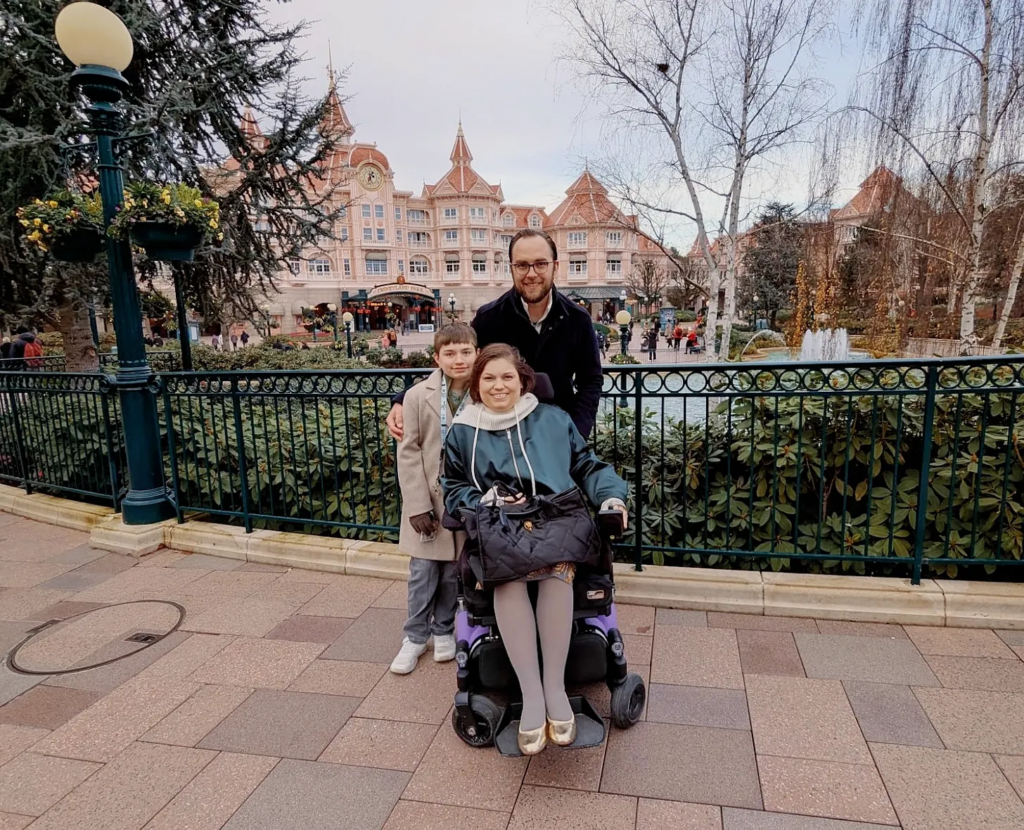
Image: Elliot, Mike, and me enjoying an accessible family outing to Disneyland Paris (December 22, 2025).
This whole ridiculous business began with Walt Disney World’s 2024 changes to its Disability Access Service (DAS). My autistic son, Elliot, and I have substantial but different disability-related needs, and Disney’s proposed alternatives, including leaving queues and returning later, were impractical for our family. My husband, Mike, provides care for both of us. He cannot split himself in half to accompany one Disabled family member out of a queue while supporting the other inside it. Disney apparently expected us to figure that out ourselves.
Then there was the money. We have owned Disney Vacation Club interests for many years, yet Disney expected us to commit vacation points and substantial travel expenses without knowing whether the accommodations necessary to enjoy the trip would be approved. Our ownership was becoming practically unusable. I filed a disability-discrimination complaint with the Florida Commission on Human Relations because I wanted Disney’s policies and proposed alternatives examined under the law.
I also interviewed my son on October 1, making a careful recording for the proceedings. Asked how he would feel being left alone in a queue, he answered, “uncomfortable,” because “I’m [I would be] alone.” Uncertainty about when or where we would return made him feel, in his wording, “paranoid.” Asked what would make leaving and re-entering a queue acceptable, he replied, “I would not do it in the first place.” He explained that unexpected changes upset him and that knowing whether he would receive accommodations before traveling mattered. He had that reassurance at Disneyland Paris, he said, but not Walt Disney World.
That was my autistic son explaining precisely why Disney’s proposed alternatives did not work for him. He made it clear that these were his own feelings and experiences, not mine. He also discussed his favorite Walt Disney World attraction, Spaceship Earth, before enthusiastically explaining how accessibility works for him at Disneyland Paris, where he knows what accommodations to expect and can enjoy the attractions with his family.
My Permobil M3 Corpus weighs approximately 388 pounds as configured. It is a custom-prescription, Group 3 complex rehabilitation power wheelchair, not a shopping cart with an unusually aggressive motor or a scoot-scoot that I purchased off a late-night infomercial so I could fulfill my dream of seeing the Grand Canyon in a group tour.
I cannot stand up and leave it unattended while I go into Pinnochio Village Haus for a $13.29 Buffalo Chicken Flatbread. I cannot safely transfer into whatever spare rickety transport chair happens to be available for rent. And I cannot suddenly decide to be ambulatory because Peter Pan’s Flight is an “Opening Day Attraction” that was designed without my body in mind.
A Disney employee (“Cast Member”) with the initials E.N. nevertheless submitted a sworn declaration very confidently asserting the wheelchair accessibility of Walt Disney World attraction queues. This person made numerous assertions under penalty of perjury stating that my wheelchair could also go into, turn around in, use its tilt and recline functions in, and evacuate from Walt Disney World attraction queues. Among the material invoked was an influencer who temporarily borrowed and reviewed my model of wheelchair and said it could turn on a “pinhead.”
A pinhead! Wonderful. I have been using a complex medical device without appreciating its true potential as a microscopic ballerina.
Again, the influencer was reviewing a borrowed chair. She was not measuring Disney’s queues filled with strollers tagged as wheelchairs, impatient toddlers, folks who have been competitively “drinking around the World,” those following instructions to “fill in all available space,” testing emergency evacuations with my actual configured wheelchair, or examining what happens when the occupant cannot transfer.
The sworn declaration by Disney’s Cast Member E.N. gave no definitive indication that they were doing that, either. I wanted to find out what exactly they were relying on. I’m a person who likes documentation. I wanted actual widths, turning clearances, operational arrangements, and evacuation evidence. Disney’s sworn claims about what my wheelchair could do were precisely why I wanted the records supporting them.
In my Florida case, there was other specific documentation I wanted to test. There was the February 24 telephone call with Disney employee K.B.. She called me, not the other way around. This happened after I’d written to Disney. K.B. later swore that I was speaking very “quickly” on the call.
Lady, Ma’am, K.B., respectfully, I’m from the southwest suburbs of Chicago, Illinois. Sometimes I speak quickly. But you also told me, “This is how this call is going to go.” That’s why I told Disney immediately in writing to preserve the call, approximately one hour afterward.
One hour. I wanted the actual recording retained, because a recording can establish who said what, in what order, and in what tone. A later declaration, sworn under penalty of perjury, about my speaking speed and (according to K.B.) a bizarre fixation on the existential dangers of scooters, is not the same thing as a recording of the conversation itself.
By October I had reached the point of seeking records through formal process. That was a huge relief to me. On October 5, the process server I hired successfully served Disney’s registered agent with a subpoena for documents relevant to the sworn representations, including material about wheelchair maneuverability and attraction queues. I paid for that service. The expense was real, as was the work involved in preparing it. It was not a whimsical request that somebody at the Magic Kingdom please check behind the photocopier. I didn’t send fairies and birds in to sing about what needed to happen. A process server sent me the official confirmation.
The production deadline was noon on October 8. At 12:20 p.m., I had received none of the requested documents at my designated address, no explanation for their absence, and no order modifying the deadline. That is what I documented.
I am not pretending a judge found Disney in contempt; no such finding was made. I am saying that I paid to pursue the underlying evidence, properly served the subpoena, and still did not have the records when the deadline passed.
In a dispute about whether a very large, highly individualized wheelchair can physically negotiate particular spaces, this seems an unusually elaborate way to avoid answering questions that ought to involve numbers. Actual numbers. Preferably measured in inches, rather than pinheads.
Disney put the head of U.S. labor and employment litigation at a major international law firm, a former senior federal civil-rights official with decades of disability-discrimination experience and Supreme Court litigation under his belt, up against a severely Disabled mother representing herself, paying her own expenses, and trying to obtain evidence about whether her medically necessary wheelchair could safely navigate Disney’s attractions. This was a man who had built a career in civil-rights law, now deploying that expertise on behalf of a multibillion-dollar corporation against a woman who was simultaneously fighting for the accommodations necessary to breathe safely during the proceeding.
This attorney swore that he was “intimately familiar” with the factual and legal issues in my case.
He also described himself as very familiar with DAS litigation generally. DAS is Disney’s Disability Access Service. That assertion does not prove how many cases Disney handles, but it raises an interesting reporting question: just how much experience does a company need with litigation over a disability-access program before its lawyers begin describing that experience as general expertise? And after how many cases does Disney begin to say: maybe the problem isn’t the Disabled people, but us, the corporation?
Hmm. It’s a philosophical exercise for a later time.
There was also a dispute involving another Disney attorney’s email address. Disney’s October 6 motion misidentified their own corporate lawyer’s email with a missing character. According to Disney’s position, I should have discovered the address in earlier Florida Commission on Human Relations materials and corrected the communication problem myself.
The missing character was a 2.
Apparently I was supposed to travel backward through the FCHR record and recover a numeral that Disney’s own correspondence had not supplied to me. Perhaps that is the benefit of counsel being “intimately” familiar with my case: I am expected to become intimately familiar with the historical archaeology of Disney’s email accounts.
I am not an archaeologist. I’m a historian, writer, hyperpolyglot, cat lady, wife, and mom. The judge agreed with me.
On October 6, Disney also obtained cancellation of the previously scheduled October 15 final hearing after seeking substantial scheduling relief. I had questions about the relationship between that request and counsel’s sworn familiarity with the matter, and I put them in writing. A lawyer can know a case well and still seek more time. But when the self-represented Disabled complainant is being held to exquisite procedural precision, I see no reason the corporation’s sworn representations should escape the same attention.
At this point I had spent approximately $1,850 and 175 hours on the proceeding. I was pursuing the evidence concerning my wheelchair, my autistic son, a recorded conversation, the accuracy of sworn declarations, and the physical reality of our individual family’s disability accommodations.
Then the administrative law judge finally issued an order on the disability accommodations I had requested October 1, and things became substantially more ridiculous.
Among other disabilities, I have severe generalized myasthenia gravis. This is a neuromuscular disease that can interfere with swallowing. In my case, saliva can become a choking problem. In fact, I have been in the ICU many times with myasthenic crises, which can be life-threatening. I also have respiratory vulnerabilities and a history of syncope, including with injuries. I’m a full-time wheelchair user and I use prescribed BiPAP equipment and prescribed cough-assist. I homeschool our autistic minor son, Elliot, whose support needs do not evaporate when an administrative tribunal schedules a video conference. My husband provides caregiving needs to us both as needed.
Judge Christina Shideler’s October 8 accommodation order, issued very late in the proceedings, granted only some of what I had requested. Among the restrictions I challenged was the expectation that I finish answering a question before taking a medically necessary break.
Imagine me choking on my own spit while Disney’s lawyer waits for the end of a sentence. Should I attempt a subordinate clause? Would a semicolon help? Is there an exception for respiratory distress if I manage to say “Your Honor” first?
I needed permission to interrupt when medically necessary so I don’t, you know, choke on my spit. This is a fairly modest ambition for a legal proceeding.
I also sought the ability to turn off my camera while putting on my prescribed BiPAP. The order did not grant that request. Apparently there was some procedural value in keeping the camera on while I strapped respiratory equipment to my head. I cannot imagine what Disney’s counsel hoped to learn from the spectacle, but perhaps my technique would have been entered as another sworn observation about how quickly I move.
Then there was Elliot. The order contemplated keeping my autistic child out of the room. Am I supposed to lock Elliot out and scream at him to stay there? Was the judge’s order to be cruel toward my autistic child in the name of proceedings or surrender my rights to adjudicate this disability-related issue? Does the judge believe I can order more able-bodied husbands through The Disney Store online? One to help his wife breathe, one to support his son, one to skip work, all arriving within the designated hearing window? Who will pay for these supports, including therapy for this overwhelm?
If more than five sessions were necessary, I was supposed to consider other accommodations. Which ones? What accommodations? The order did not identify a workable alternative. I suppose I was meant to improvise one after the fifth session, provided I had successfully completed all my sentences, secured the BiPAP under humiliating continuous video observation, kept my son out of the room without him melting down or needing additional therapy, and ensured my husband was not fired from the job that provides for us.
On October 8, I filed an emergency challenge to the accommodation restrictions and a separate motion addressing procedural noncompliance, preservation of the disability-discrimination record, and protection against retaliation. Both were accepted before I filed my voluntary withdrawal at 1:21 p.m. That same day, Judge Shideler closed the DOAH file, canceled the remaining proceedings, and relinquished jurisdiction to the referring agency.
No determination was made on the merits. Neither side won or lost. I decided the case would end on my terms, and that I would decide what my relationship with Disney would look like moving forward.
At 1:30 p.m., I sent Disney’s lawyers the docketed voluntary withdrawal, reiterating that I had not retracted my allegations, entered into a settlement, signed a confidentiality or nondisparagement agreement, or relinquished my family’s independently surviving rights, including our Disney Vacation Club ownership, future visits to Disney properties, and my right to investigate and publish about the proceedings.
I subsequently forwarded the documents to Disney’s designated corporate contact, Disney Vacation Club Member Services, and Disneyland Paris, the latter in formal French.
I remain a DVC owner. My family intends to keep using its lawful rights and visiting Disney properties, particularly Disneyland Paris, where we are well accommodated and enjoy our time. I also intend to keep writing about accessibility, including the things Disneyland Paris does very well.
I have nothing against a good Disney holiday. I have a great deal against sworn assertions about my wheelchair unsupported by the measurements I sought, and an accommodation arrangement under which I might be expected to finish answering a question while choking.
I do not view the Florida adjudication situation as anything but “extraordinarily revealing” and “profoundly disappointing” regarding Walt Disney World, although I did not lose on merits. Right now, at this point in my family’s life, I would rather spend my time in France. At least there, I can very happily enjoy my time with my family instead of having my accommodations subject to my Chicago accent and a pinhead.
So! We pivot from Florida to Disneyland Paris with joy! Vivement avril. Alors là, c’est magique.
The public administrative docket, including the parties’ filings and the October 8, 2026 order closing the proceeding following my voluntary withdrawal, is available through the Florida Division of Administrative Hearings under Kelsey Brickl v. Walt Disney World, Case №26–004354.
Legal and Editorial Notice: This article documents Kelsey Maurine Brickl’s disability-discrimination proceeding against Walt Disney Parks and Resorts U.S., Inc. (FCHR Case No. 2026119734; DOAH Case No. 26-4354), drawing upon sworn declarations, administrative records, correspondence, and firsthand experience. On October 8, 2026, Brickl voluntarily withdrew the proceeding; the administrative law judge closed the file without adjudicating the merits or finding in Disney’s favor. No settlement, admission, retraction, confidentiality agreement, or release accompanied the withdrawal. The article incorporates factual reporting, personal opinion, criticism, and satire, with all independently surviving legal rights expressly reserved.