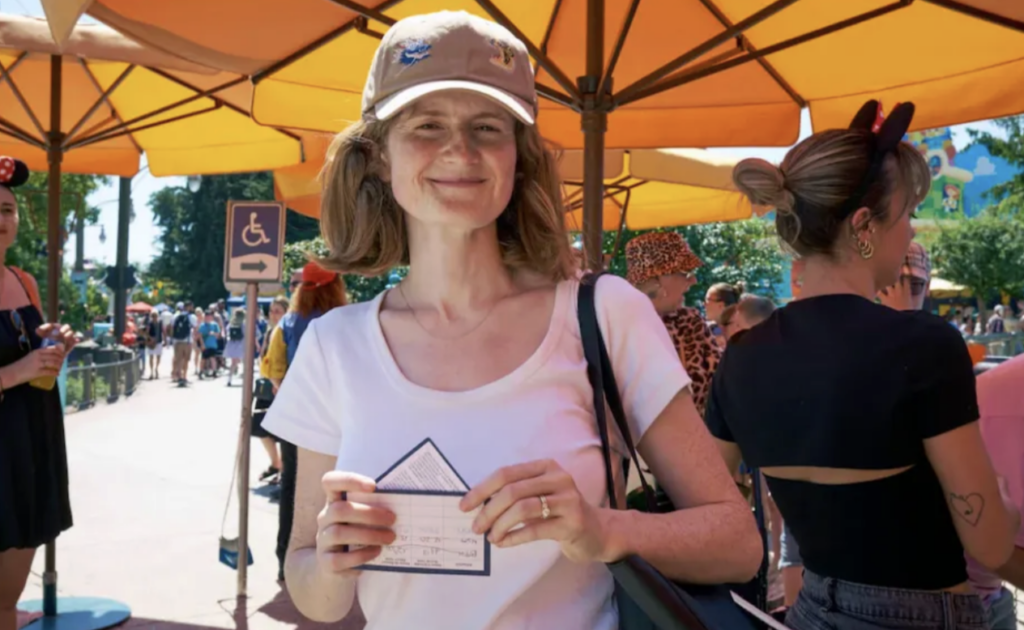
Image: The Telegraph’s Leaf Arbuthnot holding her Disneyland Paris Easy Access Card, which she obtained after presenting medical documentation she acknowledged was not approved. Courtesy of The Telegraph (https://tinyurl.com/5n7rshb3)
By: Kelsey Maurine Brickl
Ghost Light Access exists to advocate for accessibility, primarily on Broadway and in the West End. We cannot do that work effectively while major newspapers publish articles that undermine accessibility programs or encourage widespread hostility toward the genuinely Disabled people who depend upon them.
Recently, The Telegraph has published several troubling articles with serious implications for Disabled creators and families, and has defended those publications while resisting requests for information about its treatment of the Disabled advocates who challenge its reporting.
As the founder and director of Ghost Light Access, I am not merely contesting the ableism in these articles or pursuing complaints with the Information Commissioner’s Office, Disneyland Paris, and the competent French legal authorities, although I am doing those things, too. I am also asking difficult questions as an independent investigative journalist.
In particular, I am examining the circumstances surrounding the reporting, editorial preparation, and publication of a 31 May 2026 article in The Telegraph that cast suspicion on Disabled families using accessibility accommodations at Disneyland Paris, against the backdrop of an increasingly hostile British public discourse about disability benefits, medical diagnoses, economic inactivity, and the legitimacy of Disabled people’s participation in ordinary public life.
Leaf Arbuthnot went to Disneyland Paris to investigate what her newspaper presented as a British disability-diagnosis epidemic. Her article invited readers to examine the legitimacy of people using disability accommodations at one of Europe’s most popular tourist destinations.
What Was Leaf Arbuthnot’s Motive in Going to Disneyland Paris and Writing Her Article?
On 31 May 2026, The Telegraph published Leaf Arbuthnot’s article, “How Britain’s disability diagnosis epidemic reached Disneyland.” It suggested that British Disabled visitors were exploiting Disneyland Paris’s accessibility system, particularly those presenting PIP and Disability Living Allowance documentation.
There’s a problem with that argument. Disneyland Paris expressly accepts qualifying British disability-benefit documentation for its Priority Cards. Those visitors were following the rules.
Arbuthnot’s description of her own visit, however, raises some rather interesting questions.
She reported presenting a Cast Member with NHS documentation concerning a 2024 MRI. She acknowledged that this was not an accepted form of evidence. Nevertheless, she obtained an Easy Access Card. She then reported waiting just three minutes at Orbitron when the posted queue was 70 minutes.
[Photo]
Why did Arbuthnot present documentation she knew Disneyland Paris did not accept?
Did she have another, qualifying medical certificate? If so, why didn’t she use it, and why did she use the NHS document she knew didn’t qualify? Did she request an exception? If so, why? Did the Cast Member know the document was not accepted under the published rules?
Did Arbuthnot record the time, location, or any other information that would allow Disneyland Paris to identify the Cast Member and verify her account? What explanation, if any, did the employee give for issuing the card?
What exactly did she tell the Cast Member?
Did Arbuthnot speak French? Did she attempt to? Was the conversation conducted entirely in English? How did she establish that the Cast Member understood the age, nature, and eligibility of the medical document she was presenting? Did both parties understand which documents the resort required, or might something have been misunderstood?
Were the rules communicated in advance? Did Arbuthnot use the online system available to guests to apply for her pass before arriving, or did she wait until she got there?
Did Arbuthnot disclose to the Cast Member that she was a journalist investigating disability access?
How familiar was Arbuthnot with Disneyland Paris?
How many times had she visited Disneyland Paris, Walt Disney World, or Disneyland Resort in Anaheim before this assignment? Had she previously used either accessibility-card system at Disneyland Paris or Disney’s Disability Access Service (DAS) system at its American resorts? Had she read the resort’s official accessibility guidance before arriving?
Someone investigating alleged widespread, terrible abuse of a system certainly ought to understand how it works on a personal and professional level.
What happened at Orbitron?
Arbuthnot compared her three-minute wait with a posted 70-minute queue at one attraction.
Anyone familiar with Walt Disney World or Disneyland Paris knows that posted wait times are estimates and that attraction queue times fluctuate wildly throughout the day. Sometimes queues are surprisingly long or surprisingly short. Anyone who’s visited Disneyland Paris more than once is probably familiar with the phrase “walk-on” and what it means. Sometimes an attraction displays a much longer wait than visitors actually experience.
Did Arbuthnot verify that the ordinary queue really took 70 minutes?
Did she time anybody using it? With a stopwatch? Did she observe the queue’s actual length? Or did she simply photograph or read the posted number on the sign and treat it as an established fact?
Did she receive an assigned Easy Access return time for Orbitron? At what time of day? Was it assigned by a Cast Member at the attraction? How long had she waited before returning? Was the three-minute figure merely the time between entering the accessible queue and boarding?
And if she had never visited Disneyland Paris before, did she understand how its waiting-time displays and accessibility procedures normally operate?
Did Disney really “run out of passes”?
In her article, Leaf Arbuthnot also quoted someone claiming that Disneyland Paris had “run out of passes.”
Run out of what passes?
Disneyland Paris issues Priority Cards and Easy Access Cards according to published eligibility rules. It does not advertise a daily quota of Disabled people who may receive accommodations.
Did Arbuthnot ask what the person meant? Did she ask them to clarify? Did she try to help them obtain a pass if they were confused about the process? Did she check the claim with Disneyland Paris? Was the speaker discussing accessibility cards, attraction return-time arrangements, or something else?
Why publish such an extraordinary claim without explaining how it could happen? Why not add a clarification that the individual might have misunderstood the system?
Did a Disney employee actually tell this person that the resort had exhausted its supply of accessibility cards? If so, which type of card, and under what circumstances? Was this an unusual administrative problem, a misunderstanding, or something the newspaper simply failed to investigate?
Was Arbuthnot trying to demonstrate how easily the system could be “gamed”?
This is perhaps my most important question. It is also, perhaps, the darkest. I am not making an accusation. I am asking a question.
Was Arbuthnot deliberately testing whether she could obtain an Easy Access Card without the required documentation?
If so, did The Telegraph authorize that exercise? What were the instructions? Was the intention to demonstrate that Disney’s accessibility system could be exploited?
And if she was testing the rules, why did the article not clearly tell readers that she was conducting such a test?
Did Arbuthnot believe that obtaining a card herself proved that other British visitors were abusing the system? How would it prove anything of the sort?
If she was not testing the system, why did she knowingly present documentation outside its published requirements?
What conclusion did The Telegraph expect readers to draw from her experience?
Did its editors verify that her application was approved according to Disney’s rules? Did they establish whether her wait at Orbitron was unusual? Did anybody check the claim about running out of passes?
Before travelling to Disneyland Paris, had Arbuthnot or her editors already decided that British visitors were abusing the accessibility system?
If not, what evidence gathered during the visit led them to that conclusion?
What evidence justified describing British disability diagnoses as an “epidemic”? How many visitors were interviewed? How many were observed using accommodations improperly? Were any actual cases of fraudulent eligibility established?
Did the newspaper distinguish between people presenting qualifying government-issued disability documents and people who had allegedly obtained accommodations without satisfying the rules?
Or was the story already decided before those questions were answered?
I would also like to know what The Telegraph anticipated when it promoted the article on social media. Did its editors consider how readers might respond to an article presenting Disabled visitors as suspicious? What moderation policies applied to the resulting comments? Were comments accusing Disabled people of fraud, or proposing arbitrary limits on disability diagnoses, reviewed or removed?
In my earlier investigation, I documented some of those comments, including one proposing that disability diagnoses be capped at four percent of the population.
Four percent. Apparently, once the allotted number of people have become Disabled, everybody else’s pancreas, spinal cord, immune system, and central nervous system will simply have to cooperate until the next vacancy becomes available.
The commenters are responsible for their own words. But I would like to know whether The Telegraph examined the public response to its reporting with anything approaching the curiosity it brought to the sight of Disabled families enjoying a theme park.
Disneyland Paris executive leadership and the French authorities have been notified
On 19 October 2026, I formally reported Arbuthnot’s published account to Disneyland Paris and referred the circumstances to the French public prosecutor at Meaux.
My eight-page bilingual report asks Disney to investigate how her Easy Access Card was issued, whether an authorized exception was made, and whether the card was used according to the rules. It also requests preservation of relevant evidence.
I subsequently notified Disneyland Paris executive leadership, including correspondence addressed to its presidency, of the report and the need to protect the accessibility arrangements upon which my family and other Disabled visitors depend.
French Penal Code Article 313-1 addresses fraud involving specified forms of deception used to obtain a service. Whether that law has any application here depends upon what Arbuthnot actually said and did. An unapproved document alone does not establish fraud, and no finding of wrongdoing has been made.
I am not questioning Arbuthnot’s medical diagnosis. I am questioning her account of obtaining and using an accessibility accommodation while reporting on other people’s supposed misuse of those accommodations.
Why did The Telegraph treat British visitors presenting officially accepted disability documentation as grounds for suspicion, while publishing its own journalist’s account of obtaining an Easy Access Card with documentation she knew was not approved, apparently without investigating how that happened?
There may be an explanation. Arbuthnot and her editors are welcome to provide it. They and their solicitors have my email address and know how to reach me.
I would particularly like to know how many times she had visited Disneyland Paris before writing this article, whether she understood the difference between its two accessibility cards, and whether anybody at The Telegraph bothered to check her claims about queues and passes.
Those seem like rather elementary questions for a newspaper conducting an investigation.