Why Disability Compliance Is Worth It, Even When Enforcement Becomes Brutally Exhausting
Crossposted to the author’s Substack
By: Kelsey Maurine Brickl
Over and over and over in Disability Civil Rights Enforcement work, I find myself needing to explain not only to able-bodied individuals or to institutions but sometimes to other Disabled people that protective laws do not allow the powers that be to say,
“It’ll be fine. The accommodation will exist. Just trust us.”
Nope! That isn’t how it works. Others’ past positive experiences are anecdotes, nothing more. You had fun? Good. I’m glad for you. Not legally relevant.
A lack of formal assurance or set rules in advance and a demand that Disabled people prove themselves on the day with a risk they won’t be equitably accommodated is not lawful. Failing to provide a timely written response about things like emergency egress, location of accessible toilets, accessible seating, etc. isn’t actual accessibility. The peanut gallery has all the ableist responses, and they’re all wrong.
“Don’t like it? Don’t go.” Well, no. The law says we get to go. “Who the heck are you?” I am someone with scary ethos about this. It’s nice to meet you. “They can make whatever rules they want.” They definitely can’t. “They’re required to follow the ADA there, so obviously there isn’t a problem.” Ohhhh, if only!
Just in the last week or so, I’ve had to aggressively address disability non-compliance across jurisdictions with an AV robotaxi operator, a theme park, a magnetic phone pouch company, an arena, an actress’s management, a singer’s management, a gala in NYC, and a convention in France.
I’m probably (definitely) forgetting a few… because my brain is fried right now.
This isn’t because I’m a serially-complaining “Karen” who wants to sniff out trouble and enjoys complaining. It’s because being a Disabled person means encountering near-constant access barriers — laws that are casually broken. Pursuing these violations is expensive, cognitively draining, emotionally damaging, and brutally exhausting.
And that’s why so many get ignored and dismissed, passed off as insignificant by able-bodied people who don’t have to think about them or suffered through by Disabled people who understandably can’t muster up the constant silent scream it takes to successfully confront them all.
I am exhausted.
But this work exists because noncompliance is constant and most people cannot afford to keep screaming. So I will keep working.
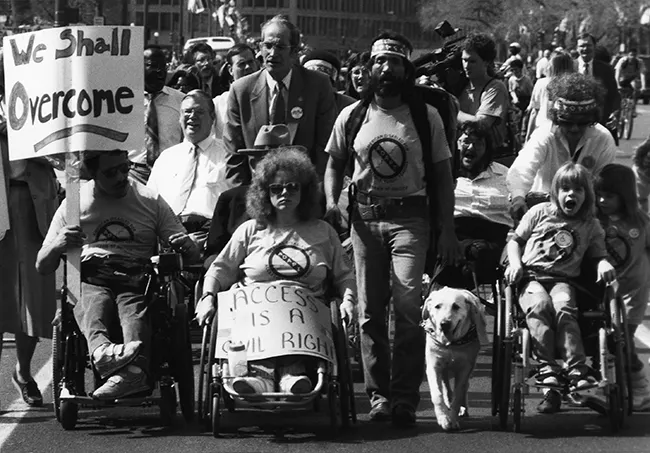
Image: Activists in the Wheels of Justice March before the Capitol Crawl, 1990. Courtesy of the Tom Olin Collection. University of Toledo Libraries.