By: Kelsey Maurine Brickl
Those of us who work in disability access spend a great deal of time documenting failures.
We write reports. We submit complaints. We explain, often repeatedly, why a particular barrier created a foreseeable problem and how it could have been prevented. We cite legislation, regulations, policies, and guidance. We escalate when necessary.
That work is necessary. But praise belongs in the formal record too.
In recent months, I have visited or interacted with several London theatres that demonstrated something worth naming plainly: accessibility is not merely the absence of barriers. It is the presence of competent planning, knowledgeable staff, and systems that allow Disabled patrons to participate with dignity and confidence.
Accessibility is often discussed as though it were primarily a matter of expensive renovations or complex engineering. Sometimes it is. More often, however, it begins with preparation. A member of staff who knows the answer. A procedure that has been thought through in advance. A route that is understood before a customer arrives.
Those things change the entire experience.
One venue that particularly impressed me was the Theatre Royal Drury Lane. I stopped by the theatre while Disney’s Hercules was in the process of house opening, meaning the building was busy and front-of-house staff had every reason to be focused on the evening’s performance. Even so, staff at the step-free Russell Street entrance took the time to explain the theatre’s accessibility provisions in detail.
They discussed many details with me, from wheelchair-accessible seating on multiple levels and adapted toilet facilities across the building to the venue’s Access Scheme and ticketing arrangements, and practical arrival information. The conversation was friendly, knowledgeable, and notably free of uncertainty. I was grateful and noted the tone.
Many accessibility failures begin not with physical barriers but with information barriers. A customer asks a question and receives conflicting answers, incomplete answers, scowls, or no answer at all. At Theatre Royal Drury Lane, the staff knew their building and the protocols that govern it and the Disabled people that come to see shows there. They understood the systems in place and were willing and able to explain them clearly. That competence creates confidence before a ticket is ever purchased.
I experienced something similarly encouraging when booking tickets for Hamilton at the Victoria Palace Theatre.
As a full-time wheelchair user who often travels alone but will be travelling with both my husband and my autistic son on my next trip, I had initially assumed that accommodating our family’s access requirements would involve compromise. Quite often, wheelchair users discover that the only available option is a wheelchair space separated from family members or companions.
Instead, I learned that, for this show, we could all be accommodated together in Stalls Box A. For our family, this was not simply a seating solution. It was an accessibility solution. The arrangement accommodates my wheelchair while also offering an environment well suited to my son’s sensory needs. The front-of-house team member handling the booking took the time to explain how accessible toilet access works from the box, as well as how drinks service is managed.
Again, what stood out was not merely the existence of an accommodation. It was the staff member’s familiarity with it. Questions were answered immediately and confidently because the systems already existed. Good accessibility often feels remarkably unremarkable. That is precisely the goal.
I would also like to recognize the front-of-house, management, access, and security teams at the Noël Coward Theatre, where I recently attended Dracula starring Cynthia Erivo. The production itself was magnificent, but what remained equally striking was the care with which access arrangements had been considered.
Ramps were deployed where needed by people experienced with using them. Clean and updated accessible toilet facilities were available. Staff escorted me safely to the wheelchair-accessible box that was big enough for my wheelchair and provided an unobstructed view and adequate sound projection. At the conclusion of the performance, safe and guided egress arrangements were in place despite an exceptionally busy stage-door environment. Importantly, a separate wheelchair-accessible viewing area had been established near the stage door. This allows Disabled patrons to participate without being forced into unsafe crowd conditions.
I often note that accessibility is not achieved by simply permitting Disabled people to enter a space. Accessibility is achieved when Disabled people can participate without being required to assume disproportionate risk. At the Noel Coward Theatre, I was able to focus on the performance rather than continually calculating my own safety. That is exactly how accessibility should work.
Finally, I would like to commend the Theatre Royal Haymarket.
The Haymarket presents challenges that would test any access team or theatre management. It is a historic building situated on a narrow and busy public street, with significant constraints imposed by both its age and its location. Yet despite those limitations, the theatre has developed compliant procedures that create a workable and consistently safe environment for performers, staff, members of the public, and Disabled patrons alike.
Inside the building, accessible toilet facilities are available and wheelchair-accessible seating exists at the rear of the stalls. Additional seating configurations can be explored for patrons with more complex requirements and larger mobility devices, always within the physical realities of a beautiful but historic theatre.
What impressed me most, however, was the willingness to engage with practical realities rather than pretend they do not exist. No historic venue can magically create space where none exists. What it can do is acknowledge constraints honestly and work diligently to mitigate them. That is what good accessibility management looks like.
Too often, discussions about theatre accessibility become trapped in a false choice between perfection and failure. The reality is more practical than that.
Good accessibility is built through planning, communication, training, and institutional commitment. It is built by staff who know their venues. It is built by managers who understand that access is part of operations, not an optional extra. It is built by security teams who recognize that safety includes Disabled people too.
When theatres get these things right, they deserve recognition. Criticism has its place. So do reports. So do complaints. But when a venue demonstrates thoughtful, competent, and effective accessibility practice, it deserves something else as well:
Credit.
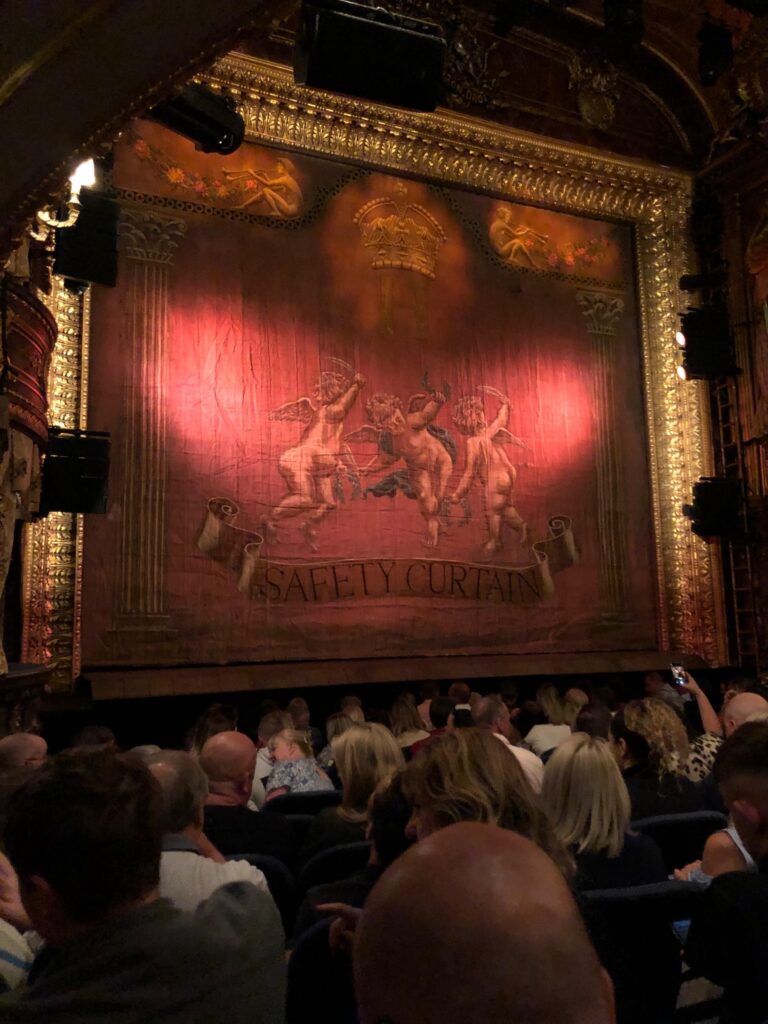
Image: Row M, Seat 21 at Theatre Royal Haymarket, London – Only Fools and Horses the Musical (A View From My Seat)