By: Kelsey Maurine Brickl
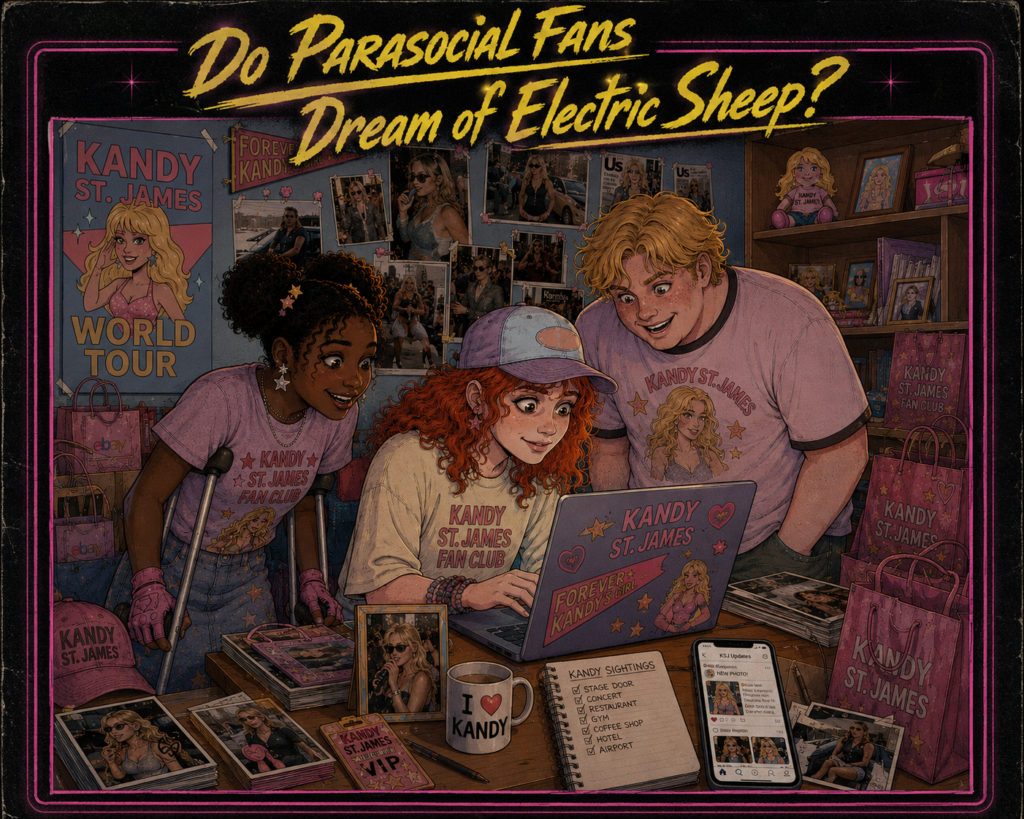
One of the most uncomfortable things about doing research on toxic and unhealthy fandom is the stuff you discover.
Not the abstract stuff. Not the clean academic categories. Not “parasociality” as a tidy term scribbled in blue ink inside a spiral-bound notebook and waiting to be put into a journal article.
I mean the actual stuff.
The artifacts, the posts, the objects. The behavior people display with no visible or perceptible shame. The expensive things that many people declare very loudly they cannot afford but buy anyway. The creations made without skill but with undying devotion and therefore wrapped up with a smothering amount of praise and encouragement.
The stuff. Enough of it to fill a museum, a very niche, very creepy museum. It feels like a bizarre near form of true crime, honestly.
There is the “art” people make, some of which looks less like tribute than like a fever dream interrupted by a jump scare. There are AI-generated images of actors in costume engaged in imagined behaviors that have the uncanny realism and sexual tenacity of sleep demons. There are real-person fanfics written about living human beings by people who then brazenly buy tickets to meet those same human beings at stage doors and conventions, as though the boundary between fantasy production and physical proximity has not become an obvious safety problem.
There is the memorabilia people buy on eBay, and the prices they are willing to pay for it. There is the proud, often competitive knowledge of living celebrities’ childhoods, relatives, romantic histories, neighborhood movements, school records, old and new interviews, minor injuries and scars, family tragedies, and personal preferences about soap and food and liquor and leather.
There is the obsession with completion, with having seen every moment of film, every interview, every red carpet clip, every low-resolution photograph that escaped from 1995. There are the posts that indignantly demand, “How does this photo exist and I haven’t seen it yet?!” as though the existence of an unseen image is not merely a discovery but a personal insult.
And then there are the paparazzi shots. The cheerful circulation of photographs in which the celebrity looks plainly distressed. These aren’t photos of a grinning reality star holding a milkshake in the driver’s seat of an SUV after phoning the press themselves. You can see expressions that are plainly exhausted, cornered, annoyed, and trapped. This obvious lack of consent is very often ignored entirely because the photo has already been converted into content.
Worse, perhaps, are the candid shots that do not even have the dirty honesty of paparazzi commerce behind them: the photographs taken at parties, events, restaurants, private-feeling public spaces, where the celebrity appears not to have known the image was being captured at all. These are circulated by parasocial fans with somewhat stomach-churning captions about them being “the best sort” of photos, or “cute,” or their “favorite person living their best life.”
It should be obvious that the ethical problem of privacy, depersonalization, and boundaries being violated does not disappear because the person in the photos and the knockoff eBay merchandise and the explicit fanfiction and art is famous. Fame changes the scale of public interest. It does not dissolve personhood.
I conduct this research because I am interested in the historical, sociological, and psychological significance of collective behavior. I am interested in how these patterns touch other sectors I work in professionally: theatre, writing, disability access, historical research, public memory, performance spaces, and the strange modern relationship between spectatorship, power, and entitlement.
I try very hard not to have contempt for the humans behind any of this. Contempt is usually lazy. It lets the observer feel clean while refusing to understand the mechanism. And the mechanism is human.
Loneliness, identification, and longing are all profoundly human. The desire to be near beauty, talent, charisma, excellence, glamour, erotic charge, childhood comfort, or some symbolic figure who seems to organize one’s inner life is human. Enjoying art is extraordinarily human. The problem is not that people love art. The problem is not that people admire performers. The problem is not even that people become emotionally attached to public figures. That has existed for as long as public performance has existed. Gladiators, Ancient Greek warrior-heroes, Renaissance Italian artistic geniuses, Napoleon Bonaparte, knights at tourneys, Elvis, the Beatles, and many others have experienced mass fame in their lifetimes by being extraordinary.
The problem with modern fandom’s scope, scale, and intensity is what happens when the very human sense of longing is fed through algorithmic urgency, commercial scarcity, social reward, and collapsing boundaries.
I am ultimately very glad not to be famous.
That’s because so much of this feels viscerally terrifying. It probably should feel terrifying. Fame has always carried danger, but the texture of the danger has changed.
True, gladiators had fame. Saints had fame. Byron had fame. Elvis had fame. Michael Jackson had fame. None of these systems were gentle, rational, or safe. But they did not have the same algorithmic thrust. They did not have fan forums producing collective urgency by the hour. They did not have social media converting fixation into identity and identity into performance. They did not have conventions, stage doors, quote-tweet pile-ons, archival obsessives, private-life sleuthing, gossip economies, and commerce all braided together into a continuous machine.
The eerie thing is that the machine does not always look like danger from the inside. It is deceptive and tricky these days because it often looks like community, humor, and creativity. It looks like “just loving someone’s work.” It looks like buying the thing, making the meme, finding the clip, reposting the photo, camping out, decoding the interview, writing the story, paying for the package, waiting at the door.
But a crowd can be frightening even when every individual in it thinks of himself or herself as harmless.
Working in theatre access has only reinforced this observation. Most people in a crowd are perfectly ordinary. Most are not malicious. Most would likely describe themselves as respectful. Crowd dynamics do not care. A crush remains a crush. An obstructed egress route remains an obstructed egress route. A performer attempting to leave safely still has to leave safely. A Disabled patron still has to move through the same physical space. The difference between an orderly interaction and an unsafe one is often not intent but structure.
And some people waiting outside a stage door happen to have social media profiles publicly and proudly obsessing dangerously over the same celebrities they have come to see in person. As a Disabled individual working in access and safety, this is significant because a trust factor comes into play. Publicly visible fixation changes the safety calculation. It means staff cannot reasonably ask Disabled patrons, performers, or workers to trust that the crowd will self-regulate when the crowd is already showing evidence that it may not.
And this is not only about individual celebrities. The same mechanics appear around products, teams, brands, collectibles, launches, and events. Collective hysteria over specific makeup brands and their releases has produced campouts, FOMO, emotional dysregulation, and ugly public behavior. Sports championships can turn communal joy into physical violence. Movie-related popcorn buckets have somehow become objects of frenzy. That sentence is ridiculous, but the behavior is not imaginary.
The thing being consumed matters less than the structure around it.
Scarcity. Urgency. Status. Proof. Belonging. Public display. The fear of missing out. The fear of not being the kind of person who knew first, owned first, saw first, arrived first, posted first. The object can be a lipstick, a football team, a celebrity, a limited-edition plastic bucket, a theatre ticket, a convention selfie, or a blurry photograph of a man trying to get from a car to a building without being eaten by cameras.
The underlying emotional economy is often the same.
So what is the solution?
The simplest answer is also the least useful at scale: people should be calmer. They should consume art and products with more grace. They should observe public figures without acting as though visibility creates ownership. They should buy things without surrendering their nervous systems to artificial scarcity. They should stop treating performers as emotional infrastructure. They should understand that proximity is not intimacy, that knowledge is not consent, that admiration is not entitlement, and that a person’s work does not make their body, family, time, exhaustion, or fear public property. They should not have social media profiles whose entire purpose is to fixate emotionally on individual people they do not know.
All of that is true. It is also not a serious large-scale behavioral technique.
Telling people to be less suggestible or less emotional is a great technique rooted in CBT (cognitive behavioral therapy) and modern Stoicism. It works beautifully as a sentence and poorly as a system. The point of the system is reducing suggestibility and increasing personal responsibility. The point is to make ordinary restraint feel like loss. The point is to make not-buying, not-posting, not-knowing, not-attending, not-meeting, not-touching, not-collecting, not-having feel like a collapse in status or belonging.
That means guardrails must come into play.
I believe we must see more age limits on social media, rules around deliberately targeted algorithmic circulation and online advertising (especially where ads exploit young people, lonely people, neurodivergent people, or people already prone to obsessive loops). Existing privacy protections should be enforced where they exist, and new ones should be written where the law remains embarrassingly behind the technological reality.
As I have stated numerous times, stage doors and conventions are not trivial spaces. Stage doors are not part of the ticketed experience, but if they occur, they must happen safely and equitably, and equal access is critical to fan conventions. These are sites where fantasy, money, crowd pressure, physical proximity, access logistics, and labor obligations collide. They need to protect fans, talent, staff, and vulnerable bodies, including Disabled people. These are the places most vulnerable to confusion about entitlement and intimacy.
A public figure being kind for twenty seconds is not a private bond. A crowd being excited does not make the crowd safe. Public roads do not absolve theatres of responsibility toward vulnerable bodies, including Disabled patrons and performers. Fan conventions must follow laws and obligations to fully protect booked talent and all attendees and preserve boundaries.
For Ghost Light Access, this is not an abstract cultural concern. It is an access, crowd-safety, and duty-of-care concern. Disabled patrons, performers, staff, access workers, and front-of-house teams are often positioned directly inside the pressure points where fandom, poor crowd management, celebrity proximity, and physical vulnerability intersect. A theatre culture that treats frenzy as harmless atmosphere has already misunderstood the room.
And, crucially, none of this requires hating fans, showing contempt, mockery, or an attitude of arrogance.
That is the wrong frame. The question is not whether fans are good or bad people but what behaviors and outcomes certain systems reward, intensify, normalize, and monetize. The question is why and how so many people are being trained to experience art, performance, celebrity, and consumer goods through urgency and reward rather than through thoughtful attention. The question is why boundaries now have to survive not only individual desire but collective reinforcement, reseller profit, and algorithmic acceleration on social media.
There is something bleakly comic about discovering, while researching unhealthy fandom, that the most frightening thing is not always the obvious monster. It is often the archive, the spreadsheet, the thirty-second video compilation,the lovingly maintained folder on Dropbox, the subreddit forum, the resale listing of an autograph, the “rare” photo taken without consent where the celebrity looks miserable.
The sleep demon is not always hiding in the art. Sometimes the sleep demon is the fan economy around the art.