By Kelsey Maurine Brickl
I. Accessibility Is a Matter of Compliance, Not Basic Customer Service.
Accessibility is a legal, operational, and governance obligation. It is not an act of goodwill, hospitality, or discretionary customer care. Disabled people are rights-holders. Theatre organisations should therefore build accessibility into their ordinary operations rather than treating it as an exception requiring special favour.
II. Accessibility Begins Long Before the Curtain Rises.
Accessibility begins with websites, ticketing systems, communication, arrival, staffing, and information. If obtaining access requires repeated explanations, extraordinary persistence, or personal negotiation, the system has already imposed an unnecessary barrier.
III. Safety Must Never Depend Upon Luck.
Emergency evacuation, medical response, crowd movement, weather, lifts, accessible toilets, refuge areas, and communication systems require planning. No patron or professional should depend upon fortunate circumstances to remain safe.
IV. Stage Doors Are Not Part of the Ticketed Experience. But If They Occur, They Must Be Safe and Equitable.
Productions are under no obligation to operate stage doors.
Once a theatre or production chooses to facilitate them through barriers, security staff, established practice, or performer participation, foreseeable duties arise. Disabled patrons cannot reasonably be expected to navigate uncontrolled crowds without appropriate planning for stewarding, emergency access, safe waiting areas, and equitable participation.
V. Accessibility Requires Professional Expertise.
Accessibility professionals are professionals.
When an architect writes about theatre buildings, they are treated as an architect. When a fire engineer raises evacuation concerns, they are treated as a fire engineer. When a disability-access specialist raises operational accessibility concerns, that expertise should be recognised in exactly the same way rather than being reduced to the status of an ordinary ticket-holder making a customer-service complaint. Professional expertise does not disappear because the expert is also Disabled or has purchased a ticket.
VI. Silence Is Sometimes an Institutional Decision.
Failure to provide a meaningful response to accessibility concerns is not automatically neutral.
Where organisations repeatedly decline to engage with operational questions, decline to explain decisions, or consistently recast compliance issues as routine customer-service matters, those choices may reasonably raise questions about institutional compliance, governance, or good faith. Transparency protects both Disabled people and organisations; silence rarely does.
VII. Disabled Professionals Have Exactly the Same Right to Work in Theatre as Able-Bodied Professionals.
Theatre is not only somewhere people buy tickets.
It is also a workplace. Disabled people are actors, directors, playwrights, critics, journalists, producers, designers, technicians, educators, consultants, donors, trustees, and executives. Accessibility therefore extends beyond the auditorium into rehearsal rooms, production offices, dressing rooms, green rooms, technical spaces, meeting rooms, and every other place where professional theatre actually operates.
VIII. Historic Buildings Do Not Suspend Civil Rights.
Historic buildings present genuine engineering and conservation challenges. They do not extinguish legal obligations. Preservation and accessibility should be addressed together rather than presented as competing moral claims.
IX. Every Barrier Reflects an Operational Decision.
Most accessibility failures do not arise from a single staircase or doorway. They emerge from accumulated decisions concerning staffing, procurement, maintenance, communication, training, scheduling, and management. Every barrier exists because someone decided, actively or passively, that it would remain.
X. Accessibility Is Never Finished.
Accessibility is not a certificate earned once.
Buildings change. Productions change. Technology changes. Law changes. Audiences change. Continuous auditing, review, consultation, and improvement are therefore ordinary responsibilities of responsible theatre management rather than exceptional exercises.
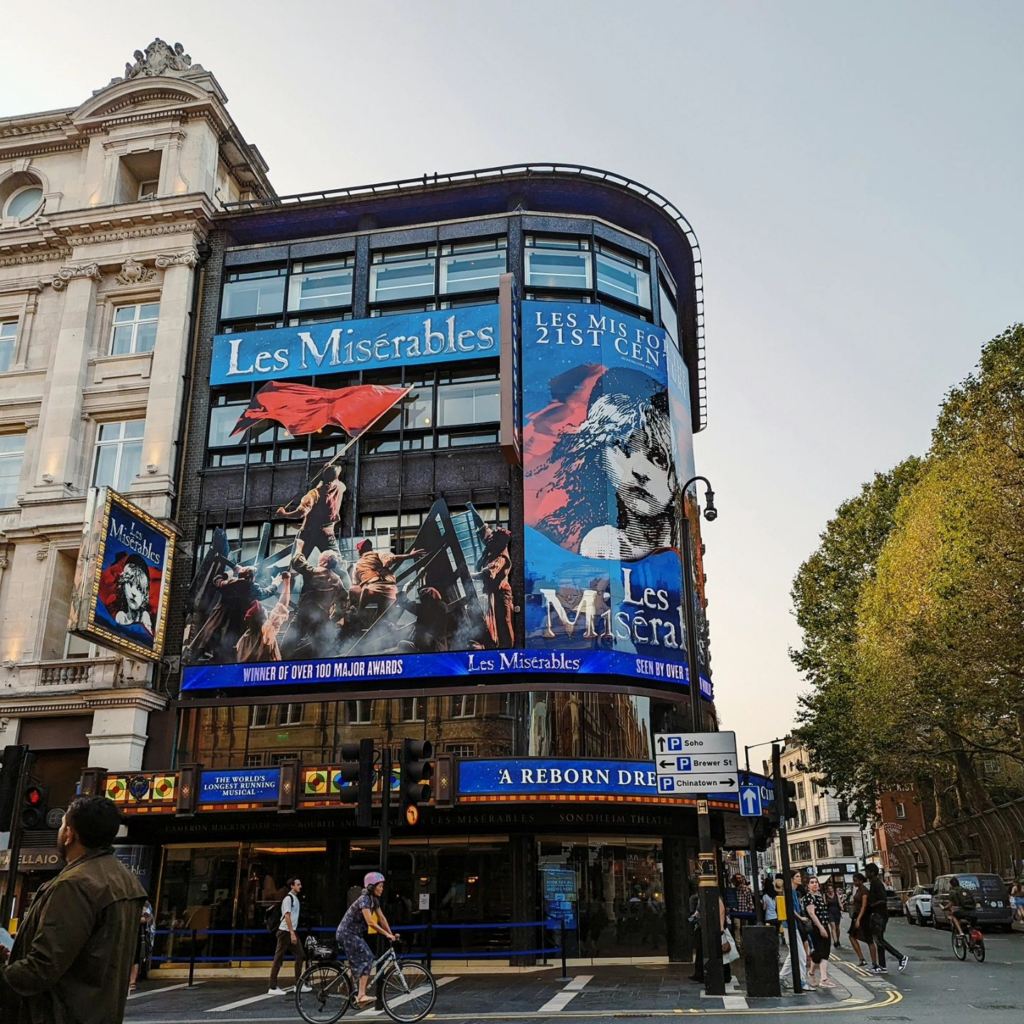
Photo: The Sondheim Theatre, London, September 2023, taken by the author.