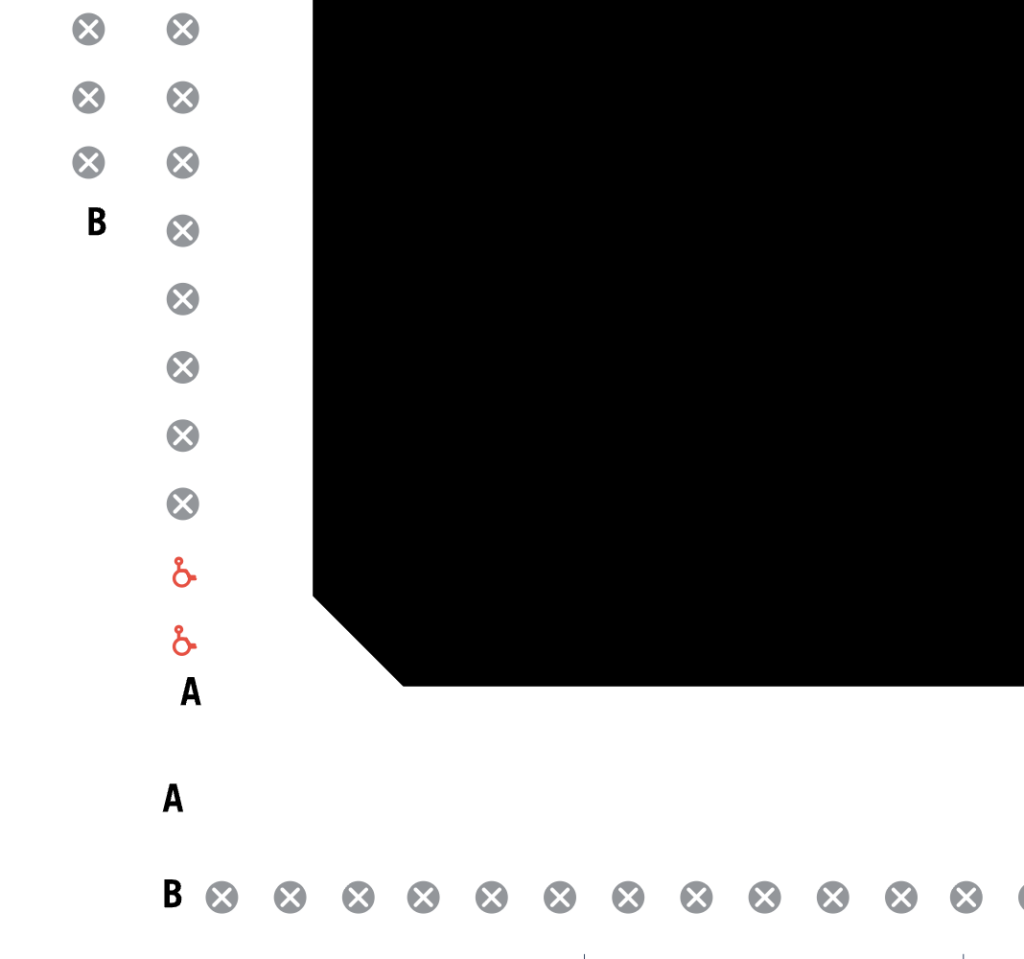
Image: Partial theatre seating chart showing two wheelchair-accessible front-row positions marked in red beside the stage, with surrounding seats marked in gray. Courtesy of Theatre for a New Audience.
Ghost Light Access is pleased to recognize Brooklyn’s Theatre for a New Audience (TFANA) for its unusually clear and transparent approach to communicating wheelchair accessibility information online.
While reviewing tickets for the upcoming production of Sophokles’ Elektra, directed by Daniel Fish and running November 10–December 6, 2026, Ghost Light Access found a ticketing system that allows Disabled patrons to make informed seating decisions independently.
Wheelchair-accessible positions are clearly marked in red on the interactive seating chart. The theatre explains that designated chairs can be removed to accommodate wheelchair users, and its seating configuration permits wheelchair users to sit in the front row, with a direct, unobstructed view of the performance.
Yes! The front row is available to wheelchair users, and all seats designated a wheelchair seats can be removed.
There is no requirement to telephone the box office simply to identify and select an accessible position.
TFANA also publishes straightforward information about step-free access, elevators, seating configurations, assistive listening devices, and open-caption performances. Also, TFANA offers multiple ways for Disabled patrons and caretakers to purchase tickets. Its box office can be contacted by email ([email protected]) or telephone (646-553-3880). Some Disabled patrons prefer phone contact, while others prefer writing. For lawful compliance, theatres need to ensure that accessible seating can be purchased in the same ways as non-accessible seating, with multiple ways of communicating access requirements.
These details are enormously important to wheelchair users, particularly those who use large, non-folding complex power wheelchairs and cannot transfer into conventional theatre seats. They’re also very significant to people for whom phone conversations may not be possible or accessible, like Deaf or neurodivergent people or who struggle with speech impediments or auditory processing disorders. On the contrary, people with dyslexia or reading processing disorders may need to conduct their purchases over the telephone to ensure accessibility.
The Polonsky Shakespeare Center in Brooklyn is fully wheelchair accessible across all floors.
There’s elevator access to all levels of the building, including the mainstage theatre floors and the mezzanine level. Fully accessible restrooms are located on both the first floor and the mezzanine level (which features a gender-neutral, single-stall private restroom). Although the theatre changes its configuration for specific productions, accessibility is never viewed as an optional matter.
Sightlines deserve particular attention, and Theatre For a New Audience is setting the standard for other New York Theatres.
A wheelchair position may satisfy the physical dimensions required for access because a wheelchair and its occupant can fit, but if the patron is seated in Row K and the entire able-bodied audience flies to their feet for a celebratory, pre-arranged and choreographed post-bows encore or standing ovation, this isn’t equitable or fair, and it’s a preditable failure. This situation leaves a fully ticketed wheelchair user looking at people’s backs, unable to see important portions of a performance, when other patrons stand. Theatre operators should examine these conditions in advance, including curtain calls, encores, and musical numbers performed after the bows. They should give just as much attention to this issue as they do to policing phone use. Wheelchair users purchase tickets to complete performances, and the location and configuration of accessible seating should reflect that expectation.
This is especially relevant on Broadway, where Ghost Light Access has recently documented more than seven weeks of negotiations with ATG Entertainment concerning accessibility arrangements for Hadestown at the Walter Kerr Theatre and The Book of Mormon at the Eugene O’Neill Theatre. ATG provided numerous written commitments, but on October 27 withdrew a proposed procedure for protecting a wheelchair user’s view of Hadestown‘s final musical number after the proposed method was challenged for potentially exposing that patron to harassment.
TFANA’s clearly identified front-row wheelchair positions offer a useful comparison. Good seating design can eliminate foreseeable sightline disputes before they reach the box office, house management, or legal department. Accessible ticketing also gives patrons information that would otherwise require lengthy individual correspondence. Institutions should be able to explain their seating arrangements publicly and implement them consistently, without requiring Disabled customers to negotiate the conditions of their attendance weeks in advance.
How to get there in a wheelchair?
Getting to certain off-Broadway theatres in New York can be a real challenge. Only around 1/3 of subway stations are wheelchair accessible, and even fewer wheelchair users in NYC own cars than the average New Yorker. Some parts of the outer boroughs, where many of the buzzy theatre happens, require multi-step, expensive transit for wheelchair users that can be difficult or even frightening to try recreate at 11 pm. But getting to and from Theatre for a New Audience (TFANA) at the Polonsky Shakespeare Center (262 Ashland Place, Brooklyn) in a wheelchair is highly manageable because the theatre sits right next to one of the largest fully accessible transit hubs in New York City. The single best transit anchor for this trip is the Atlantic Av-Barclays Ctr Station. It is completely ADA-compliant, featuring street-to-platform elevators that are more reliable than many other MTA elevators. The station has tactile warning strips and wide-aisle fare gates. From this station, the theatre is a straightforward, flat 3-block roll (approx. 0.2 miles) heading north down Ashland Place.
Why this success matters so much in the big picture of theatre accessibility in New York
Theatre for a New Audience receives public funding, including federal support through the National Endowment for the Humanities. Its disability-access obligations therefore implicate Section 504 of the Rehabilitation Act, alongside the Americans with Disabilities Act (ADA) and the New York City Human Rights Law (NYCHRL).
Ghost Light Access regularly examines theatres’ compliance with these obligations. We also believe it is important to recognize institutions that make meaningful efforts to get accessibility right.
Although online transparency alone cannot establish every aspect of a venue’s operational accessibility, TFANA’s published information and ticketing arrangements are encouraging examples of practices other theatres should adopt.
Well done to Theatre For A New Audience!
Ghost Light Access wishes the company, cast, and creative team every success with Elektra and look forward to seeing the production.
Written by Kelsey Maurine Brickl, Founder and Director of Ghost Light Access
Independent theatre accessibility and disability-rights advocacy