By: Kelsey Maurine Brickl
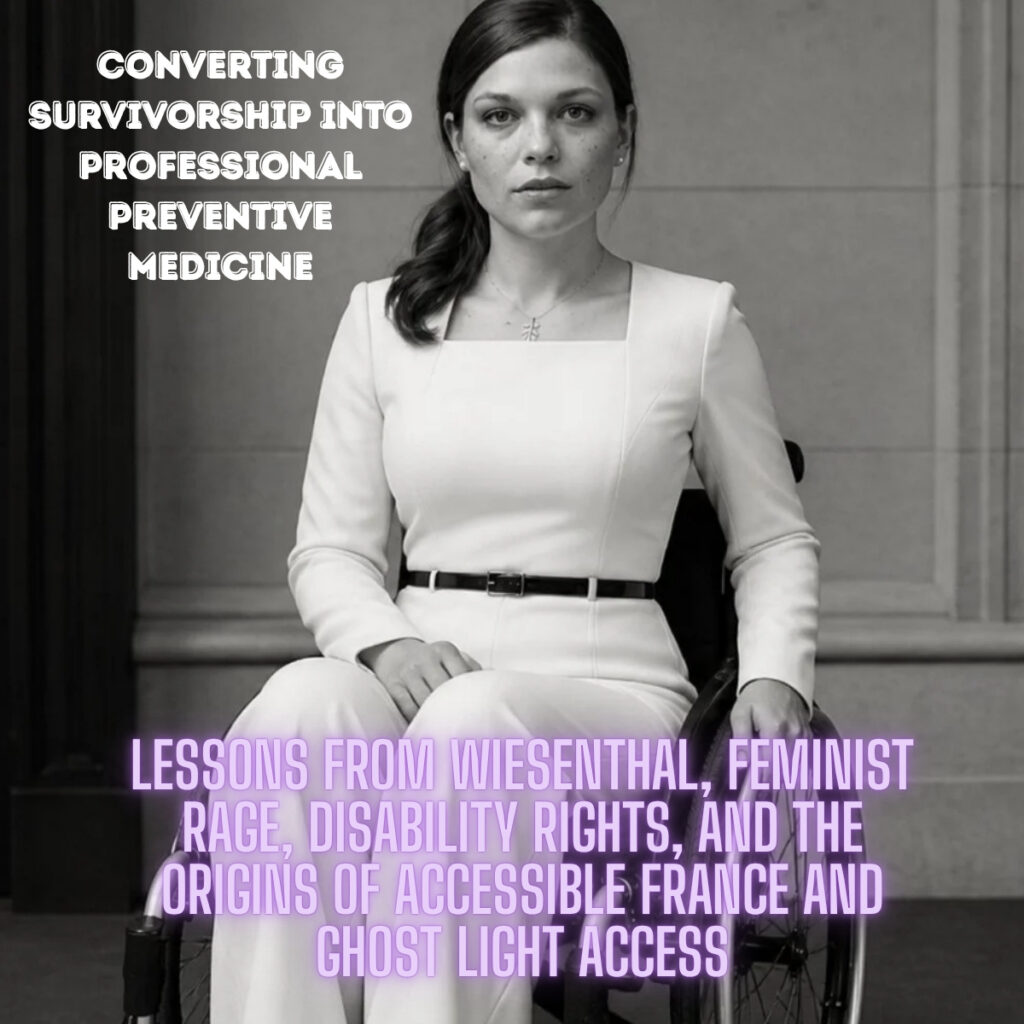
In 1989, Simon Wiesenthal wrote, “Survival is a privilege which entails obligations. I am forever asking myself what I can do for those who have not survived. The answer I have found for myself is: I want to be their mouthpiece, I want to keep their memory alive, to make sure the dead live on in that memory.” Wiesenthal famously survived numerous concentration camps and then dedicated his life to tracking down fugitive Nazi war criminals and bringing them to justice.
My husband’s grandfather, Alois (Luigi) Simonič, survived Dachau and Neuengamme and then a Red Cross Displaced Person’s camp in Sweden and another in Italy before he and his family finally came to the United States as stateless refugees in the early 1950s. I am representing my husband and son in an active appeal of Section 58c of the Austrian Citizenship Act concerning surviving descendents of Nazi persecution.
Thanks for reading! Subscribe for free to receive new posts and support my work.
Perhaps I have always felt inclined toward Mr. Wiesenthal’s quote, and not just regarding the Holocaust, although as a Modern European Historian specializing in Holocaust historiography and with a family connection, the bind is certainly tight. I have my own demons, my own survivals, that compel me.
I am a survivor of violent rape and physical violence, and I have written at length and advocated against the institutions that protect male reputations at the price of women’s mental health, physical safety, social currency, and the truth. I have made it clear that protecting male futures by destroying uncomfortable interrogations of reality is an egregious and well-documented pattern and that it must end. This form of writing has, I hope, assisted others, and I have consulted with feminist and survivors’ organizations in the past. I have also discussed these topics and my writing on it at length with the professionals who have diagnosed and who treat my complex PTSD.
And as a Disabled woman, my survival has been something I’ve used on a very personal level to continue living, thriving, and working.
As generative artificial intelligence has blossomed, I’ve explored its possibilities for my particular career rather than resisting it wholesale and have found that I may be able to leverage it as an accessibility tool where conventional creative industries fail my body because I can’t enter buildings, access parts of buildings that aren’t step-free, get to remote sets, stay on location all day, be away from specialist healthcare, and more. When physical architecture continues to bar my body from traditional creative ecosystems, digital adaptations cease to be mere technological shortcuts and become instruments of basic civil equity.
This is where my commentary on ableism in anti-AI panic in the entertainment industry is so important; generative AI has real limits and needs to be reined in, but it can seriously allow Disabled people who are bedbound/homebound or have very complex access needs to continue their hobbies and work without others presuming to dictate they must be limited to rudimentary arts and crafts or very specific adaptations like text-to-speech, mouth-painting, etc. While some may prefer these ways of participating, I prefer to write my own longform content and to use generative AI for imagery as an accessibility adaptation.
Accessible France and Ghost Light Access are relevant to these topics, but their origins date separately to incidents, or perhaps nodes, that I felt compelled to convert into real action.
When I experienced a very severe medical episode while attending a theatrical performance alone in a different country, it caused my connected phone alarm to sound loudly and to disrupt the performance of the actor onstage, who (mercifully) ad-libbed as I desperately hurtled my phone and myself out into the corridor and collapsed, breathless and only vaguely responsive.
This disruption occurred during the initial run of David Hare’s Grace Pervades, a production deeply tied to the historical legacy of Victorian theatre. The performance was not stopped. Theatre staff were nice, but did not seem particularly well-equipped or trained to handle the emergency. As I sat alone in a different country in my large custom prescription power wheelchair, unsure of how I would get to the hospital, two actors repeatedly came out in costume while the play continued and informed me that there had been a rumor backstage that I had died.
The next night at a question and answer session, one of the play’s principal actors sharply interrupted me while I was still symptomatic from the event. In my interpretation, this performer remained angry and sharp with me regarding the incident in later conversation. Reflecting on this sharp, defensive posture from the production’s leadership (juxtaposed with the play’s thematic exploration of how historical truth and public reality are constructed) revealed a profound cultural disconnect. It underscored how elite performance spaces often resist accountability when confronted with the unpredictable reality of disabled spectatorship, an institutional defensiveness that echoes the broader, systemic critique of British institutions found in related works like David Hare and Howard Brenton’s Pravda.
The emotional chaos and distress of that entire situation made me realize just how important accessibility for independent travelers was when I was designing Accessible France and founding Ghost Light Access. Not every Disabled person travels with a carer (nor should they), and cultural locations in places like the US, UK, and France should be well-prepared for Disabled patrons to arrive ahead of time, not scrambling upon the patron’s arrival or failing to accommodate them and apologizing or dealing with the aftermath of an event. Institutions habitually mistake administrative compliance for actual human access, offering performative apologies where they ought to be building robust, fail-safe infrastructure.
And that’s why Accessible France exists: France is far more possible and enjoyable than many Disabled people fear and realize if the cultural institutions in the country are held fully accountable to existing law and if Disabled visitors are encouraged to prepare for travel with detailed itineraries, needed documentation, and realistic expectations.
Accessible France and Ghost Light Access were never founded on the premise of customer-service hospitality or the cultivation of warmer institutional manners. Instead, they rest firmly, unapolegtically, and necessarily on the far sterner foundation of compliance. They hold cultural venues rigorously accountable to existing accessibility law so that independent Disabled presence is treated as a protected right rather than a negotiable favor. Many institutions are unaccustomed to this. However, the medical episode abroad and the spatial violations in Paris made plain that what is required is not more polished apologies or better-trained courtesy, but anticipatory compliance infrastructure capable of preventing the scramble, the rumor, and the physical risk before they occur.
Accessible France and Ghost Light Access do not insist upon the establishment of protocols or compliance with existing law in order to improve the customer experience or to soften the edges of institutional failure. Nor do they seek attention, monetary payout, argument, or conflict. Instead, a posture that some may regard as relentless is adopted because hollow administrative compliance leaves Disabled bodies and life-sustaining equipment exposed, and only enforceable systems convert personal survivorship into structural protection for those who follow. That is the premise on which both organizations stand: accountability to law, fail-safe protocols, and preventive equity, not the contingent currencies of niceness or individual accommodation.
An event in Paris is what led to what would eventually become Ghost Light Access. I attended a cultural event in my capacity as the Founder and Director of Accessible France. The ticket included a meet and greet with the panelists, and when I attended it, it was very poorly organized with essentially no crowd control. One woman attempted to coerce me to take a photograph of her with a panelist by pushing her phone into my wheelchair. I politely declined. Another man, in his attempt to get multiple DVDs signed, attempted to climb over my custom prescription power wheelchair, risking damage to the wheelchair and injury to me.
Able-bodied spectatorship and competition for finite and time-sensitive access too routinely weaponizes a ruthless spatial arrogance, reducing a Disabled person’s body and life-sustaining equipment to mere physical obstacles to be shoved aside or scrambled over. To occupy a visibly Disabled body in public spaces is to remain perpetually subject to the non-disabled presumption that our presence is an anomaly rather than a fundamental right.
Those who have read my published essays on stage door safety, parasociality, and the importance of ensuring that Disabled patrons have access to phones used as medical devices (rather than being forced to turn them off or use Yondr pouches or similar) will recognize that my personal experiences with access failures have successfully helped form the basis for ongoing professional work. The entitlement inherent in modern fandom frequently transforms public cultural spaces into volatile environments where physical boundaries and essential medical devices are treated as negotiable collateral.
Often, traumatized and Disabled people build machinery designed to prevent comparable things from happening again. That machinery will rarely ever be as noble or as successful as the work of Simon Wiesenthal, no matter how much we may aspire for it to be. But it can still be valid and necessary, particularly when it surrounds feminism and rape survival and disability civil rights. It can be exhausting. It can fail to bring profit and, indeed, be personally expensive.
Accessible France and Ghost Light Access never seek to erase the distress of past failures, but to ensure that our personal survivals yield structural protection for those who come after us.
And it is, I hope, cumulatively, preventive medicine.