By: Kelsey Maurine Brickl
On August 6, CRIPtic Arts announced Embark, a new programme supporting young Disabled writers and directors with significant physical access requirements. Two writers and two directors will be supported each year, with paid work, mentoring, practical production experience and an industry sharing. CRIPtic expects all four participants to be wheelchair users.
There is plenty here worth taking seriously. There is also a fairly obvious problem waiting at the other end of the programme: the West End itself.
Ghost Light Access has been examining occupational accessibility in theatre through a deliberately simple question: could a non-ambulatory wheelchair user actually work here?
Audience accessibility cannot answer it.
A wheelchair user might enter through an accessible front entrance, watch a performance from an excellent wheelchair position and use an accessible public toilet. None of that establishes whether the same person could enter through the stage door, reach a dressing room, work onstage, get into wardrobe, use the backstage toilet, attend a meeting in a production office or evacuate safely from the places where theatre workers spend their days.
CRIPtic knows this territory unusually well. Its research project Always the Audience, Never the Star concentrated on Disabled creatives with very high physical access requirements, including people requiring personal assistance, hoists, Changing Places facilities and substantial mobility support. Its research has documented inaccessible stages, dressing rooms unable to accommodate wheelchair users and assistants, inadequate lifts and other barriers that rarely appear on the customer-facing accessibility page of a theatre website.
Embark therefore addresses a genuine career problem. Early professional theatre is particularly hostile to someone with extensive access requirements because experience is accumulated through exactly the environments most likely to be inaccessible: fringe theatres, workshops, rehearsals, scratch nights, assistant positions and informal professional networks.
A young director who cannot enter the rehearsal room does not get the directing credit. A writer who cannot attend the development opportunity does not acquire the relationship that produces another commission. Several years later, the industry can observe their thinner CVs without having to look very hard at how they became thin.
Embark can interrupt some of that. Participants can leave with paid professional experience, references, filmed work, photographs and relationships with working theatre professionals. CRIPtic also understands access at a level considerably beyond asking applicants whether they need “reasonable adjustments.” Its wider work includes personal assistants and support workers, Changing Places facilities, remote participation and the practical requirements of people whose disabilities cannot be solved by putting a portable ramp over one step.
That deserves recognition without turning a four-person programme into evidence that theatre has cracked Disabled employment.
The interesting test comes afterwards.
Imagine that Embark does exactly what it promises. A non-ambulatory wheelchair-using director finishes the programme with strong work, professional references and demonstrated ability. A West End producer wants to hire them.
Can they get through the stage door?
Can their occupied wheelchair fit in the backstage lift?
Can they reach the rehearsal room and production offices? Can they work from the auditorium and get onto the stage when the work requires it? Is there a backstage toilet they can use? If they require personal assistance, is there enough physical space for the assistant to work? What happens during technical rehearsals when scenery, cables and equipment alter ordinary circulation routes? What is the evacuation plan for someone who cannot walk, transfer or be carried?
These are building and employment questions. CRIPtic cannot answer them for West End theatre owners.
There is also a danger in treating the ability to advocate for one’s own access as a satisfactory solution. A Disabled director should certainly know their requirements. They should not have to become the unpaid accessibility consultant for every production that employs them, repeatedly teaching producers about wheelchair dimensions, personal assistance, toilets, lifts and emergency egress before getting around to directing the play.
Scale matters too. Four participants a year cannot repair an industry, and Embark initially concentrates on writers and directors. A physically inaccessible backstage also excludes performers, wardrobe workers, stage managers, designers, technicians and other professionals. Its age limit of 18 to 30 leaves out Disabled people whose careers began later, including people whose education or early employment was itself delayed by inaccessible institutions.
None of those limitations makes Embark pointless. They locate what Embark can actually accomplish.
CRIPtic can help produce qualified Disabled professionals with substantial physical access requirements. It can pay them, develop their work and give them professional evidence that inaccessible early-career theatre often prevents them from acquiring.
The West End still has to employ them.
Ghost Light Access recently asked this question on Broadway through the forthcoming engagement of Tony Award winner Ali Stroker: “Could Ali Work Here?” The West End deserves the corresponding question about the people coming through programmes such as Embark.
If CRIPtic spends the next several years developing wheelchair-using directors and writers, West End theatres should be able to say which of their buildings those professionals can actually work in, which backstage routes they can use, and which jobs remain physically inaccessible.
Otherwise, we will have constructed a better pathway directly towards the same flight of stairs.
Ghost Light Access: 10-Point West End Occupational Access Assessment
A West End theatre claiming that Disabled professionals can work in its building should be able to answer these ten questions with measurements, routes and procedures rather than a generic assurance that the venue is “wheelchair accessible.”
- Stage-door entry: Can a non-ambulatory wheelchair user enter through the ordinary professional entrance, or through an equivalent independent step-free route available throughout working hours? Door widths, thresholds, gradients, security procedures and any platform lifts should be documented.
- Continuous backstage route: Is there a continuous step-free route from entry to every area routinely required by the particular job? An accessible stage means very little if the route to wardrobe, the production office or the green room contains stairs.
- Lift compatibility: Where lifts are required, what are the door width, internal dimensions and weight capacity? “There is a lift” does not establish that an occupied power wheelchair and, where necessary, a personal assistant can use it.
- Stage and wings: Can a wheelchair user reach the stage and the working areas on both sides of it where the job requires this? Temporary scenery, cables, equipment and production changes must be considered alongside the building’s normal configuration.
- Dressing rooms and workrooms: Which dressing rooms, wardrobe areas, technical rooms, offices and other professional spaces are step-free and large enough for an occupied wheelchair to manoeuvre? Can a personal assistant enter and work where one is required?
- Backstage toilets and personal care: Is there a genuinely usable wheelchair-accessible toilet within the professional working area? Does the theatre provide a Changing Places toilet or another suitable facility for workers who require a hoist, adult changing bench or assistance from one or more carers?
- Rehearsal and directing access: Can a wheelchair-using director or writer reach rehearsal rooms, production meetings, technical rehearsals and the ordinary auditorium positions from which directors work? If rehearsals occur elsewhere, the accessibility of those premises belongs in the assessment too.
- Emergency egress: What written evacuation procedure applies to a worker who cannot walk, transfer, use stairs or be carried? Where refuges, evacuation lifts or evacuation equipment form part of that procedure, are they suitable for the actual wheelchair user and available whenever that person is working?
- Role-by-role access: Which jobs can a non-ambulatory wheelchair user actually perform throughout the building: performer, director, writer, stage manager, wardrobe professional, designer, technician or producer? Access should be assessed against the physical movements the job requires rather than against an abstract Disabled visitor.
- Published occupational information: Will the theatre publish this information before recruitment and contracting, including known inaccessible areas and relevant measurements? Disabled professionals should be able to assess whether they can work in a building without first applying for a job, disclosing extensive medical information, or conducting their own unpaid architectural investigation.
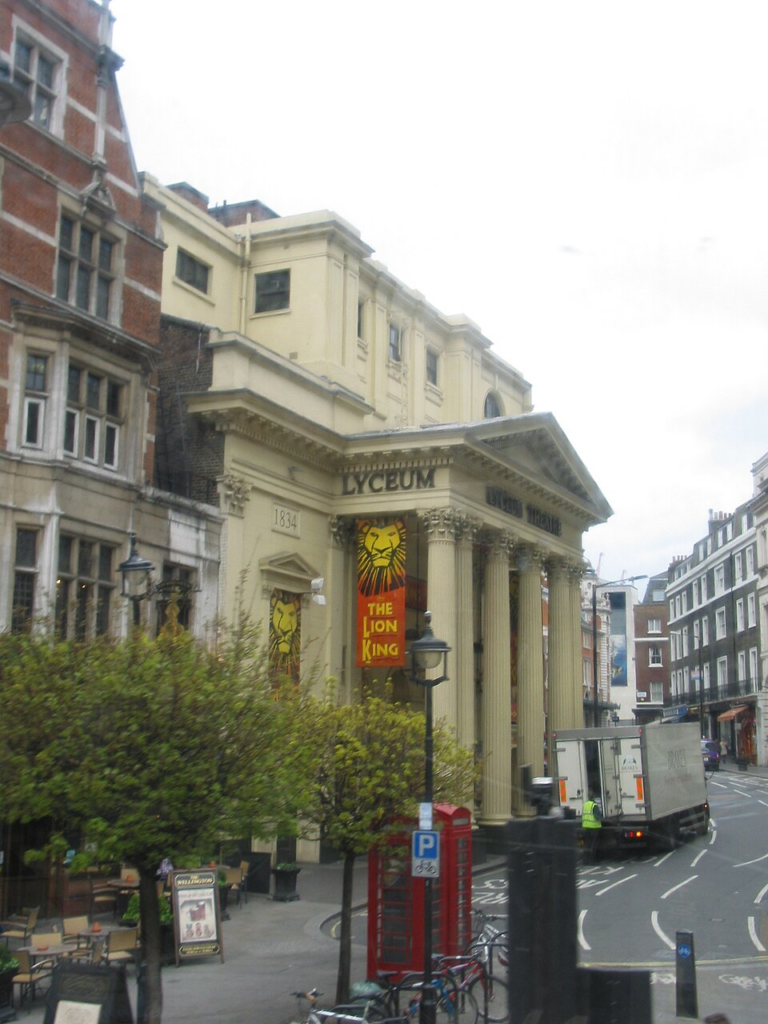
(Image: The Lyceum Theatre, London. Wikimedia Commons.)