Eurostar, National Rail, the Underground, London Buses, Black Cabs, and the Practical Business of Getting to the Theatre
BY: KELSEY MAURINE BRICKL
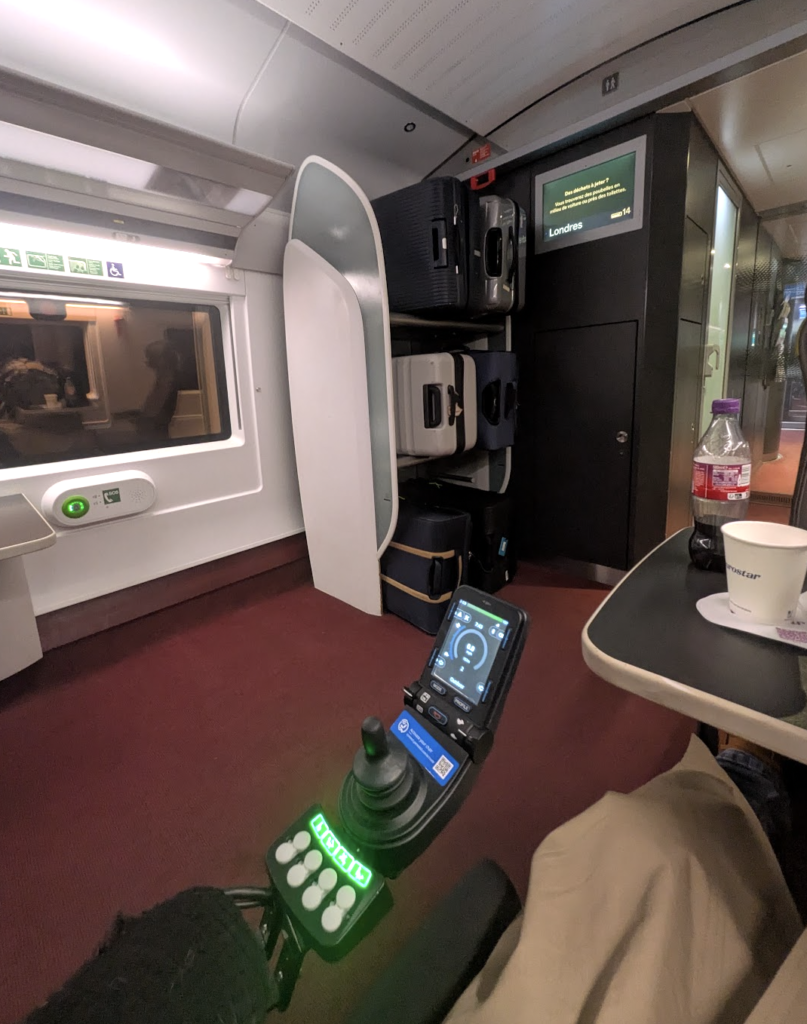
Image: The author in her Permobil M3 Corpus wheelchair while traveling on the Paris <-> London Eurostar in December 2025.
London’s West End is one of the world’s great theatrical districts. For Disabled visitors using complex power wheelchairs, however, reaching a performance can require almost as much planning as the journey to London itself.
A visitor arriving from Paris on Eurostar, Birmingham on National Rail, or another part of London on public transport encounters very different levels of accessibility. Some services are remarkably good. Others remain frustratingly unreliable, particularly for people using large, medically necessary power wheelchairs such as the Permobil Corpus or Quantum Rehab models.
The important questions concern boarding geometry, lift availability, wheelchair-space dimensions, reliable assistance, and whether an accessible return journey will still exist when the curtain falls at 10:30 p.m.
Eurostar: One of the Better Ways to Arrive
For visitors traveling from continental Europe, Eurostar is an excellent option. Its London services arrive at St Pancras International, with direct connections from Paris Gare du Nord, Brussels-Midi/Zuid, Lille Europe, Rotterdam Centraal, and Amsterdam Centraal.
Book a designated wheelchair space in advance. I recommend booking online directly with Eurostar and identifying your wheelchair requirements during the reservation process. Check the permitted wheelchair dimensions and weight, particularly if your chair is a Group 3 complex rehabilitation device. A chair weighing several hundred pounds cannot simply be folded and placed in a luggage rack.
Arrive early and report to the designated assistance point. Staff can coordinate boarding, bring the appropriate ramp, and assist you onto the train. Confirm the assistance arrangements for both ends of the journey.
Eurostar’s trains have designated wheelchair accommodation and accessible onboard toilets. They are climate-controlled, and I have found the food service quite good, with useful awareness of food allergies. Nevertheless, travelers with severe allergies should verify ingredients and cross-contact arrangements directly rather than assuming any onboard meal is safe.
Rail travel also has an important advantage over flying: you can generally remain in your own wheelchair throughout the journey.
Allow for disruption. Extreme weather, infrastructure failures, industrial action, and operational problems can cause delays or cancellations. Avoid planning an expensive, nonrefundable West End performance immediately after your scheduled arrival, particularly if you have a long international journey.
Arriving From Elsewhere in Britain
National Rail connects London with cities including Birmingham, Manchester, Liverpool, Bristol, Cardiff, York, Edinburgh, and Glasgow. Depending on the route, trains arrive at Euston, King’s Cross, Paddington, Waterloo, Victoria, or other major London terminals.
Book Passenger Assist through the National Rail system or your train operator, ideally as early as possible. Confirm that the booked wheelchair space accommodates your actual chair, including its length, width, weight, and turning requirements.
Ask whether the train requires a boarding ramp, whether staff will be available at both stations, and where you should wait for assistance. Some older trains and station platforms have substantial vertical or horizontal gaps.
Although assistance can be requested without advance booking, I strongly recommend arranging it ahead of time for complex wheelchair users. Keep the confirmation accessible on your phone.
Crucially, arriving at a major London railway terminus does not mean that the Underground journey onward will be accessible.
The Underground: London’s Most Serious Transport Obstacle
London’s Underground is an extraordinary engineering achievement, but much of it was constructed long before modern accessibility standards.
For people using large complex power wheelchairs, much of the network remains effectively inaccessible. Step-free stations are scattered unevenly across lines, interchange routes may require additional lifts, and an elevator that works when you plan your journey may be out of service when you arrive.
Even where lifts exist, boarding can present dangerous problems. The famous instruction to Mind the Gap has considerable physical significance when a wheelchair has small front casters, limited ground clearance, or a long wheelbase. Platform curvature, horizontal gaps, and changes in height can create a real risk of becoming stuck.
Some stations and services provide boarding ramps, but compatibility must be established before relying on them.
Crowding compounds the problem. During peak periods, maneuvering a large chair can become difficult or unsafe, and some Underground trains become exceptionally hot during summer. Heat is a medical accessibility issue for many Disabled travelers.
Use Transport for London’s step-free journey planner and live lift-status information, and verify the entire journey, including interchanges and the destination exit. The Elizabeth line and certain newer or upgraded stations can offer substantially better options, but they still require route-specific checks.
For many complex power-wheelchair users, I recommend avoiding the Underground for the final journey to a West End theatre unless the entire route has been individually verified.
London Buses: Accessible in Design, Unreliable in Practice
London’s buses are designed to accommodate wheelchair users, with low floors, boarding ramps, and a designated wheelchair space.
Unfortunately, there is generally only one wheelchair space per bus.
Parents with pushchairs or buggies frequently occupy that space, and some refuse to move when a wheelchair user needs it. The consequences are particularly serious for people who cannot stand, transfer, or safely occupy another part of the vehicle.
The Supreme Court’s 2017 decision in FirstGroup plc v Paulley established that drivers cannot necessarily satisfy their obligations simply by making a polite request and accepting a refusal. Where reasonable, further steps must be taken to encourage a non-wheelchair user to vacate the space.
The ruling did not, however, give bus drivers a general power to physically remove passengers or guarantee that the space will become available.
The result remains an unacceptable operational vulnerability: a wheelchair user can wait for an accessible bus, watch it arrive, and still be unable to board.
Allow extra time, especially before performances. Where possible, choose routes with frequent service and avoid making the final bus of the evening your only workable option.
Black Cabs: London’s Most Important Accessible Transport Resource
London’s famous Black Cabs are among the city’s greatest practical assets for wheelchair users. All licensed London taxis must be wheelchair accessible, with ramps and wheelchair accommodation. Drivers also undertake the demanding geographical training known as The Knowledge, which is particularly valuable when navigating the West End’s confusing streets.
However, wheelchair-accessible does not automatically mean compatible with every complex power wheelchair. Check the ramp capacity, door opening, interior headroom, turning space, and securement arrangements before relying on a particular vehicle. Some large chairs will exceed a taxi’s usable dimensions.
Black Cabs are generally easy to find in central London during ordinary hours. After West End performances, however, availability can deteriorate substantially as thousands of theatregoers leave simultaneously.
I recommend arranging your return transportation before entering the theatre, using a licensed taxi-booking service where possible. Allow time for boarding and wheelchair securement, and identify a suitable pickup location away from crowded theatre entrances.
The financial burden is considerable. Black Cabs cost substantially more than buses or the Underground, meaning that Disabled visitors may pay significantly more simply to reach the same performance.
Autonomous Vehicles Threaten an Already Fragile System
London’s forthcoming expansion of autonomous taxis raises another serious accessibility concern.
Companies including Waymo are pursuing entry into London’s passenger-transport market. Yet vehicles in existing autonomous fleets frequently cannot accommodate people who must remain seated in large complex power wheelchairs.
The concern extends beyond whether an individual Disabled passenger can book a robotaxi. If inaccessible autonomous fleets capture profitable journeys while traditional wheelchair-accessible taxi services lose drivers, passengers, or commercial viability, the existing transport system could become even less reliable.
London authorities have already acknowledged the importance of sustaining Black Cab driver numbers and the disproportionate consequences of decline for Disabled passengers.
Any autonomous-vehicle expansion must therefore be assessed against its effects on actual wheelchair-accessible transport capacity, including compatibility with complex rehabilitation equipment, waiting times, geographic coverage, and late-night availability.
Getting to the Theatre and Home Again
Before purchasing tickets, identify the theatre’s accessible entrance, wheelchair-position dimensions, companion seating, and any restrictions involving larger power wheelchairs. Ask whether accessible entry requires staff assistance or a separate entrance, and confirm that the designated position accommodates your chair without requiring unsafe transfers.
Research the route from your arrival station or hotel to the theatre. Remember that London’s historic pavements, kerbs, construction works, and crowded streets may complicate even a relatively short journey.
Most importantly, plan the return trip. A wheelchair user who can reach a theatre at 7 p.m. must also be able to leave it safely at 10:30 p.m.
London’s West End offers extraordinary cultural experiences, and complex power-wheelchair users belong in its audiences. Eurostar, National Rail assistance, selected step-free routes, and London’s Black Cabs provide workable ways to get there. Nevertheless, each requires careful verification, particularly when the wheelchair is medically necessary, heavy, and impossible to substitute.
Theatre access begins long before the auditorium doors open. It begins with the practical ability to reach them, enjoy the performance, and return safely afterward.