By: Kelsey Maurine Brickl
The wildly talented Tony Award winner Ali Stroker will join The 25th Annual Putnam County Spelling Bee at New World Stages beginning September 7.
Her casting arrives at an interesting moment for Ghost Light Access. I have spent the past several months professionally examining something Broadway rarely discusses plainly: what happens once a Disabled professional leaves the auditorium and enters the workplace.
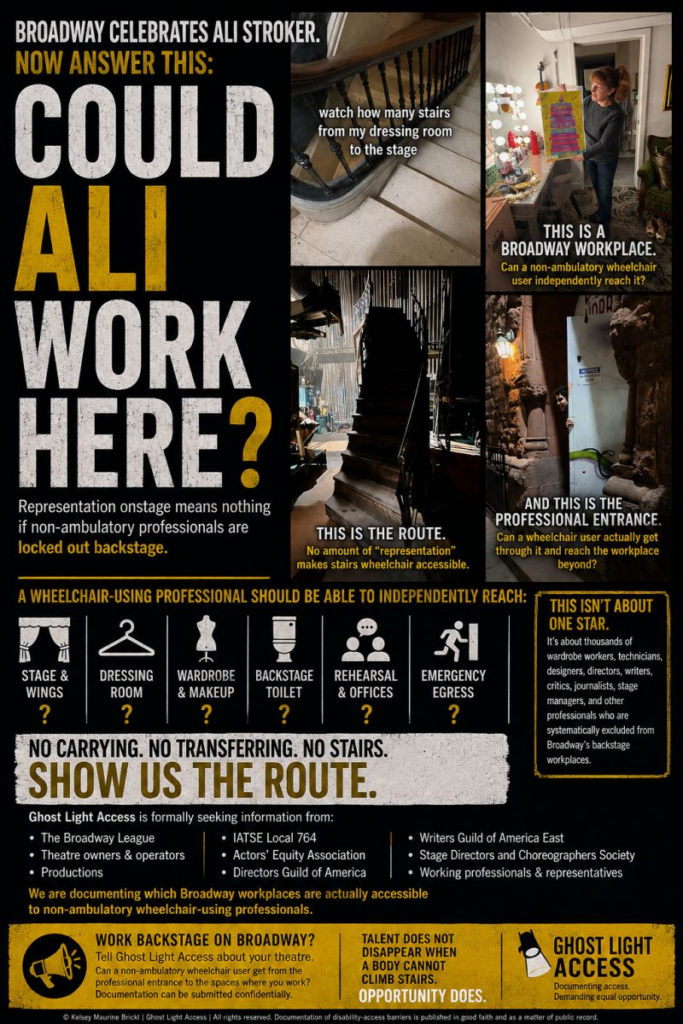
Backstage Broadway is full of stairs. Actors post dressing-room tours showing them. Wardrobe professionals move through vertically divided spaces every day. Stage doors, dressing rooms, wardrobe departments, toilets, offices, wings, rehearsal rooms and production spaces are often separated by steps, narrow passages, or routes that simply do not work for someone who cannot walk, transfer, or be carried.
On August 24, I published “Broadway’s Backstage Is Still Closed to Non-Ambulatory Wheelchair Users.” I have now reached out directly to theatre ownership and management regarding their backstage areas and have asked the Broadway League whether it knows which Broadway theatres provide continuous step-free professional routes. I have asked IATSE Local 764 what happens when a qualified wardrobe worker cannot reach the wardrobe room or backstage toilet. I have asked Shubert for a professional accessibility site assessment. I have asked New World Stages how its backstage infrastructure works for a non-ambulatory wheelchair-using performer, and I contacted Ms. Stroker’s representatives separately because I do not intend to conflate her experience as a Disabled performer with what I hear back from building operators or make unfair inferences.
Broadway has become comfortable talking about Disabled representation. It has been much less willing to discuss whether Disabled people can actually get to work.
A theatre can sell wheelchair-accessible seats while its dressing rooms remain upstairs. It can have an accessible lobby while wardrobe is unreachable. It can cast a Disabled performer while other wheelchair-using professionals remain physically excluded from the ordinary backstage life of the production.
Backstage is where people work, but it is also where people meet, talk, conduct interviews, build relationships, and become part of the professional community. Physical exclusion from those rooms is professional exclusion.
Too often, Broadway has hidden behind excuses to exclude Disabled audiences and professionals or used token representation of Disabled people while still almost entirely excluding non-ambulatory people. Ali Stroker’s engagement gives Broadway a chance to show what a workable backstage environment looks like for a non-ambulatory wheelchair user.
I hope New World Stages lets Ghost Light Access document it. Then I intend to keep asking about the rest. There are 41 Broadway theatres. We can look at the buildings one by one.