By: Kelsey Maurine Brickl
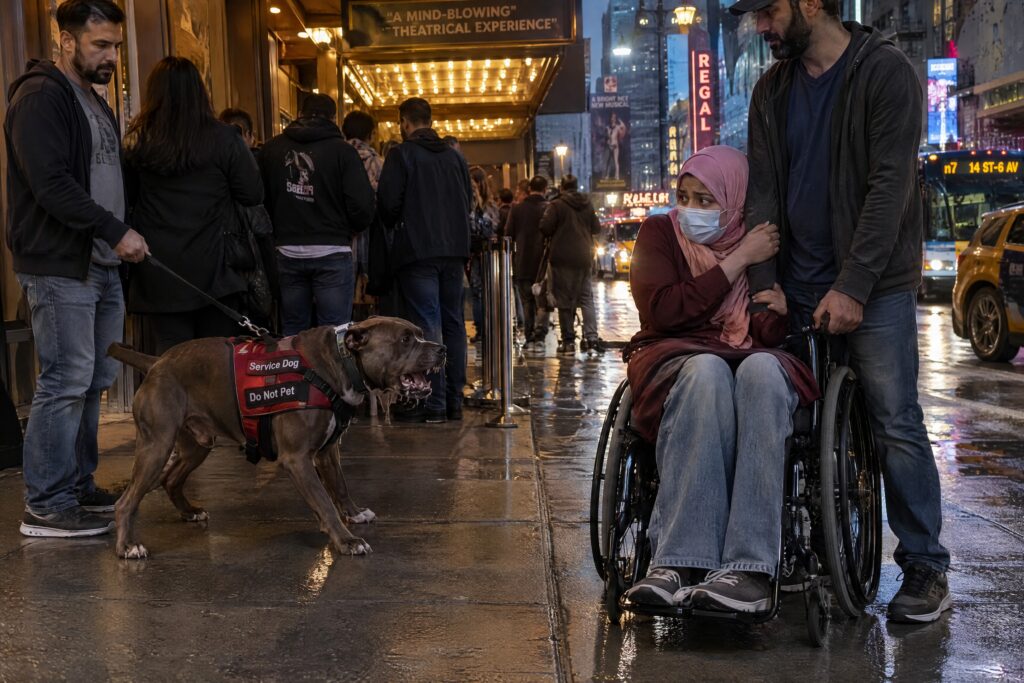
September is Service Dog Month, which makes it a particularly appropriate time to examine and interrogate an American legal policy that has acquired a peculiar immunity from serious criticism.
Under the Americans with Disabilities Act, a service animal is a dog individually trained to perform work or tasks related to a person’s disability. The Department of Justice does not require professional training, certification, identification, or a standardized public-access examination. A Disabled person may train the dog personally. When the animal’s function is not obvious, a business generally may ask only whether the dog is required because of a disability and what work or task it has been trained to perform. The business may not demand training records, certification, or a demonstration of the task.
I believe this American service-animal policy, unusually permissive among comparable regulatory systems, is overdue for wholesale replacement.
Ghost Light Access supports mandatory national training standards and licensure for service animals in the United States. GLA also rejects any legal hierarchy under which the accommodation of a service-dog handler automatically supersedes another Disabled person’s equally legitimate disability involving serious allergy, dog-related trauma, or disabling phobia, including phobias associated with autism or obsessive-compulsive disorder.
Where compulsory canine proximity creates a genuine conflict with protected religious exercise, Ghost Light Access’s policy position is that federal law should protect religious liberty rather than make violation of a sincere religious obligation the price of employment or access.
None of these positions requires denying the obvious medical value of a properly trained guide dog, even as technology advances to replace some functions historically performed by service animals. A blind person navigating a street with a guide dog provides perhaps the clearest example of an animal performing specific compensatory work. A mobility-assistance dog can retrieve an object, open a door, operate a switch, or assist its handler with another physical task. A hearing dog can alert its handler to a sound the person cannot hear.
There is another practice the United States should stop protecting under the euphemism of “mobility assistance”: using a dog’s body as mobility equipment. Dogs are made to brace human weight, provide counterbalance, assist momentum, and pull wheelchairs. Even guidance produced within the mobility-dog community warns about the force and torque transmitted through the animal, restricts bracing to limited pressure, cautions against pulling a dog off balance, and states that a dog should never replace a cane, crutch, walker, or other durable medical equipment. Once we are calculating how much human weight may safely be transmitted through a dog’s skeleton, we have already crossed a line that should never have been negotiable. A dog is not a walker, transfer bar, counterweight, power-assist wheel, or piece of adaptive exercise equipment. Disability does not confer an ethical exemption allowing a human being to use another vertebrate animal’s joints, spine, muscles, tendons, and ligaments as load-bearing medical hardware. That is animal abuse.
I have also encountered the ugly internal ableism beneath some defenses of this practice: Disabled people openly saying they would rather use a service dog than use a walker or wheelchair. That preference does not become ethically respectable because it comes from a Disabled person. Walkers and wheelchairs exist. Power-assist systems exist. Modern power wheelchairs can provide positioning, elevation, tilt, recline, complex seating, and powered mobility without asking a living animal to absorb the mechanical demands of another body. Technology has already rendered many historical service-animal functions unnecessary, and that category will continue to shrink. If somebody would rather place weight and repetitive mechanical stress on a dog because using a wheelchair or walker feels more stigmatizing, the problem is ableism, not an unmet technological need. Society should be attacking the stigma attached to mobility equipment instead of granting extraordinary legal protection to practices that make an animal pay physically for a human being’s refusal to use it.
The United States has somehow allowed recognition of the few legitimate functions for service animals to become legally entangled with the logically fallacious proposition that objective regulation of the animals would itself offend the entire umbrella disability rights. Other developed countries have reasonably managed to avoid this confusion.
Japan’s Ministry of Health, Labour and Welfare recognizes three statutory categories under its Assistance Dogs for Physically Disabled Persons Act: guide dogs, mobility-assistance dogs, and hearing dogs. These animals are trained and certified under Japanese law and carry prescribed identification. Users carry certification documents, and businesses may verify them. The Ministry describes guide dogs as assisting visually impaired people with safe travel, mobility dogs as performing concrete physical tasks such as retrieving objects and opening doors, and hearing dogs as identifying important sounds and leading their handlers toward the source.
South Korea likewise attaches public-access protection to a recognizable regulatory system. Article 40 of its Disability Welfare Act authorizes the Minister of Health and Welfare to issue an official assistance-dog identification mark and to designate professional training institutions. The statute prohibits unjustified refusal of access to public transportation, public places, lodging establishments, restaurants, and similar spaces when a Disabled person is accompanied by an assistance dog bearing that identification.
France protects legitimate guide and assistance dogs strongly. Article 88 of the Law of July 30, 1987 gives qualifying guide and assistance dogs access to transportation and places open to the public and prohibits additional charges associated with their presence. France also regulates organizations that educate these dogs through a formal state labeling system.
These countries have properly regulated assistance dogs without abolishing them. Dubai provides a narrower comparison. Its 2026 public-transport regulation generally prohibits animals on public transportation and in public-transport facilities, with an express exception for guide dogs accompanying blind people. American assumptions about canine access are plainly not universal legal principles.
Scientific evidence also counsels against treating every claimed service-dog function as though it were empirically interchangeable.
The Department of Justice itself gives seizure detection and blood-glucose alerts as examples of possible service-dog tasks. Yet the medical literature concerning those functions is often messy or skeptical and certainly does not establish that dogs are uniformly as reliable as available medical technology.
A University of Virginia study led by Linda Gonder-Frederick compared diabetes-alert-dog behavior with continuous glucose-monitor readings. During waking hours, the dogs demonstrated sensitivity of 35.9 percent for low-blood-glucose events and 26.2 percent for high events. Only three of fourteen dogs performed statistically above chance. The authors concluded that most dogs in the study did not accurately detect high and low glucose events, although performance varied considerably among individual animals.
A review by Amélie Catala and colleagues concerning seizure-alert and seizure-response dogs found only five qualifying studies among twenty-eight peer-reviewed publications considered. Four relied upon self-reported questionnaires; only one was prospective. The authors concluded that the evidence remained too scarce and preliminary to establish definitive conclusions about reliable seizure prediction, the signals dogs detect, appropriate breeds, or optimal training methods.
The evidence concerning autism assistance dogs is similarly sobering. A 2025 systematic review and meta-analysis led by Melissa Mulraney found some possible benefits, but pooled effects were similar to those associated with ordinary companion dogs. The authors found a “lack of compelling evidence” that assistance dogs provide unique benefits to autistic people.
Consider, then, two autistic students in the same school. One family wants its child to bring a service dog. Another child has a disabling phobia of dogs and cannot safely tolerate canine proximity. Both children may qualify for federal disability protection, but current service-animal policy gives the dog a specific access entitlement while the dog-phobic student must rely upon more general accommodation law and whatever separation the school can arrange. The legal starting positions are unequal despite the shaky evidence supporting unique benefits from autism assistance dogs.
I consider that a grave disability injustice. Federal disability law should not begin a conflict between two qualifying Disabled people by giving one accommodation presumptive priority over the other.
None of these findings establishes that an individual dog cannot perform useful work. They establish ample reason for requiring evidence before government attaches extraordinary public-access rights to an animal.
The other people sharing those public spaces have bodies, too.
Dog allergy is an immunological phenomenon involving identifiable proteins found in dander, saliva, urine, and serum. All breeds produce allergenic proteins. I am severely allergic to dog saliva. A dog licking my hand, or leaving saliva on something I subsequently touch, exposes me to an allergen. The fact that the dog performs disability-related work for somebody else does nothing to alter the protein involved or my immune system’s response to it.
The Department of Justice recognizes that service-dog access can conflict with another person’s dog allergy. Its guidance recommends accommodating both Disabled people through measures such as physical separation and recognizes that particular areas may appropriately be reserved for people with dog allergies. Federal law therefore already acknowledges the physical premise of the conflict.
I have already put the larger problem directly before the United States Department of Transportation. Earlier this year, I asked DOT to change its Air Carrier Access Act service-animal rules and adopt mandatory accreditation and centralized handler registries. On March 26, the Department’s Office of General Counsel responded in writing. DOT expressly described my family’s experience as involving “competing disabilities when service dogs are present on aircraft.” It also confirmed that passengers presently self-attest to required information on DOT forms, while airlines may observe an animal and may contact the listed trainer or veterinarian.
DOT then told me that the systemic changes I proposed “can only be accomplished through a rulemaking process.”
Fine. Then conduct rulemaking, DOT. Do it. Now. You’re on notice: do your job.
I wrote back that a system materially advantaging one category of disability accommodation through a low-verification process while leaving passengers with conflicting respiratory, immunological, neurological, trauma-related, or other disabilities to absorb the consequences constitutes an asymmetrical allocation of risk. I asked DOT to identify the mechanism by which such passengers can obtain meaningful protection before exposure occurs.
The problem is no longer hypothetical even at the federal administrative level. DOT has acknowledged competing disabilities, described its self-attestation system, and identified rulemaking as the mechanism required for the accreditation reform I proposed.
Trauma deserves the same intellectual seriousness. A 2024 review of fifty eligible publications concerning psychological consequences of dog bites in children found PTSD among the recurring outcomes, alongside nightmares, flashbacks, anxiety, social withdrawal, and persistent psychological distress. A systematic review of pediatric dog-bite injuries likewise recognizes long-term psychological consequences alongside physical injury.
I have written elsewhere about another historical source of canine trauma. Nazi personnel deliberately used dogs to terrorize concentration-camp prisoners. Survivors described barking during arrival, dogs being ordered to attack prisoners, severe bites, permanent scars, and the incorporation of dogs into the ordinary machinery of camp terror. Someone carrying trauma associated with dogs does not acquire a less legitimate disability because another Disabled person arrives with a dog.
Ghost Light Access has already applied the same principle in theatres. Severe dog allergies, PTSD following attacks, neurological conditions, and respiratory or immunological disorders remain disabilities when an assistance dog enters the building. Reasonable adjustments can involve seating, distance, altered routes, staggered arrival times, different waiting spaces, or other concrete arrangements.
Several theatres where I have upcoming attendances planned are on explicit notice regarding the necessary absence of third-party security dogs during my attendance and equal access regarding service animals even under current, deeply flawed American disability law. They’ve confirmed their compliance in writing.
Religious conflicts require equal precision. Islamic jurisprudence contains several positions concerning dogs, including rules involving canine saliva and ritual impurity. The Islamic Religious Council of Singapore’s Office of the Mufti discusses these doctrines while recognizing necessary guide and assistance dogs for Disabled Muslims. Its guidance describes assistance dogs as permissible where disability creates genuine functional need.
The willingness of some religious authorities to accommodate necessary assistance dogs does not extinguish another person’s sincere religious obligation. Current American constitutional and employment law does not establish a categorical rule that the Establishment Clause overrides the ADA in every private service-animal dispute. Ghost Light Access proposes a clearer federal policy: genuine religious conflicts involving compulsory canine proximity should receive express legal protection rather than being subordinated automatically to service-animal access.
I’ve communicated with disability advocates, rideshare companies, theatres, museums, and other venues about conflicts between religious rights and service animals. I’ve talked with the Disabled people involved who invoke current ADA law and those who invoke religious liberty protections. My nuanced view on what needs to happen in the U.S. has come from hearing various perspectives and experiences, studying history and Constitutional law, and examining medical and international experts’ points of view.
A replacement federal system should require an independently verified service-animal license before extraordinary public-access rights attach to the dog. Training and testing should be required, with qualification including demonstrated disability-related task performance, temperament, control, public behavior, hygiene, and appropriate veterinary care. Certification should be nationally portable and subject to renewal. Serious aggression, soiling, repeated barking, or other substantiated dangerous or antisocial behavior should trigger formal review, with restrictions or license revocation available where required.
No one should be able to simply state they are a doctor and then begin conducting surgery. No one should be able to get behind the wheel of a commercial truck and operate it without the appropriate training and license. No one should be able to captain a cruise ship after waking up one day and feeling like it. In fact, our society doesn’t allow these things. Yet a person who believes a dog will help them with their anxiety and POTS is permitted, in the United States, to adopt any dog they want from a shelter, take the dog home, train the dog themselves until they think it’s doing helpful tasks, and then demand it be granted full public access.
This needs to change immediately and permanently.
The government should subsidize assessment for Disabled people who cannot afford it. Charities should continue providing dogs and training to those who genuinely qualify. Certification need not become a $30,000 entrance fee payable to private training organizations. Japan already demonstrates that governmental assistance and regulation can coexist. Guide dog charities and similar exist in countries with staunch regulation.
Licensure would establish whether a particular animal has earned the exceptional legal status claimed for it. That status would carry strong access protection without placing the animal above every Disabled or religious person it encounters and before the health and safety of the general public.
Countries like Spain, Singapore, Austria, Japan, South Korea, New Zealand, France, and others demonstrate that disability access survives tight regulation perfectly well. The medical literature gives no respectable basis for pretending every claimed canine intervention rests upon equivalent evidence. My immune system does not recognize a service-dog vest purchased on Amazon and placed on an owner-trained pit bull. Neither does PTSD. Neither does religious liberty.
Ghost Light Access therefore supports immediate federal replacement of the present American service-animal policy with mandatory qualification, independent assessment, national licensure, enforceable behavioral standards, and explicit protection for competing disabilities and genuine religious conflicts.
DOT has already told me what changing one part of this system requires: rulemaking. The appropriate response is to begin making rules and enforcing them now.