By Kelsey Maurine Brickl
Those of us who work in disability-rights compliance spend a great deal of time identifying failures. We document inaccessible procedures, explain the foreseeable consequences, cite the governing law, and ask institutions to correct problems that should have been addressed before a Disabled patron encountered them.
That work is not just important for Disabled people to be able to access theatre as patrons and professionals — it’s necessary. But it’s equally important to record what happens when a theatre receives a serious accessibility concern, responds with care, and makes a meaningful correction. MCC Theater deserves recognition for doing precisely that.
Recently, MCC introduced Yondr pouches for the first time during its production of Birthright. The theatre’s published phone-free policy explained that patrons would be required to secure their phones inside the pouches, but it did not identify any exception or procedure for Disabled patrons who need continuing access to smartphones or connected devices.
Ghost Light Access has clarified professionally in numerous contexts that for many Disabled people, a phone is not simply a source of entertainment or a means of recording a performance. It may function as assistive technology, a communication device, medical or monitoring equipment, an emergency resource, or a necessary means of coordinating with caregivers and family members. A blanket phone restriction that does not publish its disability-access procedure leaves patrons without the information required to plan safely and independently.
Therefore, my formal notice to MCC therefore requested correction of both the public language and the underlying operational policy. Fortunately, MCC’s response was prompt, substantive, and constructive.
The theatre’s Executive Director explained that the theatre had already established an in-person accommodation procedure from the first performance of Birthright and that patrons who needed access to their phones could receive a wristband identifying the accommodation to Front of House staff. They would not be required to place their devices inside Yondr pouches and could retain access throughout the performance. However, MCC also acknowledged the central problem raised in my notice: the accommodation procedure existed inside the building, but the public had not been told about it.
That omission carried practical consequences, because Disabled patrons should not have to purchase a ticket, travel to the theatre, enter a crowded lobby, and disclose an urgent medical or communication need before learning whether an accommodation exists while being subject to the evaluation of a staff member. Advance public accessibility information allows people to evaluate arrangements before purchasing a ticket, coordinate transportation and care for themselves and dependents, prepare necessary medical and mobility equipment, and arrive knowing that staff have been given a procedure they can follow.
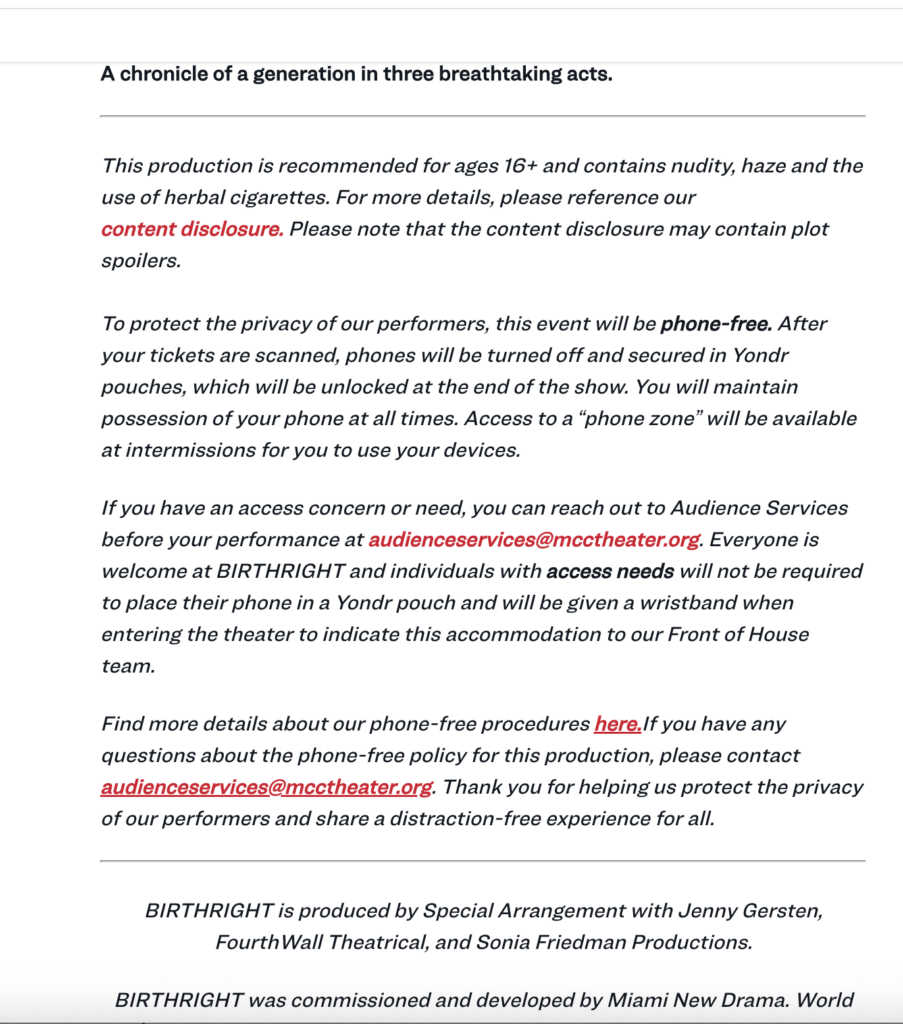
After reviewing the issue, MCC Theater in NYC added specific language to its website and pre-show communications, which you can see in the image above. Patrons are now informed that anyone with an access concern may contact Audience Services before the performance, that individuals with access needs will not be required to place their phones inside Yondr pouches, and that a wristband will identify the accommodation to Front of House staff. MCC also committed to incorporating this information into lobby signage.
The theatre did not restrict its response to one paragraph on one production page. MCC informed me that it had also engaged Access Broadway NY and had begun an audit of its accessibility policies, practices, communications, and equipment. It stated that additional corrections identified through that work would be implemented either during the audit or upon its completion.
That wider comprehensive accessibility review is especially encouraging because accessibility failures often occur in the space between a procedure and the communication of that procedure: between management and Front of House, between the website and the box office, or between a policy drafted in general terms and the Disabled person who must rely upon it in a real building. MCC recognized that the phone-policy concern offered an opportunity to examine those connections throughout the organization.
Broadway and West End theatres should receive public credit when mistakes are brought to their attention and they correct them properly. Praise does not erase the original problem, and accountability does not require treating every institutional error as permanent. A theatre that responds defensively, obscures its procedures, or leaves Disabled patrons to negotiate informally with individual employees has not resolved the concern. A theatre that publishes the accommodation, briefs its staff, creates a recognizable operational system, and examines whether similar gaps exist elsewhere has taken responsibility for making access more dependable.
MCC’s response was professional, respectful, and proportionate to the concern raised. Its leadership did not dismiss the issue as a personal request or reduce it to an isolated customer-service matter. The theatre explained the existing procedure, acknowledged that the information had not been sufficiently visible, corrected its communications, and invited qualified outside examination of its broader practices.
Theatre accessibility improves when Disabled patrons can report problems without being treated as adversaries and when institutional leaders are prepared to regard those reports as useful professional information. MCC demonstrated that a formal accessibility correction can lead to a practical result without hostility, evasion, or delay.
The original policy language required correction. MCC corrected it, made the accommodation visible to future patrons, and began looking beyond the immediate complaint. That response deserves both appreciation and a place in the formal record.
Image credit: MCC Theater (Manhattan Class Company), https://mcctheater.org/tix/birthright/