By Kelsey Maurine Brickl
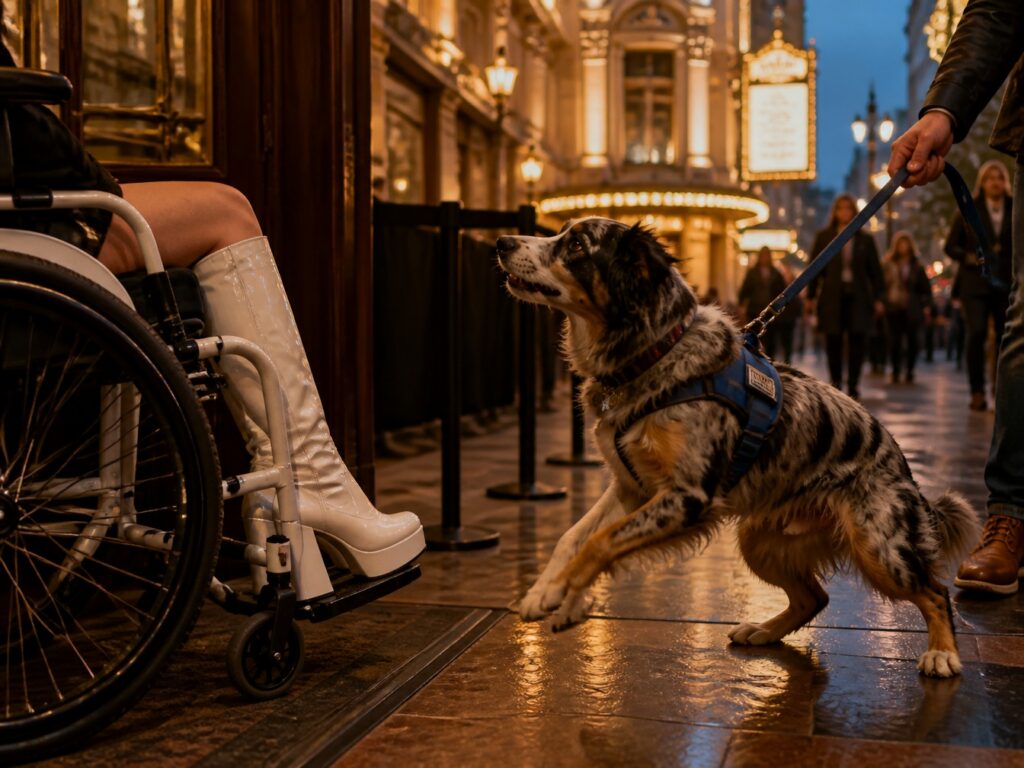
Spend enough time around accessibility discussions and eventually someone will announce that “it’s a working dog,” as though that ends the conversation.
It doesn’t. In fact, that is often the beginning of the accessibility conversation.
One of the more persistent misunderstandings in British theatre is the assumption that every dog entering a venue occupies the same legal position. Under UK law, that simply is not true. A necessary guide dog accompanying a blind patron and has protected access rights. A Metropolitan Police explosives detection dog is granted access to protect the public. A security dog handled by a third-party security contractor is allowed in by the theatre. And all these dogs may all be working, highly trained, and entirely appropriate in the right circumstances. They are not, however, the same thing.
Understanding and acknowledging this fully is crucial because the Equality Act 2010 does not stop applying simply because a dog is present.
An assistance dog accompanies a Disabled person because the dog performs work directly connected to that person’s disability. The purpose of the dog is accessibility. For many people, the assistance dog is what makes equal participation possible in the first place.
A police dog is different. Its authority arises from policing powers and public safety responsibilities. Likewise, a privately deployed security dog accompanies a commercial security operation because a venue has chosen to use that method of security. The dog is present because of an operational decision made by the theatre, not because another Disabled person requires that animal to access the performance.
Those established differences must be understood because they determine the legal questions that follow.
The Equality Act 2010 requires theatres to consider reasonable adjustments for Disabled patrons. Nearly everyone, from theatre owners and front of house staff to ushers and fellow patrons, understand and accept that there should be and are some accommodations for Disabled people in theatres in London. But most people immediately think of wheelchair users, those with vision and hearing impairments, or assistance dog handlers. In reality, the legislation is broader than that.
Some Disabled people live with medically documented dog allergies that can become life-threatening. Some have PTSD following serious dog attacks. Some have neurological conditions that make an uncontrolled animal profoundly destabilising. Others have respiratory or immunological conditions for which close proximity to a dog presents genuine medical consequences rather than personal preference.
Those disabilities are very real and do not disappear because another dog is working. Equally, the existence of those disabilities does not automatically exclude an assistance dog or require a theatre to abandon legitimate security arrangements.
The law is more nuanced and thoughtful than that.
The question becomes what reasonable adjustments are available in the circumstances. Can a dog without legally protected access be removed entirely? Can greater distance be maintained while acknowledging that a person may still suffer an allergic reaction or traumatic response? Can purchased and assigned seating be altered? Can routes into the auditorium be changed? Can arrival times be staggered? Can an alternative waiting area be used? Can the operational objective still be achieved while reducing foreseeable risk to another Disabled patron?
Very often, the answers are a resounding yes, and those are precisely the kinds of questions theatres should already know how to answer before patrons arrive.
Another misconception deserves retiring, because there is no category of dog that is somehow exempt from the expectation of professional control of its behavior.
Whether the dog is accompanying a blind patron, searching for explosives, or deployed by a private security contractor, it should remain under the effective control of its handler. Working dogs should not bark frequently, urinate on the ground or otherwise soil the environment, growl or menace, destroy property, make unnecessary physical contact, obstruct accessible routes, jump on members of the public, lunge toward mobility equipment, or create avoidable risks for patrons trying to enter or leave a venue. Good handling protects everyone involved, including the dog, and it is necessary.
Disabled patrons also have rights during these situations. Ghost Light Access seeks to ensure that all Disabled people, including those with severe allergies, a history of trauma, symptoms relating to dog phobia or neurodivergent intolerance of dogs, and assistance dogs handlers, are informed and empowered within the boundaries of UK law.
You are entitled to explain your access requirements. You are entitled to ask that the matter be treated as an accessibility issue rather than a customer-service complaint. You may ask to speak with the Access Host, Duty Manager, or House Manager. You may ask what category of dog is present, whether a dog without protected access will be removed for your protection and to protect your own access, whether reasonable adjustments are available to allow for your access and another Disabled patron’s (including between a protected assistance dog and another patron).
Those are ordinary operational questions. They should not be treated as confrontational simply because they involve disability. A hostile response to raising questions of disability access may qualify as victimisation under Section 27 of the Equality Act 2010 in certain circumstances.
If the issue cannot be resolved immediately, document what happened. Record the date, the time, the names of the staff involved if known, what adjustment you requested, and the response you received. Accessibility disputes are much easier to analyse when everyone is working from an accurate chronology rather than memory alone.
Sometimes, however, an accessibility discussion stops being just that.
If a dog is no longer under effective control, if crowd management creates an immediate danger, if you cannot leave safely, if you reasonably believe there is an imminent risk to your safety, or if you believe a criminal offence has occurred, you do not lose the ordinary rights that every member of the public possesses simply because you happen to be inside a theatre.
In an emergency, call 999. If the immediate danger has passed but you still believe a criminal matter should be reported, contact the police through 101 and file a formal report.
Calling the police is not a substitute for accessibility planning, nor is it a negotiating tactic. It is a recognition that some situations cease to be disagreements about reasonable adjustments and become questions of immediate public safety. Disabled people are not expected to remain in circumstances they reasonably believe are unsafe while waiting for an operational disagreement to resolve itself.
The encouraging news is that most of these situations should never reach that point. Ghost Light Access hopes that in the future, no situations will need to be escalated in this way.
Theatres already spend enormous amounts of time planning evacuations, security operations, medical incidents, audience flow, backstage movement, ticket sales, seating allocation, development of lighting/costuming/sound production, backstage logistics, and safeguarding of cast and crew. Accessibility deserves exactly the same degree of preparation.
The possibility that one Disabled person’s assistance dog or a third-party contracted security dog may intersect with another Disabled person’s medically documented allergy or trauma is neither bizarre nor unforeseeable. It is simply another operational scenario that competent management should anticipate and handle appropriately and respectfully when the issue is raised.
The best accessibility work is almost invisible. Patrons arrive, adjustments have already been considered, staff know who has authority to make decisions, and the performance begins without incident. That outcome is not luck. It is the product of planning, training, communication, and an understanding that accessibility is part of theatre operations rather than an inconvenience to be managed once the audience is already in the foyer.
Every theatre patron deserves a predictably accessible and safe experience. Knowing that not every dog in a West End theatre has equal legal status and how to handle that reality is helpful to ensuring this is the case.
Legal Citations & Statutory Reference
For the purpose of operational compliance, policy development, and dispute resolution, this document relies upon the following specific provisions of the Equality Act 2010:
- Definition of Disability (Section 6): Establishes that physical or mental impairments with a “substantial and long-term adverse effect” constitute a disability. This legally encompasses medically documented severe allergies, trauma/PTSD from dog attacks, and neurodivergent conditions alongside sensory or mobility impairments.
- The Duty to Make Reasonable Adjustments (Section 20): Imposes an anticipatory legal duty on service providers to alter provisions, criteria, practices, or physical features that place a Disabled person at a substantial disadvantage.
- Provision of Services (Section 29): Explicitly prohibits service providers from discriminating against, or subjecting to a detriment, any individual seeking to access or utilize a venue or performance.
- Protection Against Victimisation (Section 27): Strictly prohibits subjecting an individual to a detriment because they have raised an accessibility query, asserted their rights, or alleged a breach under the Act (defined as a “protected act”).
- Auxiliary Aids and Conflicting Duties (Section 20(5) & EHRC Statutory Code): While an assistance dog is recognized as an auxiliary aid, a service provider owes an equal, non-hierarchical duty to all Disabled patrons. Where access needs conflict, the venue must implement operational adjustments to accommodate both parties rather than arbitrarily prioritizing one over the other.