By: Kelsey Maurine Brickl
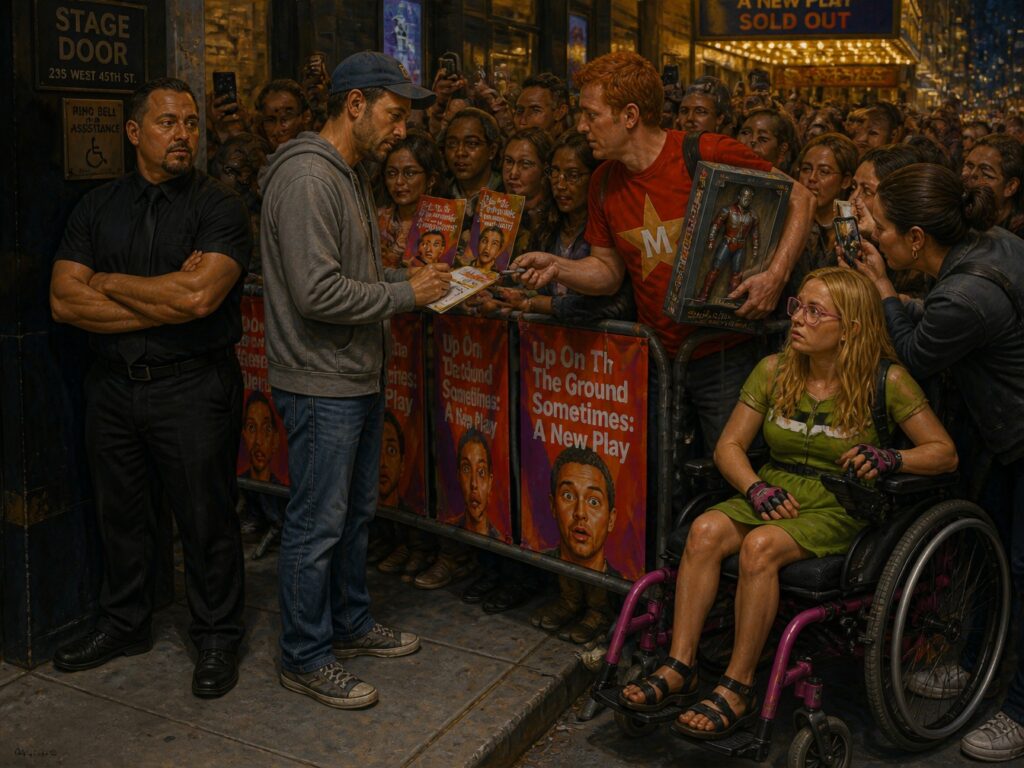
Stage doors are not part of the ticketed experience, but if they occur, they must be safe and equitable. This is especially true for performers and for Disabled patrons.
That has become one of the central principles and operating theses of Ghost Light Access because it names the actual operational problem of what happens after the show. A stage door may look informal from the outside. People gather after a performance. Programs and phones come out. People are excited. Someone hopes for an autograph, a photograph, a smile, a brief exchange, a piece of public warmth to carry home.
The theatre industry knows the scene well enough to predict it. The exit is known. The pavement is known. The barriers, if any, are known. Some productions even have custom covers made for their barricades, demonstrating a certain level of formality involved with the stage door experience, and many engage third-party security firms to manage the predictable crowds gathering outside on public sidewalks.
The likely pressure points are known. The popularity of the production, the visibility of the cast, the size of the theatre, the weather, the width of the pavement, the proximity of traffic, and the online attention surrounding a performer all shape the physical risk before anyone has reached the door.
A stage door crowd is not a mysterious phenomenon. It is a recurring public-safety environment. There is, to use a legally significant term, foreseeability.
Ghost Light Access is disability-access work. It is also crowd-safety work. Those are not separate lanes when the built environment, the crowd pattern, and the management failures are the same. The physical conditions that place performers at risk often place Disabled patrons at risk at the same time, and often from very similar variables.
A flying elbow does not distinguish between an actor, a wheelchair user, a blind patron, a little person, an autistic teenager, a security guard, or a member of the public trying to pass along the pavement. A sudden surge toward a performer can likewise trap and endanger a wheelchair user. A crush of bodies that makes a performer difficult to reach safely can also make the dropped curb, doorway, lift route, or accessible exit impossible to use. A crowd pressing toward a signature can damage a custom prescription mobility device, block a trained Guide Dog for the Blind, separate a minor child from a parent, or leave an autistic patron in a state of distress and unable to retreat.
The same conditions generate the danger.
This becomes especially urgent when the stage-door crowd is not made up only of audience members leaving the performance. In large markets such as New York and London, stage doors can attract people who did not attend the show at all. Some are there for photographs. Some are there for social-media content. Some are there because proximity to a famous person has become its own competitive event. Some are there for autographs that will later be sold online.
Profit changes crowd behavior. A person trying to obtain multiple signatures for resale is not participating in a sentimental theatre tradition. They are pursuing inventory. The performer becomes part of a supply chain. The crowd becomes a marketplace. The pressure at the barrier increases because the physical object in the performer’s hand has financial value.
That incentive structure is dangerous for everyone standing nearby.
A reseller who thrusts items forward creates risk through movement, not motive. The shove, reach, bag swing, elbow, binder, marker, phone, or poster tube moves through shared space. A wheelchair user beside the barrier feels the same pressure. A blind or DeafBlind patron attempting to orient through the crowd loses navigable space. A security worker trying to hold the line absorbs the same force.
The performer moving down the barrier is expected to remain pleasant and gracious inside a physical environment already distorted by profit, while phones record their face, posture, fatigue, hesitation, and any imperfect reaction for later interpretation.
The finished image that circulates on social media from the stage door rarely shows the conditions that produced it. The photograph catches the smile, or perhaps the awkward candid non-smile, the signed program, the fan’s eager giggle or info-dump. It does not show the elbows, the bags, the shoving, the post-performance exhaustion and sweat, the phones held over other people’s heads, the wheelchair user trying to keep a joystick from being snapped off, the frightened service animal, or the security worker’s jaw tensing each time the performer moves closer to the barricade.
On opposite sides of the barriers, the concerns may be strikingly similar.
For a performer, the risks may appear as unwanted touching, blocked movement, pursuit after declining to stop, repeated filming at close range, attempts to extract emotional intimacy, anger when access is withheld, or the expectation that exhaustion must be disguised as gratitude. For a Disabled patron, the risks may appear as blocked egress, a damaged steering panel that takes months to repair, a cane knocked out from under an elder, an assistance dog crowded from its handler and unable to task, a colostomy bag jarred by a crowd, or a route rendered unusable by stubborn resellers who will not move.
The injuries are not identical. The conditions are shared.
A performer should not have to function as a security system. A Disabled patron should not have to function as an access department. A front-of-house employee should not have to invent a crowd plan at the curb.
Once a theatre permits a stage-door gathering, the institution has made a management choice. Physical planning should follow from that choice. Where will the crowd stand? How will the pavement remain passable? How will wheelchair users enter and leave without being pushed into the densest part of the crowd? How will blind and low-vision patrons navigate? Where will security be positioned? How will the performer reach transport without being followed? What happens if people who did not attend the show arrive with stacks of items? What happens if a crowd begins filming someone who is trying to leave? What happens if a Disabled patron needs urgent egress?
Those questions belong upstream, before the crowd forms, not after, not in response to problems. And, far too often, the burden lands on the people with the least ability to control the environment. The performer is left to decide whether stopping feels safe. The Disabled patron is left to decide whether participation is worth the risk. Security is left to respond to pressure already in motion. Staff are left explaining limitations that should have been designed around rather than discovered at the curb.
In my work with theatres, I have encountered strong existing protocols that allow performers to decide whether they will engage at the stage door after all performances, some performances, or none, and to set clear boundaries around physical contact, selfies, conversation, and what they will or will not autograph. I have also encountered strong existing protocols that proactively separate Disabled patrons from crowd-crush conditions, blocked routes, and egress risk.
I have also encountered weaker arrangements: performers expected to exit directly onto a public street into an inadequately controlled crowd, Disabled patrons told to locate third-party security only after a safety concern has already developed, and staff left to manage foreseeable crowd pressure without a durable plan.
Some theatres have been receptive to durable new policies that protect performers and Disabled patrons at the same time. Others have been slower to recognize the shared risk. For the sake of legally protected Disabled theatregoers and performers, including many union members, Ghost Light Access strongly encourages theatre owners and managers, legal teams, security companies, performers’ unions, agents, managers, and municipal authorities to support practical stage-door safety measures on Broadway and the West End.
If a production benefits from the public energy of a stage door, it inherits responsibility for the conditions attached to that energy. A theatre that knows crowds assemble outside a fixed exit after performances should treat that assembly as a foreseeable safety environment. Barriers should provide real protection rather than a visual suggestion of order. Disabled patrons’ routes, sight lines, turning radius, companion access, and emergency egress should be planned before the crowd arrives.
Performer protection and disability access strengthen each other when the system is designed properly. The show is the ticketed event. The stage door is conditional. Once a theatre permits that conditional environment to occur, safety cannot depend on charm, luck, or the physical courage of whoever happens to be nearest the barrier.
Performers and Disabled patrons are often put at risk by the same physical conditions at the stage door. A theatre that understands that fact can protect both without placing them in competition. A theatre that ignores it leaves both exposed to a crowd it already knew would come.