By: Kelsey Maurine Brickl
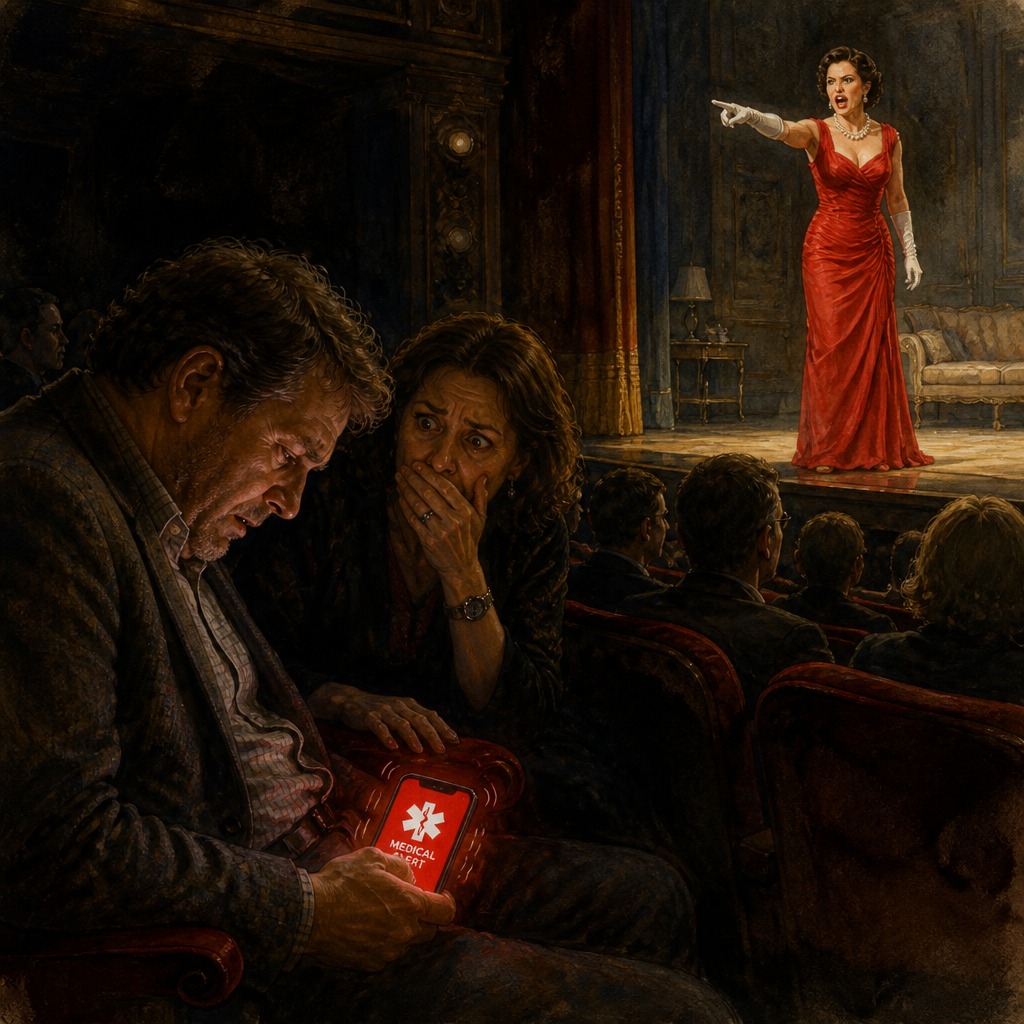
Content Warning: This post discusses medical emergencies, public shaming, trauma, sexual assault, and C-PTSD. The header image is an AI-generated artistic illustration created solely to represent the themes of this article. It is not a photograph and does not depict any real people, real events, or actual incidents.
All opinions expressed are those of the author. This post is for informational and advocacy purposes only and does not constitute legal, medical, or professional advice.
I want to be very clear at the outset of this post that Ghost Light Access takes phone use in theatres seriously. Casual phone use during live performance is distracting, rude, and unfair to performers, crews, front-of-house staff, and fellow patrons. Taking photographs, filming, texting, making calls, taking calls, scrolling, checking notifications, or treating a theatre seat as private domestic space violates the basic compact of live performance. It can also raise serious legal issues around recording, copyright, production design, performance rights, and intellectual property. Therefore, Ghost Light Access does not defend, excuse, or support casual phone use in theatres.
Theatre depends on concentration. Actors must sustain a shared imaginary world under lights, pressure, fatigue, repetition, illness, grief, technical risk, and the constant possibility of live interruption. Audiences enter that arrangement with obligations of their own. A ringing phone, a lit screen, a camera held up during a scene, or a person answering a call in the auditorium can rupture the room for everyone. That isn’t fair, and the reality of that rupture should always be acknowledged with full accountability taken regardless of the circumstances.
Every theatre should have a strong phone policy. Every theatre should make clear pre-show announcements. Front-of-house staff should be trained to intervene when intervention is necessary. Patrons should know before the show begins that photography, filming, calls, alerts, casual texting, and screen use are prohibited during performance except in genuine emergency circumstances.
The problem begins when enforcement leaves staff procedure, nuance is entirely abandoned, and public anger and fluster by performers becomes permitted or encouraged public punishment.
Recently, a frustrated actor in a West End play was filmed during curtain call calling up to a man in the audience whose phone had rung earlier in the show. The actor called the audience man, whose face was visible on video and posted online without his consent, a profane name, and was applauded, with the incident mocked virally online without further context and without the audience member given a chance to provide any or to apologize.
On 31 May 2026, The Independent reported that Rosamund Pike had addressed an audience member from the stage after a performance of Inter Alia at Wyndham’s Theatre in London. According to the report, Pike returned to the stage after the show and spoke about a patron who had been texting during one of the play’s most emotional scenes. She reportedly told the audience that actors can see and feel these interruptions, while also acknowledging that perhaps the person was a doctor responding to something urgent.
Her frustration is understandable. Inter Alia is a demanding play about sexual assault and the legal system. As a survivor of rape living with associated C-PTSD, I could not possibly empathize more strongly with Ms Pike’s stress in having emotional scenes in Inter Alia disrupted. Visible phone use during an intense scene can rupture concentration in a way audiences often underestimate. A performer carrying that kind of material has every reason to object to casual audience disregard.
The public response to that moment is the concern. The actor speaks. The audience cheers. The story is published. The quote circulates. The unknown patron becomes a symbol of bad audience behavior before anyone outside the room knows what the person was doing, why they were doing it, whether urgency was involved, or what the consequences of public identification might be.
No actor onstage can know, in real time, why a phone has sounded or why a patron has taken it out. The person may be behaving thoughtlessly. The person may also be managing a blood glucose alert, a seizure alert, a cardiac alert, an urgent message from a child, a caregiver emergency, a medical device alarm, or a safety issue outside the theatre.
Pike’s own caveat about the person possibly being a doctor responding to something urgent should sit at the center of the discussion. Once that possibility has been admitted, public shaming becomes a reckless instrument.
A theatre audience responds to authority. When an actor returns to the stage and identifies a section, a row, a person, or a visible act of phone use, the audience is receiving permission to judge. When that moment is cheered in the room, clipped for social media, celebrated online, and folded into the broader culture of theatrical scolding, the unknown patron becomes a public object.
Once the audience is invited to participate in the judgment, enforcement has slipped into dangerous dogpiling.
The effects can continue long after the curtain call. Public humiliation can make a person afraid to return to theatres. It can produce panic, shame, and sustained distress. It can compound existing trauma. It can be especially dangerous for Disabled people, medically vulnerable people, neurodivergent patrons, trauma survivors, and anyone whose body or circumstances make sudden public scrutiny unsafe.
A person who has already been managing a medical episode may leave the theatre with a second injury created by the institution’s response. The original alert may have been physical. The aftermath may be psychological.
I write this as someone who believes deeply in theatrical discipline. I also write as a Disabled theatregoer who experienced a serious cardiac incident during a performance in a regional theatre.
That experience left me with a complicated understanding of these incidents: I encountered real concern, empathy, and kindness, but I also saw how quickly a life-threatening medical emergency can be flattened, repeated, or remembered by people around it as though it belonged to the ordinary category of audience disruption rather than severe medical crisis.
That experience is the reason I draw this distinction with care. A medical alert does not belong in the same category as scrolling, filming, texting, or taking a casual call. A Disabled patron in acute distress should not be treated as rude because a device sounded in a theatre. An emergency-management system attached to someone’s body must not be treated as ordinary audience disregard.
And because a performer onstage simply cannot know in real time what the situation causing the phone disruption, is phone enforcement becomes dangerous when it turns into theatrical spectacle. The patron being called out may be rude. The patron may also be ill. The patron may be in danger. The patron may be trying to prevent a worse danger. The actor cannot know which from the stage.
That uncertainty should produce restraint, not profanity, name-calling, an outraged lecture that gets cheered, or a video of a patron posted and circulated without their consent, drawing further ridicule. In the United Kingdom, where privacy and data-protection principles may also be implicated by the recording and circulation of identifiable people, theatres should be especially careful before allowing public discipline to become public content.
Professionalism can be absurdly difficult to maintain under live-performance pressure. Theatre workers deserve protection from filming, distraction, harassment, and audience misconduct. Patrons deserve a performance environment not dominated by screens. Disabled and medically vulnerable patrons, without question, deserve policies that do not turn their medical systems into grounds for public shaming.
Performers cannot know the circumstances in real time. They may receive clarification later. They may never receive it at all. And while the intent in calling out phone use may be good enough, the impact matters far more. Over-correction resulting in harm against vulnerable people won’t solve casual phone use.
Theatres can prohibit casual phone use while instructing performers not to single out patrons from the stage. They can empower front-of-house staff without encouraging public humiliation. They can remove someone who is filming or taking calls without converting that person into material for applause, viral clips, and online punishment. They can distinguish between misconduct and emergency without requiring an actor, mid-performance or at curtain call, to make that determination under adrenaline and audience pressure.
Audiences should put their phones away. Respect should govern. Theatres should enforce their rules regarding casual phone use much more stringently through paid staff. Performers should be protected from disruption, because policing audience members is not an actor’s job. And Disabled patrons should not have to fear that a serious medical alert will be treated as moral failure before a cheering crowd or become viral food for the internet.