By: Kelsey Maurine Brickl
I use a wheelchair full-time, including a very expensive custom prescription power wheelchair and a custom manual wheelchair. I have severe neuromuscular disease and chronic neuromuscular respiratory impairment. I have a pacemaker, which was put in after I survived a very prolonged stoppage of my heart recorded by an implanted loop recorder. I live in complex PTSD from violent rape. My medical equipment exists because important parts of my body do not function normally, my medication and treatments are documented and necessary, and no amount of academic, personal, or professional success has yet persuaded my nerves or brain or legs to reconsider and play nice.
In addition to being a Disabled person, I am also a wife and mother, a historian, an educator, a writer, a rights specialist, and an entrepreneur. I publish essays, write fiction and screenplays, conduct research on historical and social topics and on artificial intelligence, create my son’s custom curriculum, develop films and build organizations.
I try to earn money from home because home allows me to construct work around a body that cannot reliably conform to the ordinary physical requirements of employment. Sometimes I accomplish a remarkable amount in one day, more than most people accomplish in weeks. Sometimes my body decides otherwise, and all I can do that day is sleep in pajamas or be hospitalized.
There is no legitimate question that I qualify as Disabled under the civil-rights laws of the United States or Great Britain. The same would be true under the major disability-discrimination statutes of the other comparable countries I have examined, such as Australia, New Zealand, Canada, and France. Yet a persistent and terrible public idea too often treats professional competence, intelligence, employment, entrepreneurship or simply having a visibly productive day as evidence that somebody cannot be very Disabled.
This has always been stupid, but in Britain in 2026, it is becoming very dangerous.
In February, Suella Braverman, Reform UK’s spokesperson for education and equalities, announced that a Reform government would repeal the Equality Act 2010. Her argument for repeal has been framed around “meritocracy,” “personal responsibility” and “excellence,” while Reform has simultaneously offered assurances that some individual protections against disability discrimination would survive in whatever it proposes to put in the Act’s place. That is not a minor technical revision to equality law. It is a proposal to abolish the existing statutory framework first and ask Disabled people to trust the political architects of its repeal about what protections will eventually return.
Disabled people would be reckless to regard this as an argument occurring somewhere else in British politics.
The Equality Act does not merely announce that discrimination is bad. It establishes the legal position from which a Disabled employee can require reasonable adjustments, a wheelchair user can challenge inaccessible services, and a Disabled person can establish that apparently neutral practices place them at a substantial disadvantage. It is part of the machinery through which participation in employment, education, transportation, commerce and public life becomes enforceable rather than dependent upon whether the institution involved happens to feel accommodating that day.
Pay close attention to that last point in particular.
A person is Disabled under the Equality Act when a physical or mental impairment has a substantial and long-term adverse effect on normal day-to-day activities. “Substantial” means more than minor or trivial. Long-term generally means at least twelve months or the remainder of the person’s life, and the law accounts for recurring and fluctuating conditions.
For a permanent wheelchair user with serious neuromuscular and respiratory impairment, this is not a close question. I cannot walk. I am a fall risk if I even try. I have extreme muscle weakness while breathing and have prescribed durable medical equipment regarded by my neuromuscular pulmonology team as life support. My power company is on explicit notice, with documentation from my neurologist, that my household must be prioritized in case of storms and outages because my diagnoses require heating and air conditioning to remain safe and electricity to keep my medical equipment charged.
The fact that I can write has no legal tendency to make those diagnoses or limitations disappear. The British government’s current guidance expressly warns against assessing disability by setting the things a person can still do against the things they cannot. A person may retain considerable intellectual, professional or creative capacity while remaining profoundly limited in mobility, breathing or other ordinary bodily functions.
American law is even more explicit because Congress has already watched courts turn disability into an unnecessarily demanding threshold question. The Americans with Disabilities Act includes walking and breathing among its major life activities and separately recognizes neurological, respiratory and circulatory bodily functions. Congress amended the ADA after restrictive Supreme Court decisions narrowed its coverage, directing that “substantially limits” be construed broadly. One substantially limited major life activity is enough, and Congress specifically said the threshold question of disability should not require extensive analysis.
There is a particularly concrete example in my own employment history. It is not classified information that I was offered conditional employment by an American intelligence agency, an offer I ultimately declined, and that during the hiring process its Office of Reasonable Accommodations and Accessibility was already working with me on accommodations related to my power-wheelchair use, myasthenia gravis and medical needs. The agency did not regard my qualification for intelligence work as evidence against disability; it treated professional competence and the need for reasonable accommodations as entirely compatible facts.
Congress also anticipated the equally mistaken argument that successful treatment or technology somehow eliminates the disability itself. The ADA therefore generally assesses disability without counting the beneficial effects of medication, medical equipment, mobility devices, assistive technology, prosthetics or oxygen therapy equipment. A wheelchair can enable movement without restoring the ability to walk. Respiratory equipment can support impaired breathing without converting neuromuscular respiratory weakness into normal respiratory function.
Without that rule, disability law would collapse into circular reasoning. A person cannot walk, obtains a wheelchair, and is then treated as less Disabled because the wheelchair allows her to move through the world more effectively. The very device compensating for the impairment becomes evidence against the impairment itself.
The ADA rejects that logic. Justice Department regulations direct attention to how a major life activity is limited, rather than merely to the outcome somebody manages to achieve despite the limitation. The government’s own example is a person with a learning disability who reaches a high level of academic success while remaining substantially limited because of the additional effort required.
Applied to physical disability, this is straightforward. A wheelchair-using lawyer who wins a case has demonstrated her ability as a lawyer. A quadriplegic CEO running a successful company has demonstrated executive ability. Neither result tells us whether the person can walk, breathe normally, transfer independently, tolerate a conventional working day or perform some other bodily function affected by disability. A verdict and a balance sheet are not neurological examinations.
Work performed from home deserves the same seriousness. A severely Disabled person may construct an entire professional life around the one physical environment in which sustained work is sometimes possible. Home may provide a usable wheelchair setup, medical equipment, assistance, an accessible bathroom, medication and respiratory support within reach, temperature control, somewhere to lie down, and the ability to stop working immediately when symptoms require it without first explaining the body’s latest revolt to a supervisor three corridors away. Self-employment can make it possible to distribute work over strange hours, abandon a day that has become medically impossible and resume when the body permits it.
That is accommodation carried almost to its logical extreme: instead of asking an employer to modify a workplace, the Disabled person has built the workplace around the disability.
It can still fail.
The work may be intellectually sophisticated while the business makes very little money. A productive Tuesday does not guarantee a productive Wednesday. A person may spend six hours writing one day and the next twelve asleep or the next week hospitalized because the effort required to produce those six hours has consequences. Someone who can perform highly specialized work under tightly controlled conditions may remain completely incapable of sustaining the schedule, physical demands, commuting, fixed hours and basic reliability expected in conventional employment.
None of this is mysterious unless disability has been quietly defined as incompetence. Britain has an unusually famous demonstration of why that definition is ridiculous.
Stephen Hawking held the Lucasian Professorship of Mathematics at Cambridge for thirty years. He produced extraordinary scientific work while motor neurone disease progressively stripped away physical function. His ashes are now interred in Westminster Abbey beside Isaac Newton and near Charles Darwin. Stephen Hawking did not cease being Disabled when he became Lucasian Professor.
That should create a fairly serious problem for a British political argument that places disability equality law in opposition to meritocracy, personal responsibility and excellence.
A staircase cannot assess merit. It cannot tell whether the wheelchair user approaching it is Stephen Hawking, an undergraduate who is failing physics, a barrister, an accountant, a novelist or somebody on the way to collect a pension. It has no opinion about whether her company made £2 million last year or collapsed in March. It excludes according to the physical configuration of the building and the body attempting to enter it.
Removing that barrier does not manufacture excellence. A reasonable adjustment does not win a Disabled lawyer’s case. Step-free access does not solve a physicist’s equations. An accessible university does not confer intelligence upon a Disabled student. These measures permit people whose bodies do not match the assumptions built into an environment to be judged on the abilities actually relevant to what they are there to do.
That is why the present political rhetoric is so hypocritical. Disabled people are repeatedly told that greater economic participation is desirable while the principal British statute requiring institutions to make that participation possible is being openly targeted for repeal.
The trap is obvious once stated plainly. A Disabled person unable to work can be condemned as dependent. If she constructs an unconventional way of working from home, the work itself may be treated as evidence that the disability was exaggerated. When she leaves home and requires an accessible train, taxi, hotel, theatre, office or restaurant in order to conduct professional or ordinary life, she can be accused of asking for special treatment. If she earns very little, she is a burden. If she succeeds, somebody starts wondering how a genuinely Disabled person could possibly be doing so much.
The standard has ceased to measure disability at that point. It is policing visibility.
I have encountered the smaller version of this repeatedly in disability-access disputes. In Move: The Exhausting Weaponized Helplessness of the Able-Bodied, I wrote about how quickly recognition of disability becomes controversial when it requires somebody else to vacate a wheelchair space, distinguish a Guide Dog from a pet, respect an accessible queueing arrangement, or accept that another person’s legal access takes priority over convenience. The category itself is rarely the problem. The resistance appears when recognizing it changes who gets the space, what somebody must do, or what an institution is required to provide.
Repealing the Equality Act raises that problem from individual confrontations to national policy. Reform is proposing to remove the legislation through which many of those conflicts are presently governed while offering the assurance that some protections will later be reconstructed in another form. Disabled people whose employment, education, transportation and access to services depend upon rights that exist now have every reason to examine that promise with care. We already know what happens when compliance depends upon goodwill.
Nor should disability benefits be allowed to muddy the argument.
Benefits systems answer questions that civil-rights statutes do not. Governments may examine household income, assets, contribution history, sustainable work capacity, assistance needs or the requirements of a particular disability payment. A person can therefore unquestionably be Disabled while failing a particular benefits test or earning too much for a means-tested benefit.
Civil-rights protection does not depend upon economic failure. A wealthy paraplegic remains protected by the ADA. An employed quadriplegic remains Disabled under the Equality Act. A successful novelist does not acquire the ability to climb an inaccessible hotel’s stairs when her royalty statement arrives.
Confusing those categories produces terrible policy. A government that says it wants more Disabled people in employment should be especially careful not to create a culture in which employment becomes evidence against disability. If somebody with major physical impairment has managed to construct a working life around medical equipment, accessible infrastructure, remote work, flexible hours and reasonable adjustments, the useful policy question is what made that possible and how to preserve it.
Canada demonstrates why I am equally unwilling to become impressed merely because a country has written an expansive disability definition.
The federal Accessible Canada Act defines disability broadly, including impairments and functional limitations which, in interaction with barriers, hinder full and equal participation. Those disabilities may be permanent, temporary or episodic and need not be immediately apparent. A permanent power-wheelchair user with severe neuromuscular and respiratory impairment presents no serious problem under that definition.
Canada is nevertheless not my model for enlightened disability policy. I have written about why in The Right to Live. Its MAID regime exists in the same country where Disabled people have had to contend with inadequate housing, income, care, healthcare and the material resources required to live independently. A government can describe disability intelligently in legislation while permitting conditions that make Disabled life frighteningly precarious. Recognition is necessary. It is not sufficient.
That is precisely why Britain’s present argument should not be treated as ordinary partisan noise.
The Equality Act has not made Britain fully accessible. Disabled people continue to encounter inaccessible housing, transportation, workplaces, businesses and cultural institutions. Enforcement too often requires the Disabled person already absorbing the exclusion to document it, pursue it, argue about it and somehow find enough energy left to live an ordinary life afterward. Those are arguments for making existing protections work better.
London’s transport policy now supplies an almost painfully literal example of what moving backwards can look like. Transport for London requires every licensed London taxi—the black-cab fleet—to be wheelchair accessible, and its own public guidance describes the fleet as 100 percent wheelchair accessible.
Waymo, meanwhile, is already testing its existing Jaguar I-PACE autonomous fleet in London as it works toward commercial ride-hailing, while advertising a future in which its technology will make getting around the capital “more accessible.” Those I-PACEs are not wheelchair-accessible vehicles in which a full-time power-wheelchair user or a non-ambulatory user can simply board and travel while remaining in the chair. Britain is therefore entertaining a supposedly futuristic transport model that can offer a power-wheelchair user or non-ambulatory user less independent access than the London taxi fleet already provides today; against the wider political attack on established equality protections, that is deeply concerning backward momentum rather than an incidental omission.
They are not persuasive reasons to repeal those protections.
The people affected by this debate are already trying to work under the system Britain has now. They are applying for jobs, attempting to retain them through fluctuating illness, studying, raising families, starting businesses, conducting professional work from adapted bedrooms and home offices, and navigating public infrastructure built around bodies very different from their own. Some will become conspicuously successful. Their competence will not make the equipment disappear.
Britain knows this already. It buried the most famous example in Westminster Abbey.
Stephen Hawking’s grave sits beside Newton’s because Britain judged his scientific achievement extraordinary. The motor neurone disease that progressively destroyed his physical function did not become less severe every time he published important work.
Ms. Braverman, if I publish a historical essay and an update to Archive Voices tomorrow while sending off a rights enforcement email about Broadway and homeschooling my son and writing a fiction chapter, my disabilities will be exactly as legally real and severe as they are today.
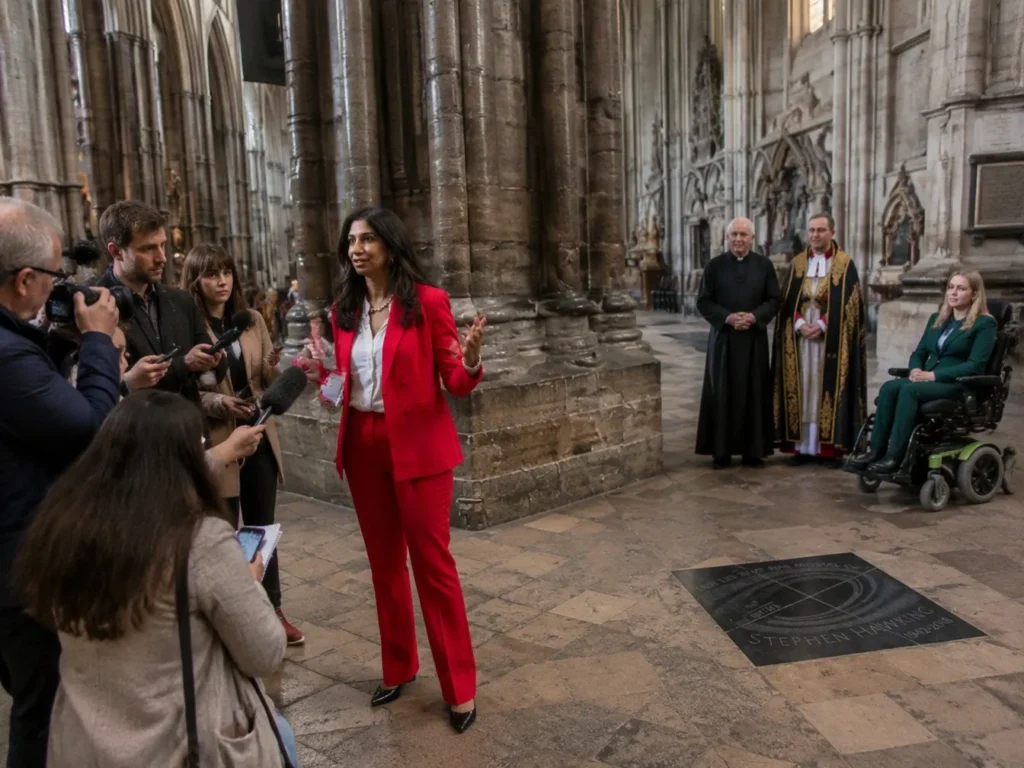
Content Disclosure: The accompanying image was deliberately generated using AI and is deliberately perceptible as AI as a satirical illustration of the arguments made in this essay. It does not depict a real event and should not be construed as a documentary photograph or factual representation of an actual occurrence or real person. The image is used only for commentary and criticism. The essay itself is human-written.