The campaign against generative artificial intelligence in the arts has acquired the confidence of a moral crusade. Critics call the technology theft. Artists organize boycotts. Publishers, studios, universities, festivals, and professional organizations develop disclosure rules and prohibitions. Lawsuits continue over copyright, licensing, consent, and the use of creative work in model training. Writers, illustrators, musicians, actors, editors, designers, and animators reasonably fear that companies will use software to reduce labor costs and eliminate paid human work.
Those concerns are serious. We do not, however, grant either able-bodied or Disabled opponents of generative AI the authority to decide that Disabled artists must surrender tools that make creative participation possible.
Much of the current debate proceeds as though the arts existed on equal physical terms before generative AI arrived. They did not. They do not now. The discussion assumes that everyone has enjoyed a reasonably comparable opportunity to become a writer, filmmaker, editor, designer, actor, composer, journalist, or director, and that AI has entered a functioning meritocracy to threaten people who had previously competed on fair ground.
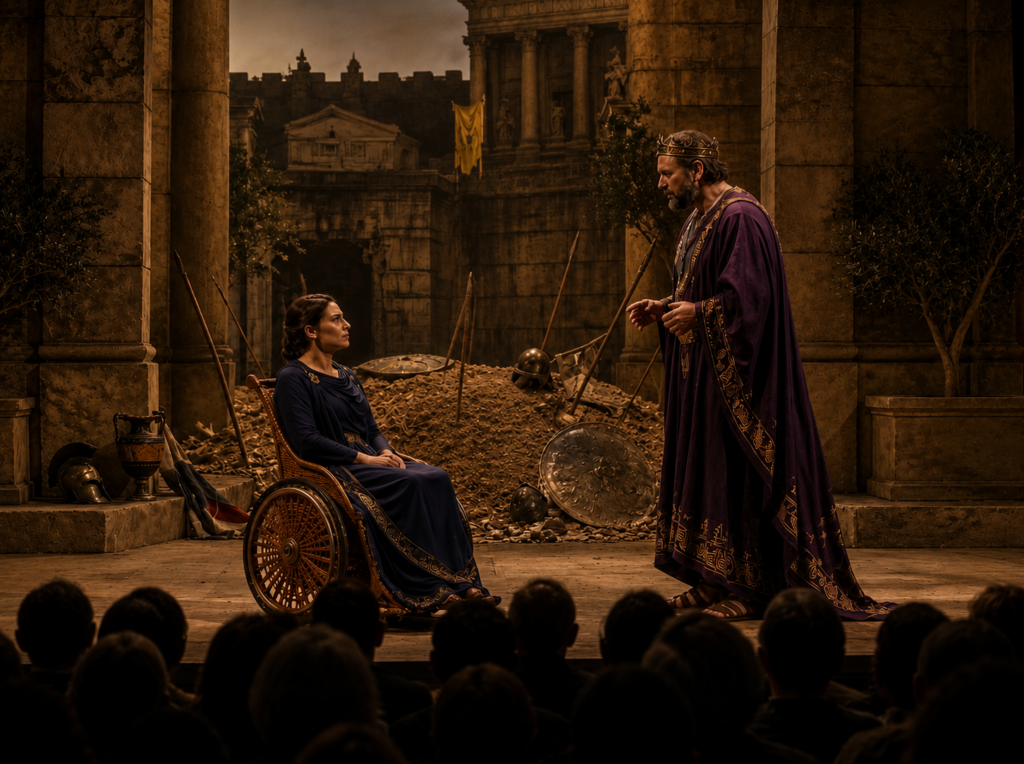
That account is a fantasy that bears absolutely no resemblance to the creative industries as Disabled people meaningfully encounter them, including on Broadway and the West End.
Theatre, television, film, journalism, publishing, music, and design remain profoundly physical professions. They reward people who can travel repeatedly, remain alert and safely present through twelve or fourteen-hour working days, go to remote locations far from reliable hospital systems with rough terrain, eat and drink on flexible schedules, work in environments without climate control, tolerate sensory exposure, navigate old and inaccessible buildings, work on location for weeks or months, attend evening networking events, manage unreliable or inaccessible housing and transportation, and treat exhaustion as proof of seriousness, dedication, and loyalty. Backstage areas remain inaccessible. Film locations remain inaccessible. Studios, rehearsal rooms, offices, press events, festivals, and professional gatherings remain inaccessible.
These conditions are rarely described as ableism or as gatekeeping, and relevant disability civil rights laws are rarely cited appropriately, because the hardships have been absorbed into the mythology of creative work. Long days become dedication while physical collapse becomes sacrifice and constant travel becomes commitment. The person who cannot endure those conditions is treated as insufficiently suited to the profession, even when the profession has simply been organized around an able-bodied worker.
Disabled artists are therefore excluded before anyone evaluates their talent or has the chance to do so. Their manuscripts remain unwritten because sustained typing is impossible and the theatres and sets cannot conventionally produce even the best ones with the authors present. Their visual ideas remain private because they cannot physically construct, photograph, or present them through approved professional channels. Their careers disappear before the industry is required to admit that their careers might have existed or had worth and value.
Generative AI has begun to disturb that arrangement in ways that are uncomfortable for traditional arts establishments.
The hostile outrage that has followed the availability and noticeable presence of these tools should be examined carefully. Many able-bodied professionals and other people who tolerated inaccessible arts industries for decades have very suddenly discovered an extraordinary moral urgency now that studios, financially strapped theatre producers, independent creators, and, yes, Disabled artists can bypass some of the barriers those industries refused to remove.
For many years, theatres, film sets, and professional networks remained inaccessible without triggering rage on TikTok, five-alarm fires in op-eds, or doom-and-gloom predictions about entire industries. Production schedules continued excluding people with serious illness, pain, fatigue, mobility limitations, neurological disabilities, and fluctuating capacity without producing widespread panic. None of this generated a comparable campaign demanding that artistic work cease until every Disabled person could participate.
The moral outrage is therefore exceedingly selective and hypocritical, and that must be noted. A tool appears that allows some of those people to create anyway, and prohibition suddenly becomes a matter of principle. The Disabled artist is told to protect human creativity by accepting continued exclusion from it.
What, precisely, are we being asked to protect? Pay attention to the criticism.
Some people online demand that those using generative AI to create images “just learn to draw,” although many visionary Disabled people have serious disabilities that make drawing impossible. Others insist that Disabled hair and makeup artists should simply do the job “the traditional way,” as though inaccessible backstage spaces, narrow corridors, stairs, and inaccessible workstations were artistic standards rather than architectural barriers. Musicians are told to “learn an instrument” instead of using AI for musical arrangement, even when their hands can no longer reliably play the instrument they expertly performed for years and progressive neuromuscular disease has diminished their diaphragm support. An autistic filmmaker is told to make the work “properly,” meaning through inaccessible sets, punishing schedules, and production systems their mind cannot reasonably withstand.
Historians should recognize the dishonesty within another common argument. Generative AI is repeatedly condemned as uniquely illegitimate because it learns from existing work and produces material shaped by that inheritance. Yet human culture has never developed through artistic isolation. Every tradition has emerged through imitation, inheritance, adaptation, translation, rejection, appropriation, revision, and synthesis.
Shakespeare repeatedly drew upon chronicles, earlier plays, classical literature, and stories already in circulation. Walt Disney transformed inherited folklore and fairy tales into some of the twentieth century’s most profitable cultural products. Pablo Picasso absorbed influences from African sculpture, Iberian art, Cézanne, and Velázquez. George Lucas constructed Star Wars through an unmistakable combination of Akira Kurosawa, Flash Gordon, mythology, westerns, samurai cinema, and Second World War aviation films. Quentin Tarantino has built a career through visible conversation with earlier cinema. Wes Anderson’s films belong to an identifiable lineage of European cinema, illustration, theatre, literature, and production design.
Human-made art is often derivative. Much of it is mediocre. Some of it is dreadful. The fact that a work was created entirely by a human hand does not make it original, profound, ethical, or good. It may be a competent repetition of familiar conventions, an imitation of a fashionable style, a commercial adaptation of an existing property, or a technically accomplished work with almost nothing to say.
This is not an insult to art. It is the history of art.
Civilization is cumulative. Artists inherit languages we did not invent, forms we did not create, technologies developed by others, myths older than their nations, genres with established rules, and aesthetic traditions that shape their imagination before we begin to work. Originality has never required creation from nothing. It has required judgment, selection, transformation, interpretation, and the production of something sufficiently distinctive to carry an author’s mind into public view.
The legal and economic questions surrounding generative AI remain real. Human learning and machine training are not identical. Copyright, licensing, attribution, compensation, labor rights, disclosure, and corporate exploitation require serious regulation. Companies should not be permitted to invoke technological novelty as immunity from law.
None of those questions establishes that Disabled people must accept exclusion while courts, legislators, corporations, and professional organizations settle the future of technology. None gives opponents of AI a moral license to police Disabled creators who use it to perform work their bodies would otherwise prevent.
A filmmaker may possess a visual imagination as recognizable and disciplined as any celebrated auteur while being unable to endure the physical conditions under which films are conventionally produced. We may be unable to work for fourteen hours, travel repeatedly between locations, manage sensory overload, enter inaccessible sets, or sustain the bodily strain of directing in its current industrial form. Generative AI can allow that filmmaker to develop storyboards, visual references, shot compositions, production palettes, set concepts, animatics, and a short proof-of-concept film that demonstrates a coherent artistic intelligence.
The software did not create that intelligence. It allowed other people to see it. Likewise, Disabled people very often are not defective in imagination. We instead are lacking in the approved method of extracting it.
Production designers can develop visual concepts without physically building or transporting every object involved. Editors can examine structure and pacing while preserving limited energy for consequential creative choices. Journalists can organize documents, compare chronology, and develop reporting without exhausting ourselves through repetitive mechanical tasks. Voice actors unable to travel or tolerate conventional studios can work remotely. Disabled performers, animators, composers, costume designers, lighting designers, and directors can demonstrate their skills before an inaccessible institution decides whether we are worth accommodating.
Cinema has always been collaborative. Directors do not sew every costume, construct every set, operate every camera, edit every frame, or compose every note. Their authorship rests upon judgment, coherence, selection, interpretation, and command of the work as a whole. Denying Disabled people authorship because software assists with execution imposes a standard that celebrated able-bodied artists have never been required to meet.
The question extends beyond whether AI replaces artistic labor. AI may also allow artistic minds previously filtered out by the physical demands of production to become visible.
That possibility has provoked gatekeeping from able-bodied people and from Disabled people who oppose generative AI categorically. Disability does not confer authority to limit the tools other Disabled people require. A Disabled artist who can work within conventional production, or who objects to AI for ethical reasons, may refuse it, criticize it, organize against it, demand stronger laws, or decline to collaborate with anyone who uses it. They may not impose their own access circumstances upon people with different bodies, impairments, resources, and barriers.
There is no solidarity in demanding that another Disabled person remain unable to work.
Disabled people have already waited through decades of promises. For accessible theatres, film sets, studios, newsrooms, festivals, transportation, housing, rehearsal rooms, professional networks, and production practices, Disabled people have waited and continue to wait. We have watched institutions issue inclusion statements, appoint committees, celebrate representation, and continue operating spaces our bodies cannot enter. We have watched able-bodied artists passionately and eagerly describe themselves as progressive before returning to workplaces built around able-bodied endurance and functioning through exclusion.
Now we are told to wait again: until the litigation and legislation is settled, licensing systems improve, labor agreements are rewritten, every ethical dispute is clarified, and hostile industries somehow become accessible through the voluntary enlightenment they have withheld for generations. Above all, we are expected to wait until someone else grants moral permission for Disabled authorship on the TikTok with the most likes.
No. Absolutely not.
Disabled artistic professionals are under no obligation to preserve our own exclusion indefinitely so that others may enjoy a purer theory of artistic virtue and claim the moral high ground. We owe nothing, particularly not further invisibility, to a profoundly inaccessible industry. We owe able-bodied colleagues no sacrifice of tools those colleagues may never need. We owe righteously indignant Disabled gatekeepers no obedience merely because the gatekeeper has found an AI-free workaround for themselves or shares a diagnosis, identity, or political vocabulary.
Regulate generative AI and require licensing where law and justice demand it. Protect workers from displacement and compensate artists. Enforce disclosure and restrain corporate abuse. Build better systems. But take note that none of that requires forcing Disabled creators back behind barriers the arts have long refused and continue to refuse to remove.
Do not tell a Disabled writer excluded from backstage spaces, locations, studios, rehearsals, writers’ rooms, festivals, and production environments that a final product developed in a physically safe environment through generative AI is therefore illegitimate.
Do not tell a visual artist who can no longer draw by hand, a composer who can no longer physically play an instrument, a neurodivergent filmmaker who cannot survive conventional production, or a designer shut out of inaccessible studios that authorship belongs only to those who can perform every stage of execution through approved physical methods.
Do not angrily treat AI use in the arts as a yes/no binary and praise disability inclusion while policing the means through which Disabled people write, compose, design, animate, perform, direct, report, and build entire bodies of work beyond institutions, sets, and theatres that have never properly made room for us.
The arts have long permitted physical ability and endurance to masquerade as artistic merit. Those attempting to gatekeep generative AI away from Disabled creators are defending a system in which access to cultural authorship still depends partly upon whether a human body can withstand hostile physical conditions.
Disabled artists have waited long enough. We will create without approval.