By: Kelsey Maurine Brickl
I am scheduled to attend The Imaginary Invalid at the Todd Haimes Theatre on September 27 as a wheelchair user with complex medical needs including an indwelling pacemaker, use of respiratory equipment, severe dog allergy, and more, and in my professional capacity covering theatre and disability access.
I am reporting on this production because Roundabout has chosen to stage and advertise a comedy about claimed illness in 2026, when Disabled people with diagnosed chronic, fluctuating, psychiatric and medically disputed conditions and genuine access needs still face accusations that their symptoms are exaggerated or invented.
My professional inquiries to Roundabout concern what Bill Irwin’s adaptation asks audiences to laugh at, how Roundabout presents Argan in its advertising, and whether the theatre itself is accessible to a qualified non-ambulatory professional working backstage. I have not yet seen the performance and will assess it on what is staged.
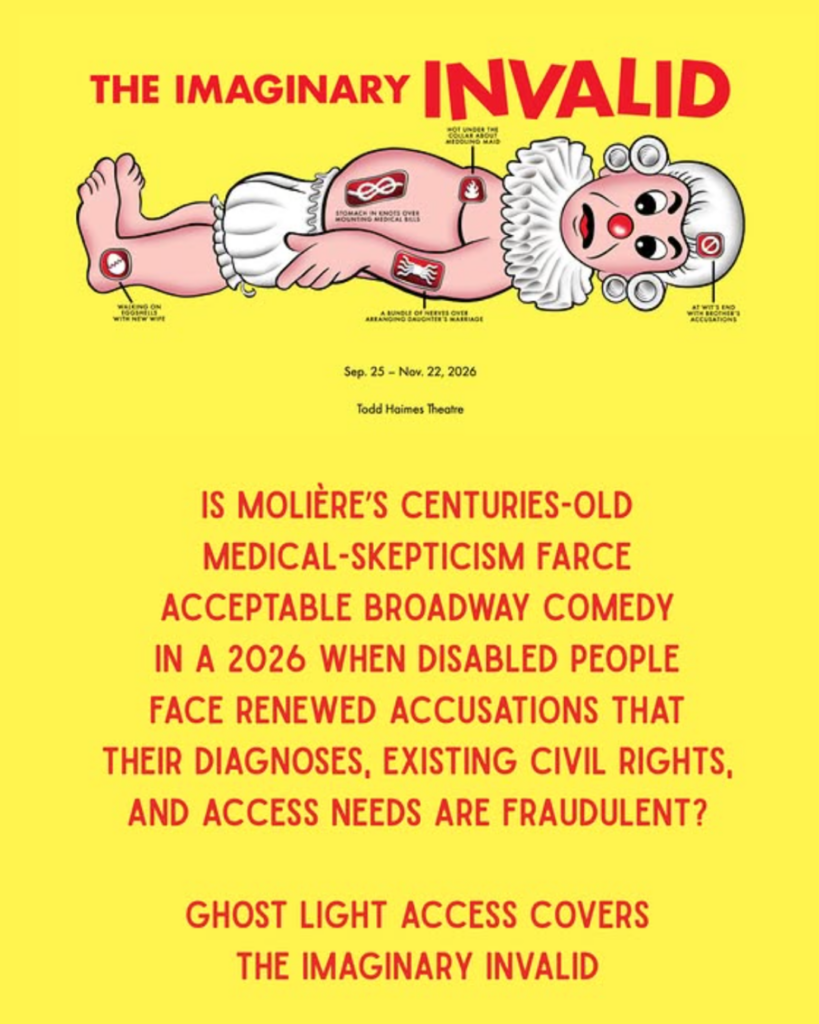
On September 15, Roundabout Communications acknowledged my emails, said it took my concerns seriously, and asked where the story would appear and when I would file it. Its response also referred to Audience Services’ work on my wheelchair ticket and attendance arrangements. I replied that the publication was Ghost Light Access and supplied a September 16 deadline for substantive, attributable comment. That deadline has now passed without Roundabout responding substantively. I had asked specific questions about the adaptation, the use of illness and medical objects as comic material, and who created and approved campaign artwork depicting an adult body covered in medical labels, along with marketing copy calling Argan a “professional patient” and using dehumanizing styling that parodies the board game Operation.
I also asked whether a non-ambulatory actor, technician or wardrobe worker using a complex power wheelchair could reach the stage, wings, dressing rooms, backstage toilets, rehearsal rooms and production offices without being carried or required to transfer. Audience access and workplace access are separate questions. A confirmed wheelchair ticket would not establish that a Disabled professional could work in the building.
My attendance arrangements remain unresolved in one measurable respect. I told Roundabout that my prescribed power wheelchair has an occupied front-to-rear envelope of approximately 72 inches when positioned with the tilt and recline I medically require. This is true. Roundabout described my reserved Orchestra K19 location as 55 by 68 inches within its railing, with a 42-inch opening. It said the seats would be removed and I could position my chair as needed if it fits. However, I will be attending in my prescribed wheelchair and using it as prescribed, and have communicated this to Roundabout. I have requested written confirmation that the location can safely accommodate the occupied chair or that a compliant alternative will be provided.
On September 17, Audience Services confirmed in a written chat I have retained that my requests were noted on my account but did not confirm that Todd Haimes Theatre house staff had received or been briefed on them. I sent Roundabout a transcript of that exchange with a signed declaration attesting to its accuracy. I have no response from Roundabout regarding that chat. Today, Roundabout sent a standard pre-visit email confirming my September 27 reservation and providing ticket and arrival information. That email did not address the 72-inch wheelchair envelope, staff briefing or my outstanding editorial questions. I followed up requesting a response.
I have also sought comment from members of the production’s creative team. I will keep readers posted on substantive replies, any access arrangements confirmed before September 27, and what I observe at the performance. No members of the creative team commented.
I will therefore publish my observations as a Disabled patron about what happens with accessibility at the theatre; my assessment, as a Disabled writer and historian, of the decision to stage Molière’s work in 2026; and my criticism of the adaptation, performance and advertising based on the production I see and the responses I receive. That publication will occur here, in my forthcoming book on accessibility, and potentially with other publications.
All rights are reserved.
I will keep readers posted before the performance if Roundabout confirms the outstanding access arrangements or provides substantive comment. Stay tuned for further coverage.
UPDATE: After Roundabout did not answer my request to identify the campaign’s illustrator, I found a public Instagram post by Jay Cooper identifying himself as the illustrator of the final marquee artwork for The Imaginary Invalid. Roundabout’s account responded to the post. I still await answers about who developed and approved the visual concept and advertising copy, and whether Disabled professionals reviewed them.
UPDATE, September 21: Roundabout has now confirmed in writing that the space required to accommodate my prescribed wheelchair in full recline will not fit within Orchestra K19 as ordinarily configured. The theatre states that it will remove the railing behind the wheelchair section before my arrival and use the open space beyond it to provide the full clearance of my Permobil M3 Corpus in full recline. This modification addresses the measurable spatial issue identified in my earlier reporting, provided that the railing is removed in advance, the entire modified area remains unobstructed and immediately usable, and I can safely operate the medically necessary tilt and recline functions of my wheelchair.
I will also rely on the other access requirements I need to safely and equitably attend.
Roundabout also states that this arrangement and my previously identified access requirements have been recorded on my account and communicated to the appropriate venue personnel, who will expect my arrival at approximately 2:00 p.m. on September 27. I have acknowledged the arrangement in writing and will report on its implementation at the theatre if my current acute disability and chronic-illness flare permits me to attend. I intend in good faith to attend, view the production, and report on what I honestly observe and experience.
UPDATE 1, September 26:
Since this article was published, Roundabout Theatre Company’s own video from the first preview of The Imaginary Invalid documented audience members standing en masse during the bows. I had already notified Roundabout in writing that wheelchair patrons require an unobstructed sightline through the entire performance, including my September 27 attendance from a designated wheelchair location. Ghost Light Access does not accept one-time, individualized accommodation as a substitute for uniform accessibility.
I have therefore placed Roundabout on supplemental written notice that it must make every reasonable effort to prevent standing patrons from obstructing my sightline, while leaving the operational means to the theatre. I expect that protection to apply to wheelchair patrons going forward. Roundabout knows my precise location, knows I cannot stand to recover a blocked view, has had this requirement in writing since September 17, has confirmed my requests are recorded, and has now published its own evidence that audiences are standing during the relevant portion of the production. The obstruction is foreseeable. See If Theatres Can Police Phones, They Can Police Standing That Blocks Wheelchair Sightlines for more information.
Separately as an update to this post: Having not received a response to the questions Ghost Light Access issued to Ms. Bloom’s representative team about the production prior to attendance, I responded directly to an Instagram post on Rachel Bloom’s account advertising/promoting her Broadway debut in The Imaginary Invalid. I warmly congratulated Bloom on the debut and introduced myself, somewhat pointedly, as a “non-imaginary invalid”: a genuinely Disabled historian, writer, critic and journalist, as well as an ordinary wife and mother, who will attend the September 27 performance. I explained that this is an extraordinarily difficult moment for Disabled people, citing the recent federal ruling affecting Section 504’s community-integration regulations, the British press rhetoric about “sickfluencers” supposedly making disability fashionable, and the recent assisted-dying debate in the UK. I explained that Ghost Light Access exists because Disabled patrons and professionals continue to encounter barriers involving everything from ticketing and bathrooms to actually working backstage on Broadway and in the West End.
I then told Ms. Bloom that I have asked Roundabout and representatives of several members of the creative team specific questions about staging The Imaginary Invalid in this climate: whether Disabled professionals can access and work backstage, what exactly audiences are being asked to laugh at, and whether those involved consider medical skepticism and disability responsible or appropriate sources of humor right now. I invited her to address those questions directly, wished her a spectacular Broadway debut, acknowledged the talent of the cast, and reiterated that I will attend on September 27 and publish a balanced and fair account of what I actually experience and see. The post on which I left this comment is no longer visible on Bloom’s Instagram account. I do not know why it is no longer visible and will not speculate about whether it was deleted, archived, removed for an unrelated reason, or otherwise taken down. I preserved a screenshot showing the post and my comment while they were visible.
UPDATE 2, September 26
I have unfortunately just received a disturbing email update from Roundabout. Audience Services has responded to my advance sightline notice by stating that K19 is “elevated above the row in front of it” and that “how audience members respond to a performance is up to them,” adding that Roundabout “can’t guarantee any patron’s uninterrupted view, including during the curtain call.” This comes after Roundabout’s own first-preview video documented patrons standing en masse during the bows and after repeated written notice that, as a full-time non-ambulatory wheelchair user, I cannot simply stand when the people in front of me do. I have also continued to publicly advise other theatre patrons who use wheelchairs about this issue in the meantime in a non-legal capacity.
The reference to an “elevated” wheelchair location has also raised an immediate safety question less than 24 hours before my attendance. Roundabout previously told me that K19 has a continuous step-free route from the main entrance, but this latest email does not explain how my medically-necessary custom prescription power wheelchair actually reaches the elevated platform.
My occupied Permobil M3 Corpus weighs approximately 570 pounds including me, my backpack and medically necessary equipment. I have therefore insisted, reasonably, that Roundabout provide me with immediate written identification of the complete route to K19 and the rated load capacity of any ramp, lift, platform or other equipment involved. I will not show up alone to the theatre tomorrow and attempt to drive a nearly 600-pound occupied power wheelchair worth tens of thousands of dollars onto equipment whose safe load capacity Roundabout cannot or won’t quickly establish, putting my body in extreme danger.
I also categorically reject Roundabout’s apparent position that audience behavior relieves the theatre of any responsibility even to attempt to preserve a wheelchair patron’s sightline.
I have not demanded that Roundabout “guarantee” the behavior of every human being in the auditorium. In fact, I know that the theatre can’t possibly guarantee the behavior of any patron about anything at all. Ghost Light Access instead demands that all theatres make every reasonable effort to address a specific obstruction that they know occur, including what Roundabout knows occurs during this particular production of The Imaginary Invalid, that its own video documents on its official social media accounts, and that I physically cannot overcome by standing.
Roundabout may choose the operational method, including announcing simply to the audience, “Remain sitting throughout the entire performance, including the bows, so that all patrons in the audience can see. Thank you.”
Doing nothing is not an operational method. It is a choice that Roundabout has now committed in writing to making. It is the wrong choice. I have demanded substantive answers to both the route-safety issue and the sightline issue today, before I travel to the theatre tomorrow.
Let’s see what Roundabout says and does.
UPDATE 3, SEPTEMBER 26
Roundabout has now stated in writing that the seat I am ticketed to attend tomorrow, which they only informed me today is elevated, is step-free on a permanent elevation with no ramp or other temporary load-bearing situation involved. This is a huge relief, and I expressed gratitude to The Roundabout to its timely written response in clarifying this.
However, Roundabout has still not stated what steps, if any, it intends to take to reasonably ensure that Disabled patrons who cannot stand during bows will be able to maintain the sightline they’ve paid for. I await a written response on that matter.
Separately, I note that the day before I am scheduled to attend The Imaginary Invalid, Roundabout emailed me its Upstage Guide. Its own publications make the continuing refusal to answer my editorial questions increasingly difficult to dismiss as routine PR silence.
Roundabout has found ample institutional space to explain what this production supposedly means. Its guide discusses medical authority, patient credibility, chronic illness, healthcare costs, wellness misinformation, the contemporary relevance of Molière, and what audiences are being asked to laugh at.
I am a historian, writer, access specialist, parent of a Disabled child, and a Disabled person. These are things I know a lot about, things that directly affect my family and community, and things that affect me personally. They’re also the subject of my professional coverage of this production. In fact, these are almost precisely the subjects I asked Roundabout, the production, and members of its creative team about before attending. I received no substantive response. That silence now feels very loud, and very deliberate.
Reading Roundabout’s own material as a writer and historian, the contradictions inside it are, frankly, extraordinary. One section acknowledges the difficulty patients face when trying to communicate pain and other bodily experiences to medical professionals. Elsewhere, Roundabout treats Argan’s lack of illness as established and his contrary belief as part of the comedy.
Its “educational” material also attempts to locate the principal satire in medical practitioners and institutions while repeatedly describing Argan’s supposed hypochondria as comic material. As a position, Ghost Light Access does not regard this as socially or artistically appropriate, nor do I personally or professionally find it to be responsible.
Most significantly, Roundabout discusses preserving Molière’s inherited jokes for contemporary audiences while considering how centuries-old work lands now. I specifically asked who evaluated how jokes involving illness, bodily knowledge, dependency, treatment, and medical credibility land for Disabled people in 2026 as our community reckons with rolled-back rights, spreading mockery, and the normalization of ableism and skepticism of our needs. Roundabout has still not answered me.
The irony becomes considerably uglier in Roundabout’s discussion of art and health. Its educational material addresses the relationship between arts participation, health and wellbeing, including the barriers created when people cannot equally access cultural institutions.
Tomorrow I am expected to enter that cultural institution in my prescribed Permobil M3 Corpus with very complex medical needs after weeks of written correspondence required to establish what time I must attend due to dog allergies, whether its wheelchair location can physically accommodate me, followed by another dispute over whether Roundabout will make any affirmative effort to preserve my sightline through the end of the performance because I cannot stand when the audience does.
Roundabout has somehow managed to publish and email out a massive, extensive, educational material acknowledging barriers to cultural participation while I have been spending substantial time, effort, and energy forcing Roundabout to address barriers to my own participation in this production. They still haven’t actually addressed all of those barriers.
Ghost Light Access thinks that this should prompt an internal reckoning at Roundabout.
And this makes the editorial silence much harder to explain away. Roundabout plainly possesses developed institutional thinking on the questions I asked. It has devoted substantial space to telling audiences how to understand Argan, what Molière was attacking, why the play remains relevant, how modern medicine relates to seventeenth-century medicine, and how art intersects with health. What it has not done is answer the Disabled journalist who asked what this adaptation asks audiences to laugh at, how illness and bodily credibility are being handled, whether Disabled professionals evaluated those choices, and why Roundabout considered this framing appropriate now.
Tomorrow I will see the production myself and judge what is actually onstage fairly. But Roundabout cannot publish elaborate answers to the comfortable versions of these questions and expect its silence toward the difficult ones to look accidental. The questions were received. Roundabout said they were routed appropriately. Its own publications demonstrate that it has considered the underlying subjects in detail. The unanswered question is why Roundabout will explain its thinking to its audience, but will not defend that thinking when a Disabled journalist asks it to show its work.
UPDATE 1, September 27: Roundabout never answered via email to identify what affirmative measure, if any, it will take to preserve my wheelchair sightline during the bows and final song. I therefore sent one final formal communication shortly after midnight, before today’s performance. This email put Roundabout on notice about something it already knows: I cannot stand when patrons in front of me stand, knows that its own first-preview footage documents patrons standing during the bows, and knows exactly where I will be sitting. I am not demanding that Roundabout guarantee human behavior. That isn’t possible or reasonable. Therefore, I am demanding that it try to prevent a known and foreseeable obstruction from excluding a Disabled patron from seeing the same conclusion everyone else paid to see.
Ghost Light Access has a policy position on phones in theatres regarding disability access and another regarding wheelchair sightlines in theatres. These positions coexist. I therefore communicated clearly, politiely, and logically to Roundabout that the theatre cannot claim that audience behavior is simply “up to them [the members of the audience]” when standing blocks the sightline of Disabled person who can’t stand, then suddenly rediscover its institutional force and ability to regulate audience behavior when somebody takes out a phone.
If Roundabout can announce, request, monitor and enforce rules concerning phones, photography, recording, texting and other patron conduct, it can make a good-faith effort to address standing that foreseeably blocks a wheelchair user’s view. Today Roundabout gets to demonstrate which principle it actually believes. I will be there at approximately 2:00 p.m., and I will document what it does.
Stay tuned for further updates on The Imaginary Invalid. Full accessibility and dramatic reviews to come on Ghost Light Access and other outlets.