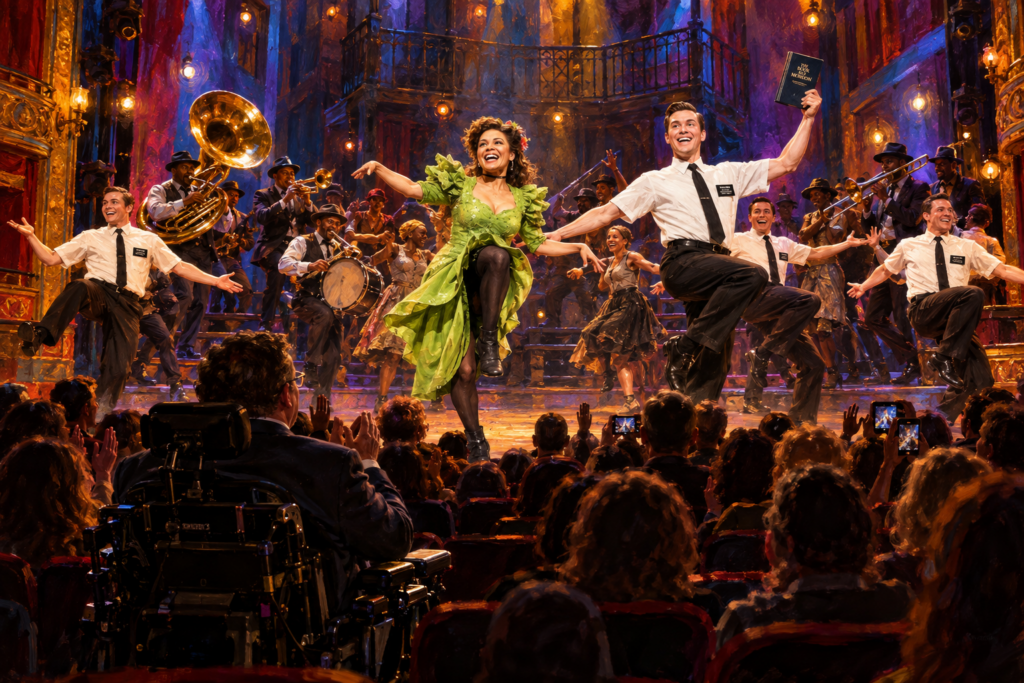
Image: Generated artwork illustrates the article’s themes. It does not depict an actual performance or audience.
By: Kelsey Maurine Brickl
As part of my work on ATG Entertainment’s Broadway accessibility, I have spent more than seven weeks securing written disability-access commitments for Hadestown at the Walter Kerr Theatre on October 30 and The Book of Mormon at the Eugene O’Neill Theatre on November 1.
On Friday, October 30, 2026, my husband and I will attend Hadestown at Broadway’s Walter Kerr Theatre. On Sunday, November 1, we will attend the 2:00 PM matinee of The Book of Mormon at the Eugene O’Neill Theatre.
I am enormously excited about both shows. I am also a full-time power-wheelchair user with complex medical equipment, and attending Broadway requires arrangements that most able-bodied theatregoers never have to consider.
Since early September, I have been corresponding with ATG Entertainment about my accessibility requirements. ATG has made detailed written commitments for Hadestown and has separately confirmed arrangements for The Book of Mormon.
Some of these commitments are routine. Others have required extensive negotiation. One has already become the subject of a serious dispute.
I am publishing these arrangements because they affect many, many more Disabled people than me.
Wheelchair Seating and Companion Access
For Hadestown, our tickets are for Orchestra Rear Left, row M. ATG has confirmed that M21 will be removed to accommodate my medically necessary Permobil M3 Corpus power wheelchair. M19 will remain installed for my husband. We will sit together.
For The Book of Mormon, ATG has confirmed that Orchestra Left R1 will be removed before my arrival, with my husband seated beside me in R3.
My wheelchair weighs approximately 388 pounds as configured, before I get into it. It cannot fold, and I cannot safely transfer into an ordinary theatre seat. Its powered tilt, recline, and positioning systems are medically necessary.
Similar complex rehabilitation wheelchairs are used by people with ALS, muscular dystrophy, spinal cord injuries, cerebral palsy, generalized myasthenia gravis, advanced multiple sclerosis, and many other conditions. Some carry respiratory equipment, feeding systems, specialized cushioning, or other essential medical technology.
These are prescription medical devices that can cost tens of thousands of dollars. We cannot leave them at the auditorium door.
Wheelchair users deserve to buy tickets, sit beside their companions, and see the same show as everyone else. That includes those of us whose wheelchairs are large, heavy, and medically complex.
Step-Free Access and Theatre Navigation
At the Walter Kerr Theatre, ATG has confirmed a step-free route to my wheelchair location. Brian Busby has been designated to coordinate my arrival with house management, with assistance before the performance and during intermission.
At the Eugene O’Neill Theatre, ATG has confirmed Priority Access entry. Head Usher Sandra will meet me inside the theatre, escort us to our seats, and coordinate assistance.
My wheelchair weighs nearly 400 pounds with me nowhere in it. I cannot step around an obstacle, climb stairs, or abandon my chair because a passage is blocked.
Other Disabled patrons face similar barriers. Some use manual wheelchairs, scooters, or walkers. Others can walk short distances but cannot manage stairs, crowded aisles, or uneven floors.
The New York City Human Rights Law, particularly Administrative Code § 8-107(4), protects Disabled patrons against discrimination in public accommodations. Access must extend beyond the designated wheelchair seat to the routes and facilities people need throughout their visit.
Getting someone from the entrance to a seat, a restroom, and back outside should be ordinary theatre operations.
Accessible Restrooms
For Hadestown, ATG has identified the accessible restroom on Orchestra House Left, across from the Sound Associates booth. The available routes include the auditorium aisle or an exterior sidewalk route where necessary. House management has confirmed assistance before the performance and during intermission.
For The Book of Mormon, ATG has confirmed staff or security escorts to and from the adjoining accessible restroom facility before the show and during intermission.
Most able-bodied people attending Broadway never give the restroom a second thought. They get up, walk down the aisle, find the toilet, wash their hands, and return to their seats.
I have to consider doorway widths, turning space, steps, crowded passages, and whether reaching the bathroom requires leaving the building. I cannot leave my wheelchair outside and walk in. If the route involves going outdoors, the weather and my medical equipment become additional considerations.
I still need to use the toilet.
Disabled people should not have to plan a small expedition to accomplish an ordinary bodily function. Nor should an intermission become a humiliating logistical emergency.
Security Screening Without Magnetic Equipment
ATG has confirmed alternative security screening for both performances because of my implanted cardiac devices and medical monitoring technology.
At the Walter Kerr Theatre, I will not be required to pass through a magnetometer or undergo screening with a handheld magnetic wand.
At the Eugene O’Neill Theatre, ATG has confirmed dedicated Priority Access entry with nonmagnetic screening. My medical, respiratory, and cardiac monitoring equipment will be permitted, subject to standard nonmagnetic bag checks.
This accommodation also matters to people with implanted defibrillators, deep brain stimulators for Parkinson’s disease, spinal cord stimulators, vagus nerve stimulators for epilepsy, and implanted devices used to manage bladder or bowel dysfunction.
Precautions vary by device. Some manufacturers advise against particular screening procedures or prolonged exposure to magnetic security equipment.
Most patrons simply empty their pockets and walk through security. People with implanted devices may have to explain equipment that is literally inside their bodies to a stranger holding a security wand.
Alternative screening is entirely possible. ATG has confirmed it for both of my visits.
It should not require seven weeks of correspondence.
Medical Equipment and Telephone Access
ATG has confirmed that my necessary medical equipment will be admitted for Hadestown and that I may keep my telephone available and powered on for cardiac monitoring throughout the performance.
For The Book of Mormon, ATG has separately confirmed admission of my medical, respiratory, and cardiac monitoring equipment. Its confirmation of that equipment does not expressly repeat the telephone-specific assurance given for Hadestown.
My telephone connects to my implanted loop recorder. It is an essential part of my medical monitoring arrangements.
Many other Disabled patrons depend on phones and connected devices:
- Autistic people and others who use augmentative and alternative communication (AAC) applications to speak or communicate.
- People with diabetes whose continuous glucose monitors send alerts to their phones.
- Power-wheelchair users who control compatible wheelchair functions through smartphone applications.
- Deaf and hard-of-hearing people who adjust hearing aids or use assistive listening technology.
- People with photosensitive epilepsy who use available accessibility information or warning applications concerning potentially seizure-triggering lighting effects.
- People with epilepsy who rely on connected seizure-monitoring systems.
- Blind and low-vision people who use screen readers, magnification, visual-recognition applications, and navigation tools.
These devices are often treated as though everyone using a telephone in a theatre must be texting friends, scrolling through Instagram, or recording the actors.
That assumption can be dangerous.
An autistic person using AAC should not have to surrender their means of communication. A diabetic should not have to disconnect from glucose alerts. Someone monitoring seizure activity should not have to disable a medically necessary application.
This is why blanket theatre phone bans present a serious disability-rights problem, and why MCC Theater’s decision to abandon Yondr pouches was an important victory for Disabled audiences.
A locked phone pouch can prevent someone from accessing essential medical or communication technology. Theatre policies must account for that reality.
A patron checking a glucose monitor is not recording the show. Someone using AAC is communicating. A wheelchair user checking a medical application is using assistive technology.
The New York City Human Rights Law protects Disabled people against discrimination in public accommodations. Those protections do not disappear because a theatre has adopted an anti-phone policy.
Dogs and Disability Access
For Hadestown, ATG has confirmed arrangements to prevent my exposure to security dogs.
Some people have survived vicious dog attacks or maulings and live with PTSD or other disabling trauma. Others have severe allergies that can make exposure to dogs medically dangerous. These people buy Broadway tickets, too.
A privately contracted security dog has no independent legal right to enter a Broadway theatre. A Disabled patron does.
A theatre may choose to use security dogs. That choice does not supersede its disability-access obligations.
Service dogs are different. Their handlers have legally protected access. If a patron with a service dog and a patron with a disabling dog allergy or trauma-related condition attend the same performance, the theatre must address both people’s needs.
That may require separate routes, appropriate seating, physical distance, or other practical arrangements. Neither person’s disability should automatically become grounds for excluding the other.
The ADA does not permit exclusion of a service dog merely because another patron fears dogs or has an allergy. At the same time, someone whose allergy or trauma independently qualifies as a disability retains their own rights to reasonable accommodation.
The theatre operates the building. It controls its security arrangements, entrances, and audience movement. Disabled patrons should not have to negotiate these arrangements among themselves.
ATG has confirmed my security-dog accommodation for October 30. I expect that commitment to be honoured.
The dog does not have a ticket. I do.
The Final Song of Hadestown and Equal Sightlines
This is one of ATG’s most important written commitments, and one it subsequently attempted to withdraw three days before the performance.
Hadestown includes a final choreographed musical number after the curtain call. Audience members may already be standing for the bows. Wheelchair users who cannot stand with them may spend the final number looking at the backs of other people’s coats.
On September 10, ATG expressly wrote: “The view of the final song will be coordinated with the knowledge that you are to remain in your wheelchair.”
On September 30, ATG provided further assurances that equity of performance reception would be addressed through building procedures.
These commitments matter to people with spinal cord injuries, ALS, muscular dystrophy, cerebral palsy, multiple sclerosis, and other disabilities that prevent standing. They also matter to older patrons, people with balance disorders, people recovering from surgery, and people with disabling pain or fatigue.
They matter to manual wheelchair users who transfer into ordinary theatre seats and are no longer visibly identifiable as wheelchair users. My mother, who lives with very severe rheumatoid arthritis and lupus, is another example of someone whose ability to stand by the end of a long performance where she’s been sitting for hours would likely be limited by conditions that strangers cannot see and staff would not know about in advance.
A person does not cease to need an accessible sightline because their wheelchair is parked somewhere else or because they are ambulatory.
This is why announcements about remaining seated to ensure others can see must be made to the entire audience, not just to a few people around one identifiable person in a wheelchair.
I have asked ATG to use a general audience announcement or Playbill notice requesting that patrons remain seated through the final song. Broadway theatres already issue instructions about phones, photography, and recording. They can issue instructions about standing, too.
ATG instead proposed having staff approach individual patrons in front of me and ask them to sit. I objected because this would single me out, leave my sightline dependent on strangers’ cooperation, and fail to address standing elsewhere in the auditorium.
On October 27, ATG stated that because I rejected its proposed procedure, it would remove that procedure from its building arrangements and the concern about the final number would no longer be addressed.
I rejected the method. I did not withdraw my request for an accommodation.
ATG’s attempt to withdraw its previously promised accommodation after I challenged the proposed procedure raises serious concerns about disability discrimination, retaliation, and interference with protected rights. I have formally notified ATG of those concerns and demanded compliance with its written commitments.
The ADA protects equal enjoyment of public accommodations under 42 U.S.C. § 12182 and prohibits retaliation and interference with protected rights under § 12203. New York City Administrative Code § 8-107(4) prohibits disability discrimination in public accommodations, and § 8-107(7) prohibits retaliation for asserting rights under the New York City Human Rights Law.
In PGA Tour, Inc. v. Martin, 532 U.S. 661 (2001), the Supreme Court addressed reasonable modifications necessary for Disabled people to participate in public accommodations. In Fortyune v. American Multi-Cinema, Inc., 364 F.3d 1075 (9th Cir. 2004), the court addressed a cinema’s responsibility to protect wheelchair companion seating rather than leave access dependent on another patron’s cooperation. Camarillo v. Carrols Corp., 518 F.3d 153 (2d Cir. 2008), addresses meaningful access to services, while Mihalik v. Crédit Agricole Cheuvreux North America, Inc., 715 F.3d 102 (2d Cir. 2013), confirms the broad, independent interpretation required under the New York City Human Rights Law.
These cases do not require a particular announcement at Hadestown. They establish important principles concerning meaningful access and disability accommodation.
Here’s what the announcement could sound like. It’s very simple.
“Please shut off your phones, etc. Please kindly remain seated for the entire performance, including through the entirety of the bows, so that everyone in the theatre can see.”
That seems simple and nice, right? I will bring printed copies of ATG’s September 10 and September 30 commitments, together with my formal notice and copies for relevant theatre personnel. I will remain in my purchased wheelchair location, M21. I will not be moved into an aisle, doorway, cross-aisle, or circulation route to compensate for standing patrons.
I am relying on ATG’s written commitments. Its subsequent attempt to withdraw an arrangement because I challenged the proposed method does not erase those commitments or its underlying legal obligations.
My husband and I paid to see the entire show. Including the part after everyone bows and begins performing a choreographed song and dance that others stand and can see and photograph. That is part of Hadestown.
Safe Departure After the Performances
For Hadestown, ATG has confirmed assisted egress after the final song concludes and the house lights come up. I will not be required to leave during the curtain call or miss the final musical material to avoid the departing crowd.
ATG has also addressed possible stage-door arrangements, depending on whether a stage-door operation takes place. My concern is safe movement through crowds and barricades, rather than access to performers.
For The Book of Mormon, ATG has confirmed that a staff member will meet us at our seats during the bows to keep the exit route clear. This is an egress arrangement, and I expect it to be carried out without requiring us to miss the performance.
Stage doors are not part of the ticketed theatrical experience. Frankly, I would prefer if they did not occur. If one takes place, my concern is safe passage through the surrounding crowd. My wheelchair is medically necessary, weighs hundreds of pounds, and costs tens of thousands of dollars. I cannot simply lift it over a barricade or maneuver it through a crush of people.
I expect both theatres to manage departure safely. That seems reasonable (a very important word in disability rights).
Equal Treatment and Protection Against Retaliation
ATG has expressly confirmed that I will not be subjected to exclusion, separation, adverse monitoring, restriction, or retaliation because of my disability, medical equipment, accessibility requests, or assertion of my civil rights.
I intend to hold ATG to that commitment throughout both visits. On October 27, ATG attempted to withdraw the final-song accommodation for Hadestown after I challenged its proposed method. It then declared that it would no longer correspond with me.
That sequence is part of the written record. The ADA prohibits interference with the exercise of disability rights under 42 U.S.C. § 12203. The New York City Human Rights Law prohibits discrimination in public accommodations under Administrative Code § 8-107(4) and retaliation under § 8-107(7).
I have the right to request accommodations. I have the right to challenge inadequate arrangements. I have the right to insist that the law be followed. None of those actions gives a theatre permission to punish me.
I expect ordinary courtesy, equal treatment, and the accommodations ATG confirmed for each performance. I will not accept being singled out, watched, separated, moved, or subjected to potential foreseeable glares and negative commentary or any additional restrictions because I asserted my rights. That may constitute retaliation or incitement to harassment.
The events of September 27 at the Todd Haimes Theatre make the advance notice here regarding retaliation and harassment on this particular access issue unmistakable.
I bought theatre tickets. I did not surrender my civil rights at the box office.
Bespoke Is a Tell
In my essay Bespoke Is a Tell, I discuss what happens when Disabled people have to negotiate basic access individually, sometimes for weeks, with institutions that should already have procedures in place.
I have spent more than seven weeks corresponding with ATG about attending Broadway. I know the relevant laws, understand my medical equipment, and can identify the arrangements I need. I can write formal notices, challenge inadequate proposals, and insist on written commitments.
Many Disabled people cannot do all of that. Some lack the time, money, legal knowledge, energy, or communication resources. Others are managing serious illnesses, working, raising children, or simply trying to get through the day.
A person with ALS using a complex power wheelchair should be able to buy a ticket without becoming an expert in theatre seating diagrams. An autistic person using AAC should not have to argue with security about surrendering their voice. Someone with diabetes should be able to receive glucose alerts without writing to theatre management.
And someone who cannot stand should be able to see the end of a show without asking strangers to sit down. I have been able to negotiate these arrangements because I know how to do it. Many other Disabled theatre patrons are not able to perform this level of detailed self-advocacy, and they shouldn’t have to.
Access should not depend on whether a Disabled patron knows how to make an institution take its own legal obligations seriously.
ATG’s commitments for two different Broadway theatres show how much planning is possible. Its subsequent attempt to withdraw one arrangement also shows how vulnerable individualized accommodations can become when they depend on negotiations rather than established procedures.
The practical solutions are hardly mysterious. Theatre staff can identify wheelchair locations accurately, preserve accessible routes, arrange alternative screening, permit medical technology, and manage audience conduct so patrons who cannot stand can still see the performance.
I want the work I have done for these two performances to benefit the next Disabled person who buys a ticket. And the next one after that. I would be delighted if the next person never had to know I had anything to do with it. What ATG has promised me in writing needs to apply theatre-wide to all Disabled patrons at all performances moving forward.
Looking Forward to October 30 and November 1!
Anyway, enough about all that.
I AM GOING TO SEE HADESTOWN AND THE BOOK OF MORMON!
On Broadway! With my husband! Two shows in one weekend! Yay!
I have spent years studying and writing about Greek mythology, and the prospect of seeing Orpheus, Eurydice, Hades, and Persephone brought to life onstage is absolutely thrilling. I have listened to just enough of Anaïs Mitchell’s score to become thoroughly impatient to hear the rest, and I have deliberately avoided watching recordings of the production.
I want to experience it in the theatre, with the orchestra, the lighting, the actors, and the whole glorious machinery of Broadway.
I want to get dressed up. I want to have dinner with my husband. I want to sit beside him in the Walter Kerr Theatre, hear the first notes, and disappear into the story for a couple of hours.
ATG has had more than seven weeks’ notice of my requirements for Hadestown. I will bring copies of its written commitments, and I expect them to be honoured.
Friday night belongs to Orpheus and Eurydice. I already know how their story ends, of course. I’ve known for years. I cannot wait to see what Hadestown does with it.
And on Sunday, November 1, we’re seeing The Book of Mormon!
It’s one of our all-time favorite musicals, and we’ll be attending the 2:00 PM matinee at the Eugene O’Neill Theatre. ATG has separately confirmed our wheelchair and companion seating, Priority Access, alternative security screening, medical equipment, restroom escorts, and assisted departure. Head Usher Sandra has been designated to coordinate our arrival.
After an evening immersed in ancient Greek tragedy, we’ll be spending Sunday afternoon laughing at one of the most gloriously irreverent shows on Broadway. I cannot imagine a better theatrical weekend.
I’ll report on both visits through Ghost Light Access and document how the promised accommodations work in practice. Now, if you’ll excuse me, I have two Broadway outfits to plan.
ALL RIGHTS EXPRESSLY RESERVED. © 2026 KELSEY MAURINE BRICKL, GHOST LIGHT ACCESS.