From Poppy Coburn Calling Disability “Cool” to Leaf Arbuthnot Using Unapproved Documents to Get Disneyland Paris Access and Then Smearing Disabled Visitors, The Telegraph Has a Serious Integrity Problem.
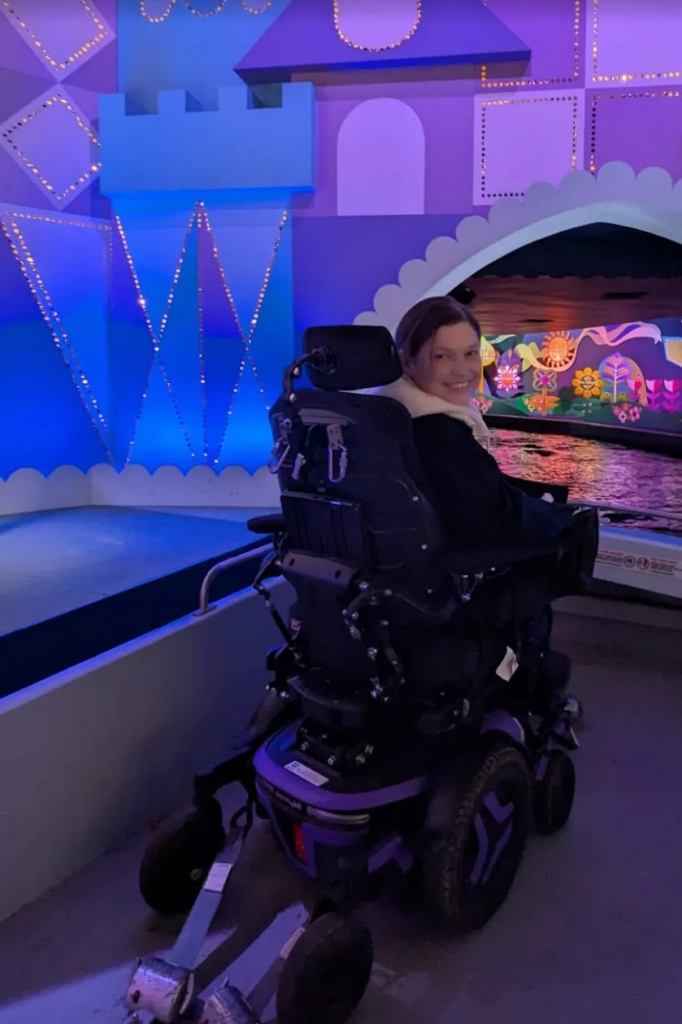
The author, Kelsey Maurine Brickl, in Disneyland Paris in her custom prescription Permobil M3 Corpus wheelchair while using a Blue Priority Card to access attractions, queues, shows, and restaurants.
Now is a difficult time to be a Disabled person in the United Kingdom. Disabled people are subjected to relentless suspicion over Personal Independence Payment (PIP) and Disability Living Allowance (DLA), while government reforms threaten essential support and changes to the Motability Scheme are presented as taxpayer savings rather than examined for their consequences for Disabled people’s independence.
The Access to Work programme, supposedly designed to help Disabled people remain employed, has accumulated tens of thousands of outstanding applications, while wheelchair users are still denied bus journeys because parents refuse to move pushchairs from legally protected wheelchair spaces. Former Home Secretary Suella Braverman has contributed to the political rhetoric surrounding disability benefits and reassessments, while NHS patients face enormous treatment backlogs and British theatres continue to exclude Disabled performers and audiences through inaccessible stages, seating, backstage facilities, and buildings.
Disabled people are blamed for the cost of their benefits, the mobility equipment that allows them to leave home, the accommodations that allow them to work, and the wheelchair spaces they are legally entitled to occupy, while the institutions responsible for providing access continue to demand patience, gratitude, and proof that their disabilities are real.
Despite this incredibly difficult reality for Disabled Britons, The Telegraph has been publishing vicious, inflammatory attacks on Disabled people, encouraging its readers to regard disability diagnoses, mobility aids, and legally recognized accessibility accommodations as evidence of fraud, entitlement, or social decline.
Following Poppy Coburn’s “How having a disability became cool,” The Telegraph faced backlash for portraying disability diagnoses, mobility aids, accommodations, and Disabled people’s social-media activity as evidence of a fashionable identity rather than legitimate medical and functional needs. Coburn’s article attacked so-called “sickfluencers” and suggested that disability had acquired social prestige, inviting readers to regard Disabled people who publicly discuss their conditions with suspicion. Disabled critics challenged the article’s sweeping generalizations, its treatment of visible disability as a cultural trend, and its failure to account for the discrimination, poverty, inaccessible services, and institutional barriers Disabled people actually experience. The controversy intensified the broader criticism of The Telegraph‘s disability coverage, particularly its willingness to amplify suspicions of exaggeration and fraud without establishing that the people being discussed had misrepresented their conditions. Rather than addressing the substantive objections, the ensuing defensiveness reinforced the impression that Disabled people were expected to tolerate public attacks on their credibility while journalists treated criticism of their reporting as an unreasonable personal affront.
But this was hardly The Telegraph’s only recent attack on Disabled people. Leaf Arbuthnot published “How Britain’s disability diagnosis epidemic reached Disneyland,” portraying Disabled visitors using Disneyland Paris’s accessibility arrangements as evidence of a supposed national epidemic.
The most deeply concerning part of the article was the conduct of its author, Leaf Arbuthnot. She acknowledged presenting a Disneyland Paris Cast Member with NHS documentation concerning an MRI, despite knowing that it was not among the resort’s accepted forms of evidence for accessibility accommodations. She nevertheless obtained an Easy Access Card, used it at an attraction where she reported avoiding a lengthy queue, and subsequently published an article casting suspicion on Disabled visitors who use the resort’s accessibility arrangements. She also quoted a guest who claimed that Disneyland Paris had told her it had “run out of” Priority Cards for the day, despite the fact that the Priority Card system does not operate on a daily quota and therefore cannot simply run out of cards in the manner described. Arbuthnot gave no indication that she questioned this account, sought clarification from Disneyland Paris, or investigated the obvious discrepancy before presenting the allegation to her readers. For a journalist writing an article that invites public suspicion of Disabled people’s legitimacy, her apparent failure to scrutinize either the irregularity in her own access arrangements or a plainly questionable allegation about the resort’s procedures raises serious questions about her reporting.
The public commentary resulting directly from The Telegraph’s article included myriad insults namecalling Disabled people, suggesting they should stay home and out of Disney parks. I’ve written about this sort of virulent anti-disability reaction in Disney communities before. It makes me angry that Leaf Arbuthnot’s writing permitted more commentary that suggested Disabled children and their Disabled parents should stay away from a theme park intended to bring joy. Far more frighteningly, though, directly under The Telegraph’s post of Leaf Arbuthnot’s article was a post with a demand to cap disability diagnoses at four percent of the population and accusations that Disabled people are grifters.
I’m a severely Disabled woman, disability civil-rights enforcement specialist, and regular Disneyland Paris visitor. My disabilities are profoundly disabling and extensively documented. My autistic son and I both qualify for Priority Cards, supported by disability documentation valid through 2029. There is no way some random internet stranger could know that only 4% of the population is Disabled or qualifies for Priority Cards at Disneyland Paris, and it is despicable that The Telegraph posted an article that enabled these comments and then failed to moderate them.
I have now taken formal action. On October 19, I submitted an eight-page bilingual report to Disneyland Paris requesting an internal investigation, verification of accessibility procedures, and preservation of evidence.I formally referred the matter to the French public prosecutor at Meaux, requesting examination of potential irregularities under French law.
That evening, I escalated the matter to Christophe Murphy, President of Disneyland Paris, and corporate communications, formally documenting my familys accessibility rights and protections against discrimination and retaliation under French law.
To be clear, I am specifically asking Disneyland Paris and the French authorities to investigate whether Leaf Arbuthnot knowingly disregarded the resort’s clearly published accessibility eligibility requirements, presented documentation she knew was not accepted, and nevertheless obtained and used disability accommodations for her own benefit, potentially in violation of French law.
What makes her conduct particularly reprehensible is that she then used the experience to publish an article casting suspicion on genuinely Disabled visitors, fueling discriminatory harassment and encouraging public hostility toward the very accessibility programme from which she had benefited.
The Telegraph’s editorial, legal, and data protection representatives have been notified as a professional courtesy. I have also submitted a separate Article 15 UK GDPR subject access request concerning Leaf Arbuthnot’s article and the newspapers handling of my personal data, acknowledged under Case 24073245.
These are documented legal and institutional referrals, not whining complaints. No authority has yet made a finding, but I will continue pursuing accountability and issuing public updates. Disneyland Paris’s accessibility program is essential to families with documented, diagnosed disabilities who want to have fun together, and Disabled visitors should not have to defend their legitimacy against ableist, manufactured suspicion and journalists who break the rules.
I’ve also published commentary on Medium called Evidently, The Telegraph Thinks Disabled People Should Stay Out of Disneyland Paris. Good Thing Disneyland Paris Doesnt Agree!
I’ve published about the greater anti-disability climate taking hold in the UK right now, and about how anti-disability choices in various industries, like the arts and in AI, harm Disabled people. I’ve also written about the difficulties faced by Disabled people in the UK just trying to get around on buses and other public transit and the risks Waymo will post to them in cities like London.
The Telegraph cannot continue to be one of the leading publishers of essays encouraging or enabling hate, skeptism, inaccessibility, or dangerous doubt for Disabled people in 2026. That is not an acceptable position for a journalistic publication.